
IEEPA tariff refunds and advances against them aren’t guaranteed. For high-quality claims, indicative advance rates are 70-85% of the validated refund amount, while funding availability, terms, and approval depend on the third-party provider’s underwriting. Advance funding for tariff refunds can provide cash while a claim is pending, but it doesn’t make the refund certain.
It’s reasonable to want access to money tied up in duties without taking on more financing than your business needs. With advance funding for tariff refunds, first understand what the advance is based on, how repayment works if a refund is received, and what happens if the claim is delayed or unsuccessful.
This guide explains how advances are assessed, what repayment may involve, and how claim-based funding compares with bank loans and credit lines. It also outlines the records that support a refund claim, helping you weigh potential cash-flow benefits against the conditions and risks.
Key Takeaways
- Separate refund eligibility from access to an advance, and organize the entry and transaction records that can support a claim.
- Understand how a funding assessment, offer, and transfer fit around a filed recovery claim before relying on cash for business needs.
- Review the proposed advance rate and repayment terms together; the amount advanced is not the same as the final refund.
- Compare claim-based funding with a bank loan or credit line by weighing their approval criteria, repayment structure, and fit for your cash-flow needs.
Is the IEEPA tariff refund guaranteed?
No. A tariff refund claim is not a guaranteed payment, and an advance isn’t guaranteed either. Funding is intended for U.S. importers with an existing filed recovery claim. For high-quality claims, indicative advance rates are 70-85% of the validated refund amount.
Specialty third-party funding providers offer financing against expected tariff refunds. Each provider sets its own underwriting, approval, and funding terms. A customs broker can assist with customs records and filings, but brokerage support alone isn’t an advance or a promise of government payment.
A collateral assignment links funding to specified refund proceeds. Under the agreement, the importer assigns the provider rights to those proceeds. Before accepting an offer, understand how it handles a delayed, reduced, or denied refund, including any remaining repayment obligation.
Validation starts with ACE entry data and supporting records. Entry summaries, including CBP Form 7501, can help establish the importer of record and duties paid. Shipment, invoice, and transaction records connect entries to the claim. Clear, consistent documentation supports review of the requested refund amount.
Claim preparation then organizes eligible entry numbers for filing. Requests use CAPE declarations, with eligible entry numbers submitted in a CSV file. Each declaration is limited to 9,999 entries. A customs broker may help with filing, while the importer’s records support the underlying claim.
For customs deadlines, entries finally liquidated beyond the 180-day protest window can have a more complex recovery path. During Phase 1, unliquidated IEEPA entries are eligible for refunds. Financing terms are separate from CBP claim rules, so review the funding agreement alongside the filing status.
If a claim is denied, delayed, or reduced, expected proceeds may shrink or arrive later than planned. That can leave a cash-flow gap or trigger repayment obligations under a funding agreement. Neither a refund filing nor an advance application guarantees payment.
Is advance funding guaranteed?
No. Applying does not guarantee approval, a funding commitment, or cash. A third-party provider determines availability and terms through underwriting. Eligibility depends on the filed claim, supporting records, and refund amounts under review. An application begins an assessment, not a promise of funding.
The process moves through assessment, offer, acceptance, and transfer. The assessment process is scheduled for Days 1-2. During review, the provider examines CBP entry summaries and verifies tariff amounts. If underwriting supports an offer, its terms describe the advance and how refund proceeds apply. Review those terms before accepting. The funding process can help clarify how claim review and funding stages connect.
Applications typically use a secure form for claim details and supporting documents. Keep entry information and refund amounts consistent with the filed claim. Mismatches can prompt further review and affect timing or the offer. Submitting a form does not establish eligibility or approval. Funding remains subject to the provider’s underwriting and final terms.
Refund timing and advance timing are separate. The overall IEEPA refund disbursement estimate is 6-18 months after filing. U.S. Customs and Border Protection says refunds should be issued within 60 to 90 days after an accepted CAPE declaration. That processing window begins after acceptance, not when an importer first applies for an advance.
CBP issues tariff refunds by ACH transfer to the bank account on file. An advance may arrive before that government payment, subject to provider approval and agreed terms. The Office of the Federal Register, National Archives and Records Administration says the court has not set a refund timeframe but has signaled that refunds should be issued as quickly as possible because interest accrues. Interest does not establish a payment date.
For importers, the practical question is whether the proposed timing and repayment terms fit current cash needs. Compare the written offer with the claim status, expected refund amounts, and possibility of a delay or adjustment. An advance may bridge the wait, but cannot guarantee CBP payment or its timing.
Advance rates and repayment mechanics
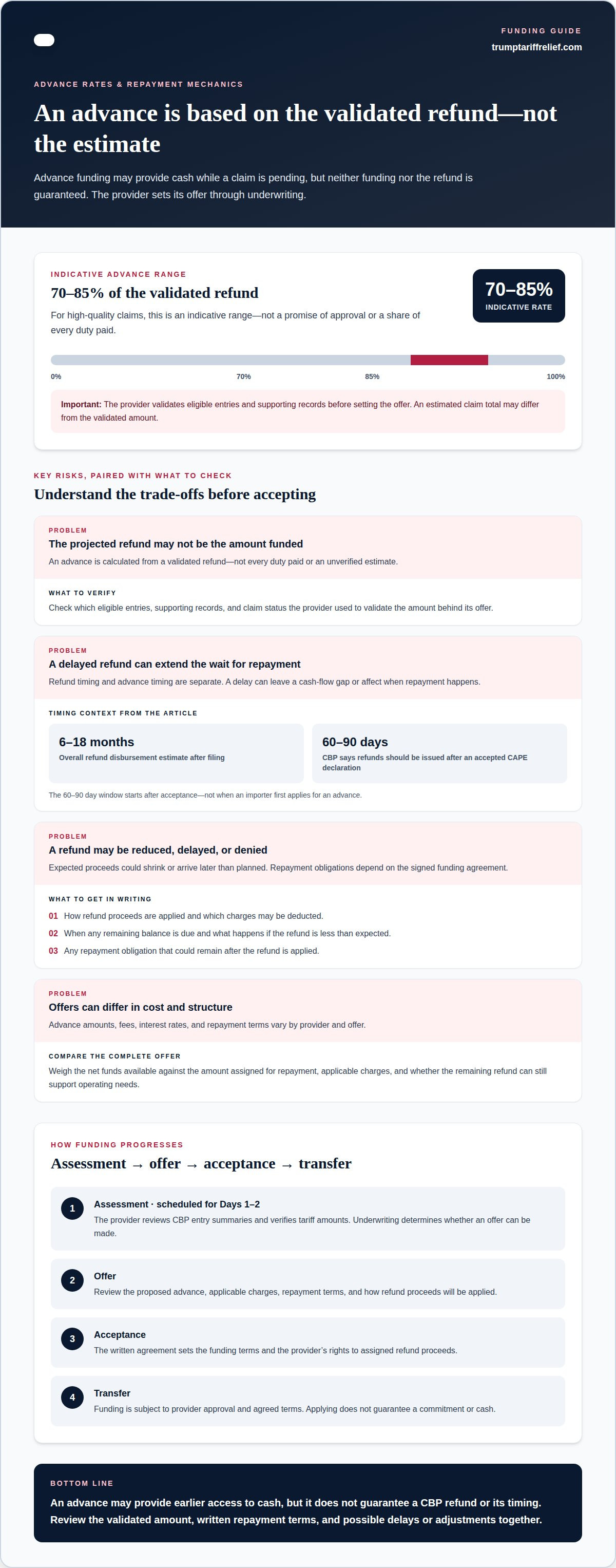
An advance is calculated from a validated refund, not every duty paid. For high-quality claims, indicative advances are 70-85% of the validated refund amount. The provider reviews eligible entries, supporting records, and claim status before setting its offer. An estimated claim total may differ from the validated amount, so don’t treat the projected refund as available capital.
Repayment follows the signed funding agreement. It should explain how refund proceeds are applied, which charges may be deducted, and when any remaining balance is due. If the refund is assigned as collateral, the agreement should describe the provider’s rights to those proceeds. Read these terms before accepting, especially if repayment depends on funds arriving through a particular process.
Timing matters. A delayed customs payment can extend the time before repayment from refund proceeds. If CBP pays less than the validated estimate, the agreement determines how the difference is handled. Review that scenario in writing, along with the repayment timeline and any obligations that could remain after the refund is applied.
Fees, interest rates, and advance amounts vary by provider and offer. For advance funding for tariff refunds, the written offer sets the advance, applicable charges, repayment terms, and any financing cost for that claim.
To assess an offer, compare the net funds available with the amount assigned for repayment. Then consider whether the remaining refund can still support operating needs. An importer facing a delayed customs payment may value earlier access, but should weigh that benefit against deductions and repayment obligations.
Eligibility for a particular rate depends on claim validation, documentation, and status. Complete entry and transaction records help support the amount under review. Before choosing advance funding for tariff refunds, compare each written term with expected proceeds and the claim timeline. This makes the financing trade-off clearer before you commit.
For strong, validated claims, an advance may be around 70-85% of the refund amount. Fees and financing costs vary by claim and are set out in the provider’s written offer; there is no single standard schedule.
Comparison with bank loans and credit lines
Choose financing by matching repayment to the cash need. A tariff refund advance is tied to a filed claim and its expected proceeds. A bank loan or credit line is separate from the customs refund. Compare the funding source, repayment trigger, and effect on working capital before deciding.
With an advance, the provider assesses claim documentation and validated refund amounts. The offer states how much capital becomes available and how proceeds apply toward repayment. If CBP delays or changes the refund, the agreement governs the consequences. This structure may suit an importer bridging a gap while a claim is processed.
A bank loan provides funds under lender terms, which may set scheduled repayments independent of a customs refund. Consider whether operating cash can cover those payments if the government refund arrives later than planned. A loan may suit needs beyond the claim, but does not depend on the claim’s validated value.
A credit line lets a business draw capital within its approved limit. Its usefulness depends on available credit, draw terms, and repayment conditions. For example, an importer facing uneven supplier payments may value flexible access. The line still creates a repayment obligation, whether or not a tariff refund arrives.
Compare the options in writing. List the amount available, when funds can be used, what triggers repayment, and what happens if the refund is reduced. Include any fees or interest stated in each offer. Then match those terms to your cash-flow timeline rather than comparing headline amounts alone.
A customs broker may support entry records and filings, but that role is different from providing financing. If a lender requests claim evidence, organized ACE entry data and refund documentation can support its review. The right fit depends on whether the business needs claim-linked capital or broader borrowing capacity.
For a claim-focused review, request a tariff eligibility assessment before weighing funding options.
Trump Tariff Relief: IEEPA Tariff Refund Recovery
Trump Tariff Relief helps businesses pursue IEEPA tariff refunds through eligibility assessment, documentation management, and recovery support. Turn to this process if your company paid IEEPA tariffs and needs help organizing its claim and supporting records.
Trump Tariff Relief reviews customs documentation, assesses whether entries may qualify, and manages the claim process through government filings. This can help when entry records are spread across shipments or when your business needs to understand its potential recovery before making financing decisions.
The service operates on a contingency-fee basis: there are no upfront costs, and payment is due only if a refund is successfully recovered. Refund eligibility, amounts, timing, and any advance funding remain subject to their respective review and approval processes.
If you’d like help assessing a tariff refund claim, contact Trump Tariff Relief.
Make your next funding decision with clarity
Before treating a potential refund as operating capital, compare the cash your business needs now with the obligations that continue while the claim moves forward. This can help you decide whether advance funding for tariff refunds addresses a genuine short-term need or creates repayment pressure you would rather avoid.
Base the decision on your claim’s records, status, and expected proceeds. A focused eligibility assessment can clarify whether entries may qualify and what documentation is needed before you commit to financing terms. Projected funds are not available until a refund is recovered.
For help evaluating your IEEPA recovery options, contact Trump Tariff Relief. A clear view of the claim can help you move forward with greater confidence.
Frequently Asked Questions
What Documentation Should You Gather?
Gather entry summaries, commercial invoices, transportation documents, and duty statements. CBP Form 7501 can help identify the importer of record and connect duties to specific entries. Organizing records by entry number makes it easier to reconcile customs data with invoices and shipment paperwork. Include claim details that show which entries and tariff amounts the refund request covers.
What advance rate can I expect on my claim?
Indicative advance rates for high-quality claims are 70-85% of the validated refund amount. The calculation uses the amount validated for the claim, not simply the total duties originally estimated or paid. The funding offer sets the actual advance and repayment terms. Compare the amount offered with any deductions and assigned refund proceeds before deciding whether it meets your cash needs.
When Should Businesses Expect a Refund?
Full IEEPA refund disbursement may take 6-18 months after filing. CBP says refunds should be issued within 60 to 90 days after accepting a CAPE declaration, a separate processing window that begins after acceptance. CBP sends refunds by ACH to the bank account on file. For cash planning, distinguish the claim’s filing date from CAPE acceptance and eventual disbursement.
Which entries qualify for refunds?
Potentially eligible entries include IEEPA fentanyl tariffs imposed from February 4, 2025, through February 24, 2026, and reciprocal tariffs imposed from April 2, 2025, through February 24, 2026. Entry status also matters: during Phase 1, unliquidated IEEPA entries are eligible. Eligibility is assessed entry by entry, so tariff type, dates, liquidation status, and supporting records all affect the review.
Who should complete the funding application?
The importer seeking an advance should submit or oversee the application, using details consistent with its filed claim. For an eligibility check with Trump Tariff Relief, provide basic company data, estimated tariff fees paid, import regions, and information about available documentation. If a customs broker maintains entry records, coordinate those records so the application details are accurate. Business information is kept strictly confidential and is not shared without explicit consent.
Will terms be provided before I accept?
Yes. Review the funding offer before accepting it. Read the advance amount, repayment process, assigned refund proceeds, and any charges or obligations if the refund is delayed, reduced, or denied. Confirm that the written terms align with your claim and cash needs. Submitting an application alone does not create approval or a funding commitment, so decide only after reviewing the offer.
Ready to find out what your business may be owed?
Check My Eligibility