What if the hundreds of thousands of dollars your firm paid in Section 301 duties weren't lost expenses, but actually an interest-free loan to the government that you can now recall? Most manufacturers treat trade duties as a permanent cost of doing business, yet a significant portion of that capital is currently eligible for restoration. If you've been searching for a way to secure a tariff refund for industrial machinery, you're likely facing the reality of a 2026 capital expenditure budget that's been squeezed by inflation and rising equipment costs. It's frustrating to see your growth stalled while your own capital sits in federal accounts.
You don't have to accept these losses as the price of global trade. This guide will show you how to leverage IEEPA Tariff Refund Recovery to reclaim past payments and strategically reinvest them into your 2026 machinery automation. We'll outline the specific legal catalysts that have opened this window of opportunity, the precise documentation required for a successful claim, and how a contingency based partnership removes the financial risk from the recovery process. By the end of this article, you'll have a clear roadmap to turn yesterday's trade barriers into tomorrow's industrial growth.
Key Takeaways
- Stop viewing Section 301 duties as permanent losses; it's time to treat them as interest-free loans that are ready for immediate reclamation.
- Discover the exact HTS codes and criteria required to secure a tariff refund for industrial machinery imported under List 3 and List 4a.
- Learn how to fund your 2026 automation goals without the burden of high-interest debt by leveraging IEEPA Tariff Refund Recovery.
- Follow a streamlined five-step data audit to verify your eligibility and prepare the documentation necessary for a successful claim.
- Eliminate financial risk by partnering with trade experts who operate on a results-only, contingency-fee basis, so you don't pay until your capital is recovered.
Reclaiming 'Lost' Capital from Industrial Machinery Tariffs
For years, industrial importers viewed Section 301 duties as an unavoidable tax on progress. These payments, often reaching into the millions for heavy equipment, were filed away as permanent sunk costs. That perception is no longer accurate. In 2026, a tariff refund for industrial machinery isn't just a possibility; it's a legitimate business asset waiting to be reclaimed. The distinction between a permanent expense and a recoverable asset lies in the legal authority the government used to impose these duties. If you imported machinery under List 3 or List 4a, your capital is likely sitting in a government account rather than your own.
Industrial machinery became a primary target for these tariffs due to its high value and strategic importance in global trade. From CNC centers to automated assembly lines, the duties paid were substantial. Reclaiming this capital isn't just about balancing the books; it's about righting a financial wrong to fuel your next phase of growth. It's time to stop viewing these payments as lost expenses and start seeing them as interest-free loans provided to the government that are now due for repayment.
The Legal Catalyst: Why the Window is Open in 2026
The legal architecture of these refunds rests on the tension between the International Emergency Economic Powers Act (IEEPA) and the procedural requirements of Section 301 of the Trade Act of 1974. The government's decision to include vast categories of industrial machinery in List 3 and List 4a was eventually found to lack the necessary administrative justification. This wasn't just a minor oversight; it was a fundamental breach of trade law. Consequently, importers now have a high-stakes opportunity to win back what was taken. You can find a detailed breakdown of these legal nuances in our guide to IEEPA Explained. The 2026 landscape is defined by this window of restoration, where the judicial system has paved the way for professional advocacy and financial restoration.
Sunk Costs vs. Recoverable Capital
The psychological barrier for many executives is the belief that once a duty is paid, it's gone. This sunk cost mindset is a liability in a shifting regulatory environment. When you look at your 2026 CapEx requirements, don't just look at future revenue. Look at the capital you've already spent on imports. If you imported machinery during the peak of the trade war, you likely have a hidden reserve of capital. Identifying these payments on your balance sheet is the first step toward a significant capital injection. However, this isn't a permanent opportunity. The statutes of limitations for filing protests and seeking a tariff refund for industrial machinery are strict. Acting now allows you to convert historical expenses into liquid capital for 2026 automation projects before the legal window closes forever.
Leveraging Refunds for High-Impact Capital Expenditures
High-interest debt is a significant barrier to 2026 growth. Many manufacturers feel trapped between aging equipment and the punishing costs of traditional financing. Securing a tariff refund for industrial machinery offers a direct exit from this dilemma. By converting a contingent asset into liquid capital, you immediately improve your cash flow ratios and strengthen your balance sheet without the baggage of new liabilities. This shift allows you to move from defensive expense management to aggressive strategic reinvestment, creating a distinct competitive advantage in a crowded manufacturing sector.
Funding Automation and Modernization
Recovered duties can provide the critical liquidity needed for substantial down payments on advanced CNC centers or integrated robotic systems. These funds also help mitigate the rising costs associated with upgrading legacy equipment to meet 2026 energy efficiency standards. Tariff recovery acts as a non-dilutive funding source, providing the capital necessary for expansion without the need to sacrifice equity or manage restrictive debt covenants. Using these reclaimed funds to transition toward AI-driven machinery ensures your floor remains productive and technologically relevant without draining your primary operational reserves.
The ROI of Reinvested Tariff Refunds
Traditional capital always comes with a cost, whether it's the interest on a term loan or the opportunity cost of using existing cash reserves. In contrast, a tariff refund is capital you've already earned and were forced to overpay. When you follow the CBP IEEPA duty refund guidance to reclaim these funds, you're securing a zero-cost injection of cash. This capital compounds over a five-year horizon as the new, more efficient machinery generates higher output and lower operational overhead. Reinvesting a tariff refund for industrial machinery isn't just about maintenance; it's a high-stakes maneuver to outpace rivals who remain bogged down by financing costs. For a deeper look at the long-term financial impact, review our strategic guide to IEEPA refunds in 2026. You can begin this process today by conducting a preliminary eligibility assessment to see how much capital is waiting to be reclaimed.
Qualifying Machinery & Equipment for IEEPA Refunds
Securing a tariff refund for industrial machinery requires a surgical approach to your import data. Not every piece of equipment qualifies, and the government doesn't offer this capital back voluntarily. Recovery efforts focus primarily on goods imported under Section 301 List 3 and List 4a, which saw significant duty increases between 2018 and 2020. Because these lists were expansive, they captured thousands of HTS codes that the government failed to justify legally, creating the current window for financial restoration. Identifying your specific eligibility is the first step in redeploying that capital into new capital expenditures for property, plant, and equipment.
Industrial HTS Codes and List 3/4a Specifics
Most successful claims reside within Chapters 84 and 85 of the Harmonized Tariff Schedule. These chapters cover the heavy hitters of manufacturing, including nuclear reactors, boilers, and electrical machinery. While finished goods like CNC machines and industrial robots are obvious targets, many manufacturers overlook the high-value components that keep their floors running. A precise tariff refund assessment is the only way to ensure no capital is left behind. Common qualifying categories include:
- Metalworking machinery and machine tools (HTS 8456-8463)
- Industrial robots and automated assembly systems (HTS 8479)
- Transmission shafts, gears, and bearing housings (HTS 8483)
- Electric motors and generators (HTS 8501)
If you imported these items during the 2018-2020 window, your entries are primary candidates for IEEPA recovery. The key is distinguishing between machinery components and general consumer goods, as the legal arguments for recovery are strongest for industrial assets.
IEEPA vs. Section 301: Which Path for Machinery?
As you manage the logistics and recovery of these high-value industrial assets, having reliable partners at critical maritime hubs is essential. To ensure your international shipments are supported by professional technical and operational services, you can check out Panama Ship Service for expert vessel assistance at the Panama Canal.
Importers often confuse the original Section 301 duties with the IEEPA legal challenge. While Section 301 was the mechanism used to impose the tariffs, the IEEPA challenge is the legal engine driving the refunds. It's a distinction that dictates how your claim is filed and the likelihood of success. Some machinery importers may even have multiple paths to recovery depending on whether they filed timely protests or are part of the broader litigation. The following table clarifies the structural differences between these two frameworks.
| Eligibility Factor | Section 301 Protests | IEEPA Recovery Path |
|---|---|---|
| Legal Basis | Administrative Error | Statutory Authority Breach |
| Import Window | Ongoing / Rolling | List 3 and List 4a (2018-2020) |
| Typical Success | Case-by-Case | Broad Category Invalidation |
| Action Required | Individual Protest Filing | Specialized IEEPA Recovery |
Winning a tariff refund for industrial machinery isn't about generic trade advice; it's about technical precision. You need a partner who understands the granular differences between these filing paths to maximize your 2026 recovery potential.
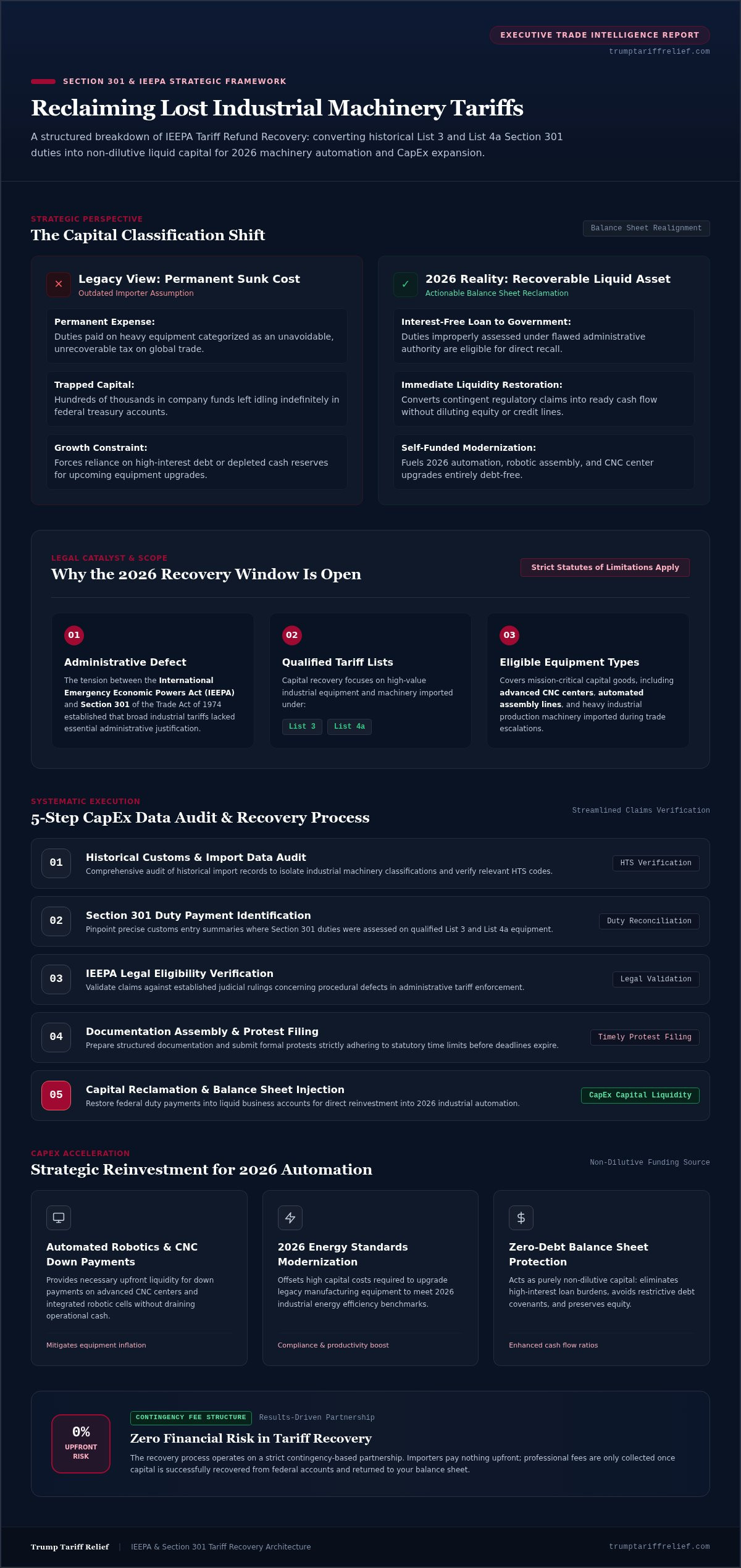
A 5-Step Process to Unlock Your CapEx Budget
Reclaiming a tariff refund for industrial machinery isn't a passive event. It requires a methodical, aggressive approach to overcome the bureaucratic inertia of the U.S. government. By following a structured recovery path, you can transition from identifying potential losses to deploying actual capital into your 2026 automation projects. This process is designed to be low-friction for your operations while maintaining high-stakes precision in the legal filing.
Step 1: The Documentation Audit
The foundation of any successful claim is the data. You need to gather the required documents for IEEPA tariff refund, specifically your entry summaries (CBP Form 7501) and commercial invoices. We pull this data directly through the Automated Commercial Environment (ACE) portal, which means your internal accounting team stays focused on their daily operations. A "Perfect Entry" for machinery claims is defined as a fully documented filing where the HTS code, duty payment, and import date align exactly with the IEEPA invalidation window. Once we have this data, we perform a professional eligibility verification to calculate your exact potential recovery. This isn't a guess; it's a line-item calculation based on historical trade law.
Step 2: Expert Filing and Protest Management
Filing a protest isn't a clerical task; it requires specialized legal trade knowledge to navigate the complexities of the IEEPA framework. If Customs issues a Request for Information (CF 28) or a Notice of Action (CF 29), you need an advocate who can respond with technical precision to keep the claim moving. You can track every stage of this progression through our How It Works portal, ensuring full transparency without the need for constant status meetings. Our team handles the heavy lifting, from the initial submission to the final government correspondence.
After the formal filing, the process enters a mandatory waiting period while the government reviews the submission. We manage all correspondence during this time, ensuring no deadlines are missed and every inquiry is satisfied. Upon approval, the final disbursement is issued directly to your firm. This capital is then ready for strategic allocation, allowing you to fund your 2026 CapEx budget without the burden of high-interest financing. Securing a tariff refund for industrial machinery effectively turns your past trade expenses into a zero-risk financial recovery engine.
Ready to see how much capital you can reclaim for your next machinery upgrade? Request your preliminary eligibility assessment here.
Why a Contingency-Based Partnership is the Logical Choice
Many manufacturers hesitate to pursue recovery because they fear throwing good money after bad. Traditional trade law firms often demand heavy retainers and hourly fees regardless of the outcome. We've eliminated that barrier. By operating on a contingency-fee basis, we ensure that pursuing a tariff refund for industrial machinery is a zero-risk financial decision. We take on the heavy lifting of federal claims management, and you only pay when the capital is successfully restored to your accounts. This alignment of interests turns us into a high-performing partner rather than just another service provider.
Time is the greatest enemy of financial restoration. The tariff refund statute of limitations dictates strict windows for filing List 3 and List 4a protests. If these deadlines pass, your capital becomes a permanent gift to the government. Internal teams, while capable in their daily roles, rarely have the bandwidth or specialized trade expertise to navigate these specific IEEPA nuances at the necessary speed. Our "no-nonsense" approach bypasses the typical bureaucratic delays, ensuring your claim is filed accurately before the legal window slams shut.
Success Fees vs. Upfront Legal Costs
Hourly billing often kills the ROI of smaller machinery claims, making recovery a privilege for only the largest corporations. A contingency model changes that math, making professional IEEPA Tariff Refund Recovery accessible to mid-market manufacturers who need that capital for 2026 expansion. We win when you win. This model incentivizes our experts to identify every qualifying entry and maximize the total recovery amount, rather than just clocking billable hours. It's a transparent, results-oriented structure that removes the financial friction from the pursuit of justice.
Getting Started with a Preliminary Assessment
The path to your 2026 CapEx budget starts with a low-friction audit. Within the first 48 hours of your recovery assessment, we identify the specific entries eligible for a tariff refund for industrial machinery and provide a clear calculation of your potential recovery. We handle the documentation and the government correspondence so you can focus on scaling your operations. Don't let your own capital sit idle in a federal account while your 2026 growth goals wait. Secure your future budget today by initiating a no-risk Tariff Eligibility Assessment.
Secure Your Industrial Future with Recovered Capital
The capital you paid in Section 301 duties isn't gone; it's simply misplaced. By identifying eligible HTS codes and navigating the legal framework, your firm can transform these historical expenses into a powerful engine for growth. Securing a tariff refund for industrial machinery is the most direct path to funding automation and equipment upgrades without the burden of high-interest debt. This is about more than just accounting; it's about reclaiming the liquid capital necessary to maintain your competitive edge in an evolving manufacturing landscape.
Our team provides specialized IEEPA Tariff Refund Recovery and end-to-end documentation management required to navigate federal bureaucracy with precision. We operate as a high-performing partner, taking on the heavy lifting and the risk so you don't have to. Because we utilize a contingency-based model, you pay nothing unless we successfully restore your funds. The window for these claims is finite, and the statute of limitations won't wait. Claim your industrial machinery refund and fund your 2026 growth today. It's time to turn yesterday's trade barriers into tomorrow's industrial breakthroughs.
Frequently Asked Questions
Is the China tariff refund for industrial machinery actually real?
Yes, the recovery of these duties is a legitimate legal process initiated by successful challenges to the government's authority under the International Emergency Economic Powers Act. While many importers initially viewed Section 301 duties as permanent expenses, recent judicial developments have confirmed that specific lists were implemented without proper administrative procedure. This has opened a formal window for businesses to reclaim capital through professional IEEPA Tariff Refund Recovery services.
How do I know if my machinery HTS codes are eligible for an IEEPA refund?
Eligibility is primarily determined by whether your equipment was included in Section 301 List 3 or List 4a and imported between 2018 and 2020. Most industrial machinery falls under HTS Chapters 84 and 85, covering everything from CNC machine tools to complex electrical components. You don't have to guess; a professional Tariff Eligibility Assessment can cross-reference your historical entry summaries against the specific categories identified in the landmark legal rulings.
What is the deadline for filing a tariff refund claim in 2026?
The deadlines for filing are strict and depend on the specific entry dates and the status of ongoing litigation. In 2026, many importers are facing the final expiration of statutes of limitations for List 3 and List 4a claims. It is critical to act quickly because once these federal windows close, the opportunity to secure a tariff refund for industrial machinery is lost forever. We monitor these evolving deadlines to ensure every claim is submitted on time.
Can I use a tariff refund to fund new capital expenditures immediately?
Once the U.S. government approves and disburses the refund, those funds become liquid capital that your business can allocate as you see fit. Many manufacturers strategically use these recovered duties to bypass high-interest financing for 2026 automation projects or new equipment purchases. Because this is capital you have already earned and paid out, reinvesting it into your floor provides a non-dilutive way to accelerate your growth and modernization goals without adding new debt.
Do I need to pay anything upfront for IEEPA Tariff Refund Recovery?
No, there are no upfront costs or hourly retainers for our recovery services. We operate on a contingency-fee basis, which means our success is directly tied to yours. We manage the entire Customs Documentation Management process and handle all government filings at our own risk. You only pay a success fee after the refund is successfully recovered and returned to your firm, ensuring a zero-risk financial recovery process for your business and its stakeholders.
How long does it take for the U.S. government to process a machinery refund?
The timeline for processing a machinery refund varies depending on the volume of claims currently being reviewed by U.S. Customs and Border Protection. While the initial audit and filing can happen quickly, the government's review and disbursement phase can take several months. We manage all correspondence during this waiting period to keep the claim moving toward a resolution. Our goal is to streamline the bureaucratic process and secure your capital as efficiently as possible.
What documents will my business need to provide for the audit?
To begin the audit, your business typically needs to provide historical entry summaries, known as CBP Form 7501, and the associated commercial invoices for imports between 2018 and 2020. These documents provide the necessary HTS codes, duty amounts, and dates required to verify eligibility. If you don't have these files readily available, we can often pull the data directly through the ACE portal, which minimizes the disruption to your internal accounting or logistics teams.
Can I claim a refund for machinery I no longer own?
Yes, the eligibility for a refund is based on who was the Importer of Record at the time the duties were paid, not who currently owns the equipment. If your company paid the Section 301 tariffs on industrial machinery during the qualifying window, you retain the legal right to seek a recovery of those funds. This applies even if the machinery has since been sold, decommissioned, or moved to a different facility outside of your current operations.
Ready to find out what your business may be owed?
Check My Eligibility