Your business is likely sitting on a massive, interest-free loan that you unwittingly granted to the U.S. government. It's frustrating to watch millions of dollars in capital remain locked away in contested Section 301 and IEEPA tariffs, especially when the complexity of trade law makes recovery feel like a high-stakes gamble. You've probably hesitated to pursue these refunds because the thought of mounting hourly legal fees with no guarantee of a return is a risk your balance sheet shouldn't have to justify. This hesitation is understandable, but it's also costing you liquidity that belongs back in your operations.
There's a more aggressive way to right this financial wrong. Utilizing a specialized model for contingency based duty recovery changes the math entirely by shifting the financial burden away from your company and onto the experts. You'll discover how to reclaim your overpaid duties through a success-based framework that requires zero upfront capital, ensuring your pursuit of restoration is as profitable as it is risk-free. We'll explore the landmark Supreme Court context surrounding IEEPA claims, the expert-led process for managing complex customs documentation, and why acting before the 2026 expiration dates is critical for securing your company's cash flow.
Key Takeaways
- Discover how a success-based model eliminates financial risk by ensuring you only pay a fee once a refund is secured.
- Learn why contingency based duty recovery is the most capital-efficient strategy for reclaiming millions in overpaid IEEPA and Section 301 tariffs.
- Compare the total cost of ownership between traditional hourly legal fees and the zero-risk contingency approach to avoid draining your budget.
- Identify the specific phases of the recovery roadmap, from the initial eligibility assessment to the final extraction of historical CBP records.
- Understand the urgency of the 2026 expiration dates and why waiting to file could permanently forfeit your right to a refund.
What is Contingency-Based Duty Recovery?
Capital recovery shouldn't be a gamble for your business. The concept of contingency based duty recovery is built on a simple premise: importers shouldn't have to pay for the privilege of getting their own money back. It's a specialized service where trade experts identify, document, and reclaim tariff overpayments in exchange for a percentage of the actual refund. This model eliminates the financial barrier that prevents many large-scale importers from challenging U.S. Customs and Border Protection (CBP). In 2026, this "no-win, no-fee" approach has become the industry standard for professional duty recovery, specifically for businesses burdened by Section 301 and IEEPA duties.
The Rise of IEEPA Tariff Refunds
The landscape of trade recovery shifted dramatically following landmark legal challenges that questioned the executive branch's authority to impose indefinite tariffs. These Supreme Court developments created a massive opportunity for businesses to seek restoration for duties paid under the International Emergency Economic Powers Act (IEEPA). While traditional customs brokers are essential for daily compliance, they rarely possess the specialized legal infrastructure required to manage these retroactive claims. You can find more details on how these specific rulings impact your eligibility in our IEEPA explained guide. Specialized consultancies bridge this gap by acting as aggressive advocates who hunt for hidden recovery potential that standard filing processes often overlook.
Success-Based vs. Traditional Consulting
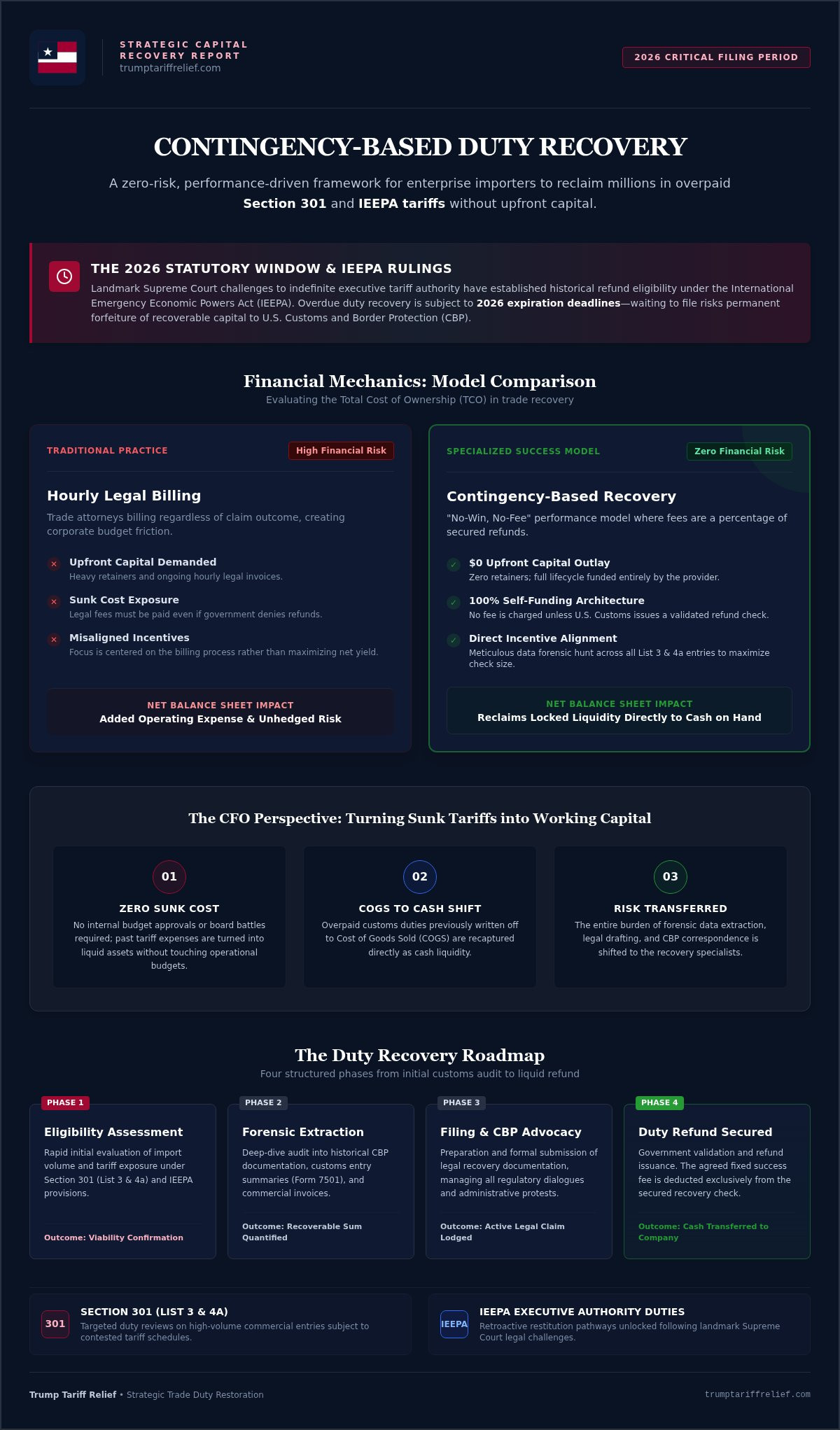
Large corporations have historically been wary of pursuing duty refunds due to the predatory nature of hourly legal billing. Traditional trade attorneys often charge significant retainers and hourly rates, regardless of whether they actually secure a check from the government. This creates a "sunk cost" trap for finance departments. The risk is ours. A model built on contingency based duty recovery democratizes access to high-level trade litigation by shifting the entire financial risk to the service provider. If the experts don't find a refund, you don't pay a cent. This model ensures that the trade expert's incentives are perfectly aligned with your bottom line, prioritizing high-yield opportunities over billable hours. It turns a complex legal headache into a streamlined asset recovery process that improves your 2026 cash flow without touching your current budget.
The Financial Mechanics of the Success-Fee Model
The financial architecture of contingency based duty recovery is designed to remove every friction point from the corporate decision-making process. Unlike traditional legal engagements that require a leap of faith and a heavy retainer, the success-fee model operates on a purely performance-driven basis. The fee is calculated as a fixed percentage of the net refund actually secured from the government. This covers the entire lifecycle of the claim, including forensic data extraction, legal analysis, and all correspondence with U.S. Customs. It’s a transparent arrangement where the cost is built into the victory. This ensures that the recovery process is always self-funding and never a drain on your current fiscal year’s budget.
Zero Upfront Cost: A CFO's Perspective
From a CFO's perspective, this model is a strategic masterstroke for preserving working capital. In an era where liquidity is paramount, committing six-figure sums to "potential" legal outcomes is often a non-starter. By utilizing contingency based duty recovery, you’re effectively turning a past expense, money already lost to the government, into a future asset without any current cash outlay. This shift allows you to move funds from the "cost of goods sold" column back into "cash on hand" once the refund clears. There's no need to fight for budget approval or justify new consulting fees to the board because there is zero risk of a "sunk cost." You can see exactly how this works by reviewing our documented recovery process.
Incentive Alignment in Duty Reclamation
Incentive alignment is the engine behind the success of this model. When a consultant is paid by the hour, their primary motivation is the process; when they’re paid by the result, their focus is the win. This distinction is critical when navigating the intricacies of Section 301 List 3 and List 4a entries, where minor documentation errors can lead to massive forfeitures. Success-based experts don't just file claims. They meticulously hunt for every eligible entry and historical data point to maximize the total recovery amount. They have the "insider" expertise to identify opportunities that generalists miss, ensuring that the government returns every dollar you’re legally owed. This model protects you from the "dead-end" research risk common in hourly models, where you pay for hours of work even if no refund is found.
If you suspect your firm has overpaid, it's time to evaluate your recovery potential with a partner who only profits when you do.
Why Contingency Recovery Outperforms Hourly Legal Fees
The total cost of ownership (TCO) for a tariff refund claim is often obscured by the traditional legal billing model. When you hire an attorney on an hourly basis, you’re essentially funding a research project with an uncertain outcome. If that attorney spends dozens of hours reviewing entry data only to find a compliance technicality that blocks the refund, your business still owes the fee. This is the "dead-end" research risk. In contrast, contingency based duty recovery eliminates this hazard entirely. The firm absorbs the cost of forensic entry review, legal research, and administrative filing. You aren't paying for effort; you're paying for successful reclamation.
Speed is the second major differentiator. Hourly firms often lack the urgency required to navigate the tightening 2026 deadlines because their revenue is tied to the duration of the work, not the delivery of the check. Performance-based firms operate with a "sprint" mentality. They have the "insider" expertise to identify the fastest route through CBP bureaucracy because their own financial health is directly linked to your speed of recovery. This expertise gap is why specialized firms take on high-stakes IEEPA claims that generalist lawyers often avoid due to the complexity of the regulatory landscape.
The Hidden Costs of Hourly Billing
Hourly rates create a psychological and financial barrier that stops legitimate claims before they even start. Many finance teams abandon potential recoveries because the projected legal fees threaten to exceed the value of the refund itself. The Success Gap occurs where the high cost of traditional legal counsel makes pursuing small-to-midsize tariff overpayments mathematically impossible for the importer. By removing the billable hour, you ensure that every eligible dollar is pursued, regardless of the complexity involved in the documentation. This model protects your capital from being wasted on legal fees that yield no tangible return.
Efficiency in Documentation and Filing
Success-based firms don't rely on manual spreadsheets; they use proprietary technology to mine historical data with surgical precision. This technological edge allows for a far more aggressive approach to customs documentation management, ensuring that every required proof point is verified before the claim hits the government's desk. Performance-based teams maintain a higher success rate because they cannot afford to submit weak or incomplete filings. Every step of their process is optimized for one specific outcome: the issuance of a refund check. This streamlined efficiency is the only way to meet the heavy evidentiary standards required by the Supreme Court’s IEEPA context while managing the volume of historical entries typical for large-scale importers.
The Duty Recovery Roadmap: From Assessment to Refund
Reclaiming your capital from the government isn't a mystery; it's a methodical campaign. A professional contingency based duty recovery program follows a structured five-phase roadmap to transform historical data into liquid assets. This process shifts the technical burden away from your internal team and places it in the hands of trade specialists who navigate these bureaucratic waters daily. Each phase is designed to build a bulletproof case for your refund while maintaining total transparency through every step of the litigation.
- Phase 1: The initial assessment to determine claim viability and potential value.
- Phase 2: Forensic data extraction and review of historical entries from CBP records.
- Phase 3: Formal submission of the IEEPA or Section 301 protest or claim.
- Phase 4: Active monitoring of government responses and managing technical inquiries.
- Phase 5: Successful recovery and distribution of the secured tariff refund.
The Importance of the Preliminary Assessment
Success begins with a comprehensive Tariff Eligibility Assessment. During this initial deep dive, trade experts analyze your historical import data to identify "low-hanging fruit," such as clearly misclassified entries, versus more complex legal challenges involving IEEPA authority. We don't believe in wasting your time. A quick "no" is often just as valuable as a "yes" because it allows your finance team to focus on other high-yield projects rather than chasing ghosts. If the data shows a clear path to recovery, we move aggressively to the next phase of the reclamation process.
Navigating the Statute of Limitations
Time is the most significant threat to your recovery. The tariff refund statute of limitations dictates strict windows for filing protests, and for many IEEPA-related claims, 2026 represents a final deadline for many importers. Waiting until the end of the fiscal year isn't just a delay; it's a choice to permanently forfeit your right to a refund. Professional contingency based duty recovery ensures your claims are filed with precision before these legal windows slam shut. We manage the clock so you don't have to worry about missing out on millions in eligible capital due to a missed administrative date.
Don't let the government keep capital that belongs to your shareholders. You can start your recovery assessment today and secure your place in the 2026 refund queue.
Reclaiming Your Capital with Trump Tariff Relief
Trump Tariff Relief isn't a generalist consulting firm. We're a specialized engine for capital restoration, built specifically to assist importers in clawing back overpaid duties from a complex federal bureaucracy. Our mission is rooted in the belief that your working capital should be in your accounts, not sitting in a government treasury. By operating exclusively on a model of contingency based duty recovery, we ensure that our interests are perfectly aligned with your financial success. We take on the technical, legal, and administrative heavy lifting because we're confident in our ability to deliver results. If we don't secure a refund for your business, you owe us nothing.
Our team provides a decisive "insider" advantage. We combine deep legal expertise with trade data forensics to navigate the intricate IEEPA and Section 301 frameworks that often baffle traditional compliance departments. We've proven our results across the most heavily impacted sectors, including manufacturing, retail, and technology. Whether you're dealing with thousands of historical entries or high-value specialized imports, we have the infrastructure to manage the recovery process at scale. We don't just file paperwork; we advocate for the restoration of your liquidity with professional persistence.
Why Choose a Specialized IEEPA Partner?
There's a fundamental difference between a standard customs broker and IEEPA recovery specialists. While brokers focus on daily compliance and moving goods across the border, our specialists focus on the forensic litigation required to win retroactive refunds. We maintain a rigorous commitment to documentation accuracy and government compliance, ensuring that every claim we submit is defensible and robust. Our firm operates with a singular focus on achieving total financial restoration for U.S. importers who have been unfairly burdened by excessive tariff regimes. This specialization allows us to identify recovery opportunities that generalists frequently overlook.
Next Steps: Your Risk-Free Assessment
Getting started is a low-friction process designed to respect your time. During your initial consultation, our experts will perform a high-level review of your import history to determine if your firm meets the criteria for a significant recovery. This assessment requires minimal time commitment from your internal team; we only need access to basic historical entry data to begin our forensic review. We'll provide a clear "go" or "no-go" recommendation based on the current legal landscape and the 2026 statute of limitations. This is your opportunity to right a financial wrong without any upfront cost or budgetary risk. It's time to stop the drain on your cash flow. Start your free eligibility assessment now and find out exactly how much capital your business is eligible to reclaim.
Reclaim Your Capital Before the 2026 Deadlines
The window to recover overpaid tariffs is closing, but the path to restoration is clear. By choosing a model built on contingency based duty recovery, you're not just hiring a consultant; you're securing a high-performing partner who takes on every cent of the financial risk. We've explored how specialized IEEPA expertise outperforms traditional hourly legal fees and why a structured roadmap is essential for navigating complex CBP bureaucracy. This isn't just about administrative compliance; it's about righting a financial wrong and returning millions in liquidity to your balance sheet.
Trump Tariff Relief provides the specialized legal expertise and data forensics needed to win, offering national service with $0 in upfront costs. Don't let your company's capital remain tied up in government accounts when it could be fueling your 2026 growth. The time to act is now, before the statute of limitations permanently forfeits your right to a refund. You've already paid the price; now it's time to collect the reward.
Secure your risk-free tariff recovery assessment today and take the first step toward reclaiming what belongs to your business. We're ready to help you win.
Frequently Asked Questions
Is contingency-based duty recovery legal and legitimate?
It's absolutely legitimate and based on established legal precedents within U.S. trade law. Following landmark Supreme Court developments regarding IEEPA authority, businesses have a lawful right to challenge specific tariff overpayments. This success-based model is a standard practice in trade litigation that allows companies to seek justice and financial restoration without taking on additional fiscal risk. It ensures that importers can hold the government accountable for regulatory overreach.
How much does a contingency-based tariff recovery service cost?
There are zero upfront costs or hidden hourly fees associated with this service. The model is funded entirely by a success fee, which is calculated as a percentage of the total refund amount successfully recovered from the government. If no refund is secured, the importer owes nothing. This arrangement ensures the recovery process is self-funding and aligns the trade expert's incentives with your company's actual cash flow results.
What happens if my tariff refund claim is denied?
If a claim is denied, your business faces no financial penalty or obligation. Under the contingency based duty recovery model, the firm absorbs all administrative, forensic, and legal costs associated with the filing. This "no-win, no-fee" guarantee protects your balance sheet from the risks of "dead-end" research. We only profit when your capital is successfully restored to your accounts, making the pursuit of a refund entirely risk-free.
How long does the duty recovery process typically take in 2026?
The timeline varies based on government processing speeds, but most recoveries involve a multi-month cycle. In 2026, the urgency is significantly higher due to tightening statute of limitations windows for IEEPA claims. While we move aggressively to file documentation, U.S. Customs response times can range from several months to over a year. We provide continuous monitoring to ensure your claim moves through the bureaucracy as efficiently as possible.
Can I still claim a refund if my customs broker says I am not eligible?
Yes, you should always seek a specialized second opinion. Customs brokers focus on daily compliance and entry filing, not the complex trade litigation required for retroactive IEEPA or Section 301 claims. Our specialized trade experts often identify recovery opportunities that standard brokers overlook because they lack the "insider" legal infrastructure. A broker's role is compliance; our role is aggressive advocacy to reclaim your overpaid capital.
What documents do I need to provide for a contingency-based assessment?
The assessment requires minimal effort from your internal team. We primarily need your historical import data, which is typically extracted from Automated Commercial Environment (ACE) reports. These records allow our forensic experts to review entry dates, classification codes, and duty amounts paid. Once we have this historical snapshot, we can determine your eligibility and estimate the total recovery potential without disrupting your daily business operations or internal staff.
Is there a minimum tariff amount required to start a recovery claim?
While there is no legal minimum, we typically focus on claims where the potential recovery justifies the specialized forensic resources involved. Most successful contingency based duty recovery projects involve significant overpayments across the manufacturing, retail, or tech sectors. During your initial risk-free assessment, we'll evaluate your historical data to confirm if the recovery volume makes a formal filing a high-yield opportunity for your firm's 2026 budget.
How does the IEEPA Supreme Court ruling affect my current imports?
The ruling primarily creates a legal path for reclaiming duties paid on past entries under contested executive authority. It doesn't necessarily change current duty rates for new shipments, but it establishes the foundation for challenging the government's right to keep those historical overpayments. This legal context is what makes the 2026 filing window so critical for importers who want to restore capital lost during previous high-tariff trade cycles.
Ready to find out what your business may be owed?
Check My Eligibility