
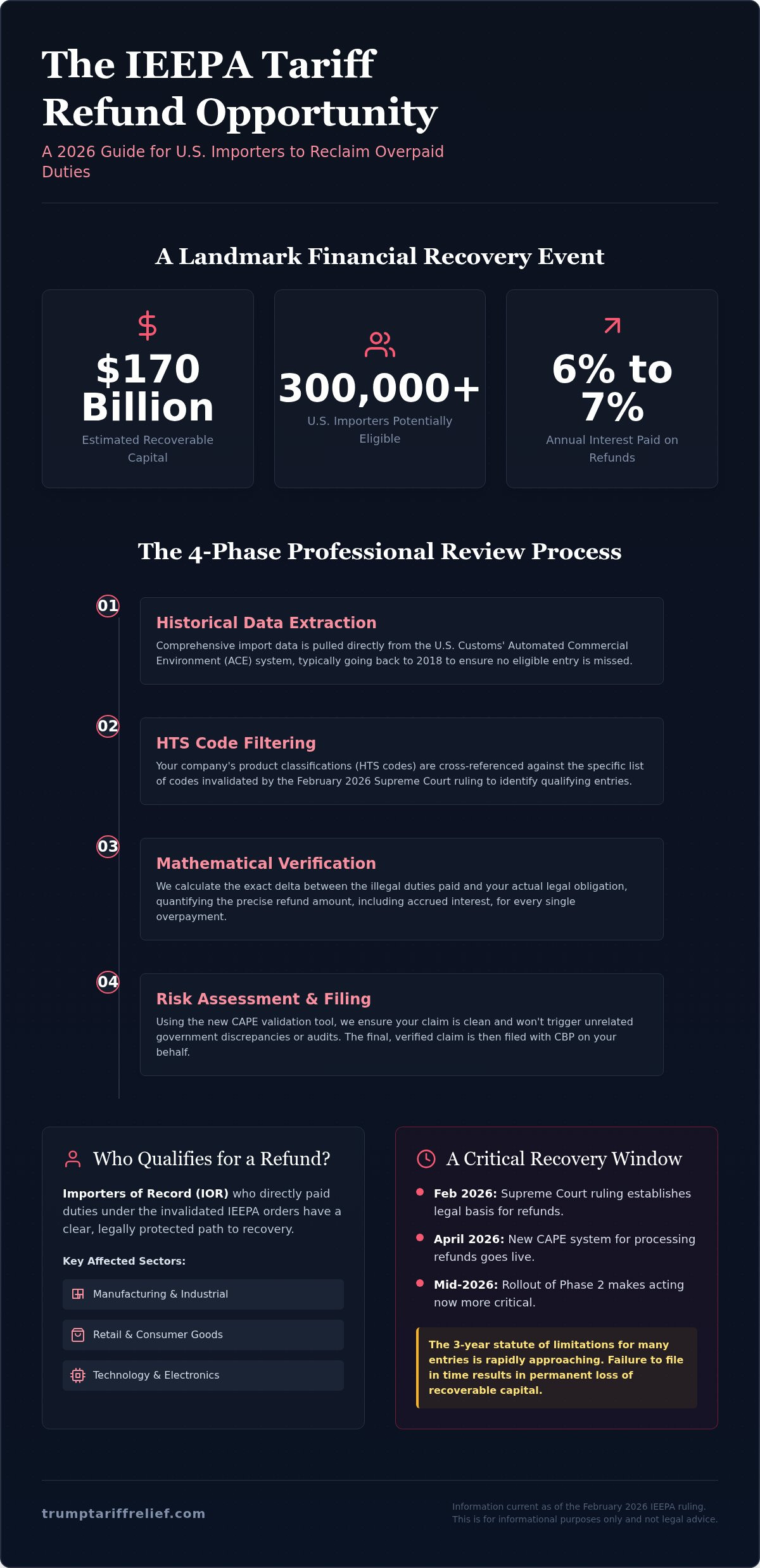
Over 300,000 U.S. importers are currently sitting on an estimated $170 billion in recoverable capital following the Supreme Court's landmark February 2026 ruling on IEEPA tariffs. You likely recognize the massive opportunity presented by the new CAPE system, yet the prospect of digging through three years of customs entries while risking a CBP audit feels like an unnecessary minefield. It's understandable to feel hesitant when your internal resources are already stretched thin and the regulatory landscape is shifting. A comprehensive tariff refund claim review changes this dynamic by identifying every dollar your business is legally owed without requiring any upfront capital or technical heavy lifting from your team.
This guide provides a clear roadmap for reclaiming your overpayments through the latest CAPE tool protocols. We'll explore how professional verification ensures your claim's legitimacy, how to capitalize on the current 6% to 7% interest rates on overpayments, and why the mid-2026 rollout of Phase 2 makes this the critical moment to act. You'll discover a streamlined path to financial restoration that prioritizes your company's security and minimizes operational disruption while we handle the complex documentation required by Customs and Border Protection.
Key Takeaways
- Understand how the 2026 Supreme Court ruling and the new CAPE system have unlocked $170 billion in potential refunds for U.S. importers.
- Learn the technical mechanics of data extraction from ACE reports and HTS code filtering required to validate your company's eligibility.
- Discover why a professional tariff refund claim review identifies recoverable capital that standard customs brokers and internal finance teams often overlook.
- Capitalize on the current 6% to 7% interest rates on overpayments using a contingency-based recovery model that eliminates all upfront financial risk.
- Identify the specific documentation and internal milestones needed to initiate a recovery process without disrupting your daily logistics operations.
Understanding the IEEPA Tariff Refund Opportunity in 2026
The International Emergency Economic Powers Act (IEEPA) has historically served as a broad tool for executive trade action, but its application reached a breaking point in early 2026. Following years of intense litigation, the U.S. Supreme Court ruled that certain tariffs imposed under this act exceeded executive authority. This decision isn't just a legal victory; it's a financial catalyst that has unlocked an estimated $170 billion in potential recoveries for U.S. importers. If your business paid duties on goods targeted by these specific executive orders, you're likely entitled to a full refund plus interest.
Many importers confuse these opportunities with the ongoing Section 301 "China tariffs." It's critical to understand the distinction. While Section 301 duties remain largely in place, IEEPA-based tariffs were found to be fundamentally invalid in specific contexts. A professional tariff refund claim review is the only way to separate these categories and pinpoint the exact entries that qualify for the new CAPE (Consolidated Administration and Processing of Entries) system. Because the government has moved to a consolidated batch system, identifying these errors requires a specialized audit of your historical trade data.
The Legal Catalyst: From CIT to the Supreme Court
The path to recovery began in the Court of International Trade (CIT) before reaching the highest level of the judiciary. High-profile cases like Atmus Filtration and V.O.S. Selections challenged the government's ability to indefinitely extend emergency tariff powers. The U.S. Court of Appeals for the Federal Circuit subsequently affirmed that the government’s expansion of these duties lacked the necessary statutory authorization, rendering the collections illegal. This ruling creates an immediate statutory obligation for U.S. Customs and Border Protection (CBP) to refund "excess moneys deposited" to affected businesses.
Because the CAPE system launched on April 20, 2026, the mechanism for these refunds is now live and operational. 2026 represents the most critical window for recovery because the three-year statute of limitations for many entries is rapidly approaching. If you don't initiate a tariff refund claim review now, you risk leaving millions in capital on the table permanently. The government isn't going to volunteer these funds; the burden of identification and filing rests entirely on the importer.
Who Qualifies for an IEEPA Refund Review?
The primary beneficiaries of this ruling are Importers of Record (IOR) who directly paid duties under the invalidated IEEPA orders. If your company operates in the manufacturing, retail, or technology sectors, your supply chain was likely hit by these illegal costs. While suppliers or indirect buyers cannot file, the IOR has a clear, legally protected path to restoration. You can verify your eligibility with our IEEPA explained guide to see if your specific HTS codes fall within the scope of the Supreme Court's mandate.
The Mechanics of a Professional Tariff Refund Claim Review
Executing a successful recovery requires more than a cursory glance at your tax filings. It demands a technical, entry-by-entry audit of your entire trade history. A professional tariff refund claim review functions as a specialized financial diagnostic, designed to pinpoint specific overpayments that are often buried under layers of customs bureaucracy. This process moves through four distinct phases to ensure that every dollar of recoverable capital is identified without exposing your business to unnecessary regulatory scrutiny.
The review begins with Phase 1: Historical Data Extraction. We pull comprehensive data from the Automated Commercial Environment (ACE) system, typically going back to 2018. This provides the raw material for Phase 2: HTS Code Filtering. During this stage, your product classifications are cross-referenced against the specific HTS codes invalidated by the Supreme Court. Phase 3 involves Mathematical Verification, where we calculate the exact delta between the illegal duties paid and your actual legal obligation. Finally, Phase 4 focuses on Risk Assessment, where we navigate the complexities of the new CAPE validation tool to ensure your claim won't be offset by unrelated government discrepancies.
Data Points Analyzed During the Review
Precision is the only way to satisfy U.S. Customs and Border Protection (CBP) requirements. To build a bulletproof case, we analyze specific data points that standard accounting software typically ignores. This includes entry numbers and liquidation dates, which are vital for managing the strict three-year statute of limitations. We also verify your Harmonized Tariff Schedule (HTS) classifications and duty rates to confirm they align with the IEEPA invalidation criteria. Finally, we establish clear Importer of Record (IOR) identification and proof of payment to ensure the refund is directed to the correct entity.
Identifying "Hidden" Recovery Opportunities
Standard customs brokers are focused on future compliance and day-to-day logistics, which means they frequently overlook historical litigation-based refunds. A specialized review uncovers these missed opportunities by analyzing entries that might have been miscoded or prematurely liquidated. We also place a heavy emphasis on interest calculations under 19 U.S.C. § 1505(b). With Q3 2026 interest rates set at 6% for corporations and 7% for non-corporations, the accumulated interest on multi-year claims often adds a substantial six-figure sum to the principal recovery amount. You can see the full breakdown of how it works to understand the timeline from data extraction to check issuance.
Internal Audits vs. Professional Recovery Services
Deciding between an internal audit and a specialized partner is often the difference between a full recovery and a rejected claim. Your internal finance and legal teams are already overextended; diverting them to a multi-year tariff refund claim review carries a massive opportunity cost. While they struggle to decode the technical requirements of the CAPE system, your core business operations suffer. Most standard customs brokers are similarly ill-equipped for this task. Their business model is built on high-volume, day-to-day logistics, not the forensic accounting and legal precision required to challenge historical IEEPA overpayments.
Traditional law firms often approach these cases with hourly billing structures, which creates a significant financial barrier to entry. You're forced to pay for the attempt regardless of the outcome. A professional recovery service flips this script. By utilizing a contingency-based model, we align our success entirely with yours. We absorb the upfront costs of data extraction and HTS analysis, ensuring that your capital stays in your business until the recovery is finalized. This specialized trade expertise is vital when navigating CAPE validation and potential government offsets that can derail an unrefined filing.
The Pitfalls of DIY Tariff Claims
Attempting a DIY recovery often leads to expensive mistakes that are difficult to reverse. The most common failure is missing critical filing deadlines. The statute of limitations is a hard wall; once an entry's window closes, that capital is lost to the government forever. Additionally, CBP is notoriously strict with CAPE declarations. A single missing proof of payment or an incorrect Importer of Record (IOR) identification can lead to a summary denial without the possibility of appeal. You can learn more about these risks in our guide on Common mistakes in China tariff refund claims.
The Contingency Advantage
A contingency-based partnership removes the "is it worth the legal fees?" barrier to entry. Trump Tariff Relief functions as the active engine for your recovery, taking on the administrative risk, the technical heavy lifting, and the government communication. This "no-nonsense" approach ensures that you only pay a success fee once your check is issued. We provide a streamlined path to financial restoration, allowing your team to focus on growth while we secure the millions in recoverable capital your business is legally owed.
Preparing for Your Claim Review: A Step-by-Step Checklist
Initiating a professional tariff refund claim review is a streamlined process, but it requires a structured hand-off of data to ensure accuracy and speed. While we act as the active engine for your recovery, your internal team plays a vital role in providing the raw materials for our forensic audit. Following this checklist ensures that your claim is positioned for success within the new CAPE system without creating unnecessary friction for your daily logistics operations.
- Step 1: Designate a Point of Contact. Assign a lead from your finance or logistics department who can facilitate data access and sign off on documentation.
- Step 2: Aggregate ACE Reports. Pull comprehensive Automated Commercial Environment (ACE) reports for the relevant period, typically covering 2018 to the present day.
- Step 3: Secure Sample Documentation. Gather copies of commercial invoices and packing lists for a representative sample of your entries to verify HTS classifications.
- Step 4: Execute a Specialized Power of Attorney. This document allows us to communicate directly with U.S. Customs and Border Protection (CBP) on your behalf, removing the administrative burden from your staff.
- Step 5: Review the 3-Year Deadline. Immediately identify your oldest entries to ensure they don't expire under the statute of limitations before your filing is finalized.
Essential Customs Documentation
The core of any successful filing is the CBP Form 7501, often referred to as the "birth certificate" of an import entry. This document contains the critical data points required for CAPE validation, including entry dates, duty rates, and IOR details. You can see our full checklist of required documents to ensure your internal records are audit-ready. It's important to remember that digital ACE records can often substitute for missing physical paperwork, allowing us to reconstruct your claim even if your historical files are incomplete.
Managing the Timeline
Speed is a competitive advantage in trade recovery. Once we receive your data, the initial tariff refund claim review typically takes between 14 and 30 days to complete. Following the submission of your CAPE Declaration, CBP anticipates that valid refunds will be issued within 60 to 90 days. Because the window for historical entries is constantly shrinking, understanding the tariff refund statute of limitations is essential for protecting your oldest, and often largest, overpayments. Don't let administrative delays turn into permanent financial losses; start your preliminary assessment today to lock in your recovery window.
Why Trump Tariff Relief is the Industry Standard for IEEPA Recovery
Choosing a partner for your tariff refund claim review is a high-stakes decision that determines whether your company recovers millions or walks away empty-handed. Trump Tariff Relief has established itself as the industry standard by operating as more than just a service provider; we are a specialized recovery engine designed to right the financial wrongs of illegal trade policy. Our methodology is rooted in an "insider" understanding of trade bureaucracy, allowing us to navigate the complexities of the 2026 CAPE system with assertive precision. We don't just identify overpayments; we secure the maximum legally allowable refund by forensically auditing every entry against the Supreme Court's February mandate.
While generalist law firms demand high hourly fees and customs brokers prioritize future compliance, we focus exclusively on historical restoration. Our process is built on 100% transparency, providing you with real-time updates as we move your claims through the federal pipeline. We've refined a proven methodology that accounts for the 6% to 7% interest rates currently paid on overpayments, ensuring that no capital is left behind due to administrative oversight or technical errors. This specialized focus is the reason why hundreds of U.S. importers trust us to manage their most significant trade litigation assets.
Our commitment to transparency means you'll never be in the dark about the status of your capital. We provide a detailed audit trail for every entry, showing exactly how the delta between the illegal duty and the legal obligation was calculated. This level of detail is what separates a professional tariff refund claim review from a generic accounting exercise. By removing the financial barriers of hourly billing, we ensure that every Importer of Record has the opportunity to challenge the government's illegal collections without risking their own operational budget.
Our "We-Do-The-Work" Narrative
We understand that your internal resources are already stretched thin and your logistics team is focused on moving freight, not filing paperwork. Our "no-nonsense" approach is designed to minimize the administrative burden on your staff by taking ownership of the entire filing lifecycle. From the initial data extraction from ACE to managing complex government inquiries and CAPE validation, we handle the heavy lifting. You can learn more about how our recovery process works to see how we transform years of complex trade data into a streamlined financial asset for your business.
Start Your Zero-Risk Assessment Today
The window of opportunity for IEEPA recovery is closing as the statute of limitations approaches for historical entries. You can initiate a preliminary review in under five minutes, providing the catalyst for a full-scale restoration of your capital. This is your chance to reclaim what your business is legally owed without any upfront financial risk or disruption to your daily operations. We encourage you to request your professional tariff refund assessment today and secure your place in the 2026 recovery rollout. Let us act as your bold advocate in the face of federal bureaucracy.
Secure Your Capital Before the Statute of Limitations Expires
The 2026 Supreme Court ruling and the subsequent launch of the CAPE system have created a finite window for importers to recover an estimated $170 billion in illegal duties. This isn't a time for internal hesitation or relying on standard logistics partners who lack the forensic tools to challenge historical IEEPA overpayments. A professional tariff refund claim review provides the technical precision needed to identify every recoverable dollar while protecting your business from regulatory risk. By utilizing comprehensive ACE data analysis, you can capitalize on current interest rates of 6% to 7% that significantly boost your total recovery.
We're ready to serve as the active engine for your restoration. Our specialized expertise in IEEPA and Section 301 litigation ensures that your claims are filed accurately and pursued aggressively. Because we operate on a contingency basis, you only pay if we win, removing all financial barriers to entry. Don't leave your capital in the hands of the government when a zero-risk solution is available. Request Your Free Tariff Refund Claim Review today and take the first step toward reclaiming what your business is legally owed. Your financial restoration is our priority.
Frequently Asked Questions
Is the IEEPA tariff refund claim legitimate?
The IEEPA tariff refund opportunity is fully legitimate, resulting from a February 2026 U.S. Supreme Court ruling that invalidated specific executive-branch tariffs. This legal precedent creates a statutory obligation for U.S. Customs and Border Protection to return billions in "excess moneys deposited." Every claim is processed through the official CAPE system in the ACE Secure Data Portal, ensuring the recovery process adheres to federal trade regulations.
How much does a tariff refund claim review cost?
A professional tariff refund claim review is conducted on a contingency-fee basis, which means there are zero upfront costs or hourly billing. You only pay a success fee after your business receives the actual refund check from the government. This model removes the financial risk for the importer and ensures that your specialized partner is fully motivated to identify every legally recoverable dollar from your historical entries.
What is the deadline for filing an IEEPA tariff refund claim in 2026?
Deadlines are governed by a strict three-year statute of limitations from the date of entry liquidation. Because these tariffs were collected over several years, the window for your oldest entries is closing every day. If you don't initiate your review immediately, you'll risk permanently losing the ability to reclaim capital on entries that have already passed their statutory limit.
Can my customs broker perform this review for me?
Most customs brokers prioritize day-to-day logistics and future compliance rather than the forensic accounting required for litigation-based recoveries. A specialized tariff refund claim review involves a deep audit of historical data that goes beyond standard brokerage services. Brokers often lack the legal resources and technical infrastructure needed to navigate the complex CAPE validation phases required for these specific Supreme Court-mandated refunds.
What happens if my claim is denied by CBP?
If a claim is denied, it's typically due to documentation errors or a failure to meet the CAPE system's strict validation criteria. Our specialized team manages the entire inquiry process, including responding to CBP requests for information. We ensure that every submission is bulletproof from the start, but if issues arise, we handle the technical adjustments needed to secure your rightful recovery and address government offsets.
How long does it take to receive the actual refund check?
U.S. Customs and Border Protection typically issues valid IEEPA refunds within 60 to 90 days after the CAPE Declaration is accepted. The timeline depends on the accuracy of your initial filing and the volume of consolidated entries being processed. Because the system is electronic, the transit time for funds is significantly faster than traditional paper-based protest mechanisms used in previous years.
Do I need to be a large corporation to qualify for a review?
Any business that served as the Importer of Record (IOR) and paid the invalidated tariffs is eligible for a review. While an estimated 300,000 importers are affected, the recovery isn't restricted to large corporations. Small and mid-sized manufacturers often find that their accumulated overpayments represent a massive percentage of their annual operating capital, making the review process essential regardless of company size.
What is the difference between a duty drawback and an IEEPA refund?
Duty drawback is a refund of duties paid on imported goods that are later exported or used in a manufacturing process for export. In contrast, an IEEPA refund is a restoration of capital that was collected under a tariff found to be legally invalid by the Supreme Court. While drawback requires proof of export, IEEPA recovery is based solely on the illegality of the original duty collection.
Ready to find out what your business may be owed?
Check My Eligibility