
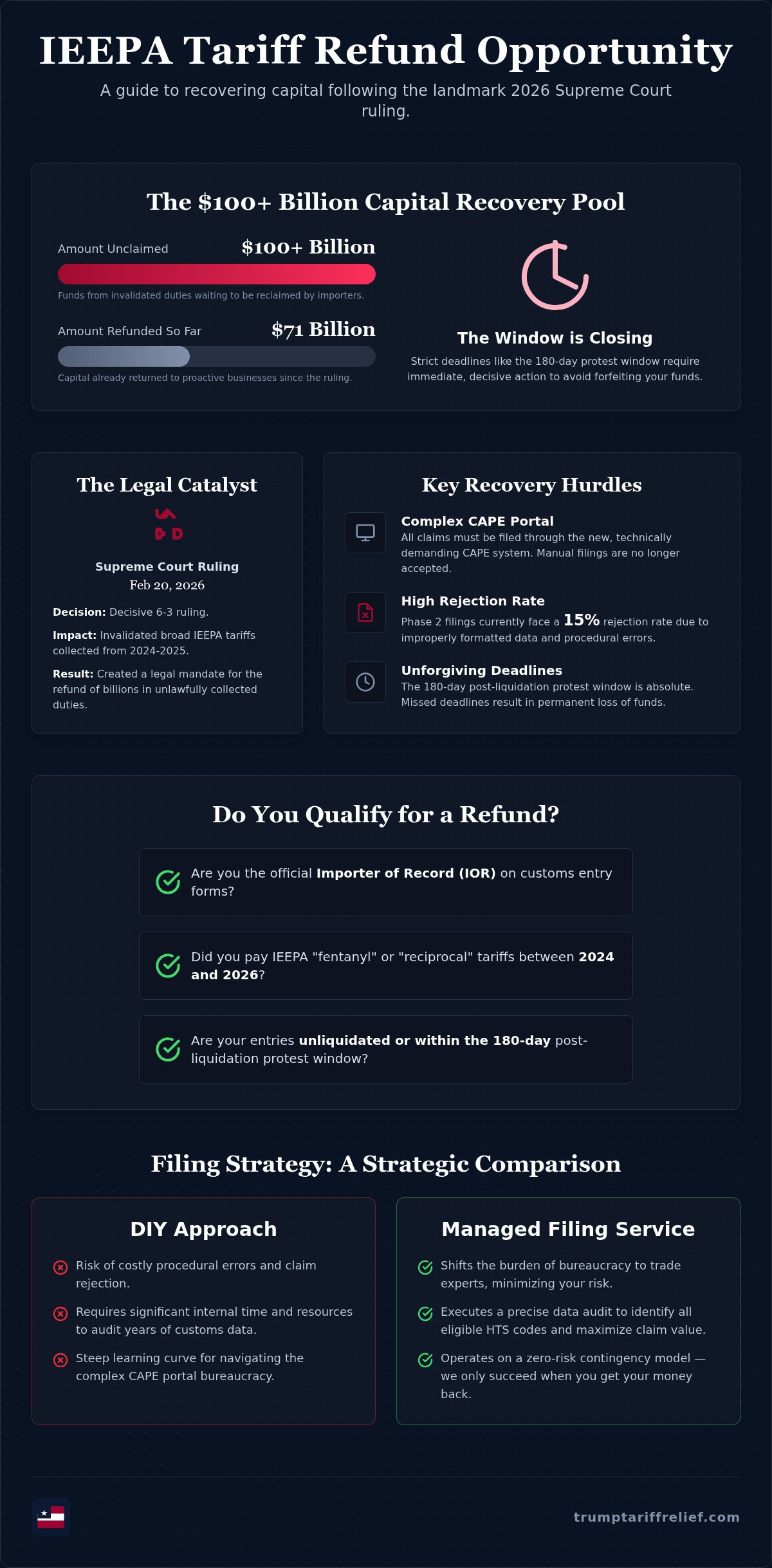
Did you know that while over $71 billion in IEEPA tariff refunds has already been paid out, more than $100 billion still sits in government accounts waiting to be reclaimed? Following the Supreme Court's landmark February 20, 2026, ruling that invalidated these duties, the window for recovery is wide open, yet many businesses are watching their capital vanish due to procedural errors. It's frustrating to know your money is available but feel blocked by the complex CAPE portal requirements and the unforgiving 180-day liquidation deadline. Most importers realize they need a specialized tariff refund claim filing service to navigate this bureaucracy, yet many hesitate until the opportunity expires.
We understand that most trade executives lack the internal resources to audit years of customs data or manage the 15% rejection rate currently seen in Phase 2 filings. Our mission is to bridge that gap and restore your financial balance. You shouldn't have to risk your own time or capital to get back what's legally yours. This guide explains how to navigate the new regulatory landscape, avoid common filing pitfalls, and secure a successful capital recovery through a zero-risk contingency partnership that handles the heavy lifting for you.
Key Takeaways
- Leverage the 2026 Supreme Court ruling to reclaim capital lost to unlawful IEEPA duties before the window of opportunity closes.
- Determine your eligibility by verifying your status as the Importer of Record and identifying entries within the critical 180-day protest window.
- Partner with a specialized tariff refund claim filing service to manage the technical complexities of the CAPE portal while protecting your internal resources.
- Execute a precise historical data audit to identify eligible HTS codes and maximize the total value of your recovery claim.
- Shift the burden of government bureaucracy to trade experts using a contingency model that aligns our success with your financial restoration.
The 2026 Tariff Refund Landscape: Why the Window is Opening
The global trade environment shifted fundamentally on February 20, 2026. For years, importers operated under a heavy burden of duties that many legal experts questioned. To understand the current opportunity, one must first ask: What is a tariff? In its simplest form, it's a tax on imported goods, but when applied through the International Emergency Economic Powers Act (IEEPA), it requires specific executive justification. The U.S. Supreme Court has now ruled that this justification was missing for approximately $166 billion in duties collected between 2024 and early 2026.
This ruling created an immediate, high-stakes transition. While the industry previously focused on Section 301 list 3 and 4a litigation, the current priority is IEEPA recovery. The government isn't simply handing this money back; it has built a complex digital gatekeeper. Importers who take a "wait and see" approach are already losing. Beyond the risk of missing strict deadlines, businesses are forfeiting millions in potential interest and liquidity that could be reinvested into their 2026 operations. Success now requires an aggressive, data-driven approach to secure what was unlawfully taken.
The Supreme Court Ruling Explained
In a decisive 6-3 ruling, the Supreme Court invalidated the executive branch's authority to impose broad tariffs under IEEPA without explicit congressional approval. This decision specifically targeted the "fentanyl tariffs" and "reciprocal tariffs" implemented during the 2024-2025 period. The court found that these measures exceeded the statutory limits of the Act, effectively turning billions of dollars in paid duties into refundable overpayments. For a deeper breakdown of the legal mechanics involved, you can review our guide on IEEPA Explained. The ruling doesn't just offer a suggestion of a refund; it establishes a legal mandate for restoration.
The Role of the CAPE System
U.S. Customs and Border Protection (CBP) responded to the ruling by launching the Consolidated Administration and Processing of Entries (CAPE) portal. This is now the exclusive electronic mechanism for all IEEPA claims. Phase one launched on April 20, 2026, targeting unliquidated entries. Phase two followed on June 29, 2026, to manage more complex liquidated entries. It's vital to recognize that CBP no longer accepts manual filings or traditional Post Summary Corrections for these claims. Because the CAPE system has already shown a 15% rejection rate for improperly formatted data, most successful importers now rely on a professional tariff refund claim filing service to ensure their documentation meets every technical requirement.
The window for recovery is defined by precision and speed. If your entries are liquidating, the 180-day protest clock is already ticking. Engaging a specialized tariff refund claim filing service allows your business to bypass the steep learning curve of the CAPE portal and move directly to the recovery phase. We don't just monitor the landscape; we navigate the bureaucracy to ensure your capital returns to your balance sheet where it belongs.
Identifying Eligibility: Does Your Business Qualify for a Refund?
Righting the wrong of unlawful taxation starts with verifying your legal standing. The "Importer of Record" (IOR) is the only entity recognized by the CAPE portal for refund disbursement. This means that if your business ultimately bore the economic cost of tariffs through price hikes from a supplier, you cannot file a claim unless your company's name and tax ID appear on the original customs entry. Understanding how these duties were initially assessed is vital, and you can find comprehensive U.S. Customs Duty Information on the official CBP website to help clarify your original obligations.
The landscape of eligibility is also shifting due to changes in de minimis exemptions. Recent regulatory tightening means many shipments that once entered duty-free are now being categorized under standard duty structures. If your business moved away from de minimis shipping in late 2025 or early 2026, you might've paid IEEPA duties on entries you previously thought were exempt. A specialized tariff refund claim filing service helps you identify these specific recovery windows that internal accounting teams often overlook.
Liquidated vs. Unliquidated Entries
Liquidation is the final calculation of duties and the formal closing of an entry by U.S. Customs.
The 180-day protest window is the most dangerous hurdle in the recovery process. If your entries have already liquidated, you have exactly six months from that date to file a protest. Missing this deadline by even a single day results in the permanent loss of your refund rights. This is why timing is the primary reason most DIY claims fail in the current trade environment. You should use the Automated Commercial Environment (ACE) portal to pull your entry summaries and track liquidation dates immediately. If the data shows your entries are approaching the six-month mark, the urgency to act becomes absolute.
Sector-Specific Recovery Potential
Manufacturers using Chinese components often see the highest recovery rates. Their supply chains were heavily targeted by the now-invalidated IEEPA duties, creating a significant backlog of overpayments. Because these businesses often deal with high-volume, repetitive entries, the cumulative value of a tariff refund claim filing service audit can reach into the millions. We've seen that precision in HTS code matching is the difference between a full recovery and a rejected application.
Retailers face a unique opportunity, particularly those affected by the "List 4a" overlap. Many retail importers suffered from double-overpayment on specific consumer goods that were caught between different tariff authorities. Identifying these overlaps requires a deep dive into historical data to ensure you aren't leaving money on the table. For a clearer picture of how these variables affect your specific case, you can review our guide on IEEPA explained to see where your products fit. If you're ready to see what's owed to you, you can get a preliminary assessment from our specialized team today.
The Managed Filing Service vs. DIY: A Strategic Comparison
Many importers believe their existing customs broker will handle the IEEPA refund process as part of their standard service. This assumption is often a costly mistake. Most brokers are experts in compliance and entry; however, they are rarely equipped to manage the high-stakes data auditing and legal maneuvering required for a successful recovery. Choosing a specialized tariff refund claim filing service isn't just about outsourcing paperwork. It's about shifting the risk of the 15% rejection rate onto a partner whose success is tied directly to your own. A dedicated service acts as an advocate, navigating the complexities of the CAPE portal while you focus on your core business operations.
The hidden costs of a DIY approach are substantial. Your internal team would need to dedicate hundreds of man-hours to historical data extraction and HTS code verification across years of entries. If your staff lacks the specialized software required to audit ACE data at scale, the process becomes a significant drain on your operational capacity. CBP rejects incomplete or inaccurate filings without hesitation. As of April 2026, roughly 15% of requests submitted through the CAPE portal had been rejected due to technical errors. A professional service provides the "heavy lifting" by managing protests and reliquidations, ensuring that every eligible dollar from the $166 billion in collected duties is identified and reclaimed.
The Contingency Fee Advantage
Risk management is the cornerstone of a sound strategy. Hourly consultants create a "sunk cost" trap where you fund a recovery effort regardless of the result. Our model eliminates this upfront risk. You only pay when the refund check hits your bank account, aligning our incentives with yours. To see how this partnership functions, review our Tariff Recovery for Importers Guide.
Technical Filing Risks
Filing through the CAPE portal requires a formal attestation under penalty of law. Because of this legal exposure, many customs brokers refuse to handle these complex filings. They simply won't take the liability. A professional service assumes this responsibility, using rigorous data scrubbing to maximize your claim. We identify HTS nuances that internal teams miss, turning potential rejections into successful capital restorations. This specialized tariff refund claim filing service ensures your documentation is bulletproof before it reaches a customs official's desk.
Step-by-Step Guide to Filing Your Tariff Refund Claim
Securing a refund isn't a matter of a simple request; it's a rigorous forensic exercise. A professional tariff refund claim filing service treats this as a five-stage operation to ensure no capital is left behind. The first step involves a historical data audit where we gather 3-5 years of entry data to identify every potential overpayment. Once identified, we move to eligibility verification, matching your specific HTS codes against the Supreme Court's IEEPA ruling. This isn't just a surface check; it's a line-by-line validation to prevent the 15% rejection rate seen in early 2026 filings. Engaging a tariff refund claim filing service ensures this technical burden doesn't fall on your overstretched internal staff.
We then move to documentation preparation, requiring entry summaries and proof of duty payment to build a bulletproof case. We then manage the CAPE portal submission, navigating the electronic interface that has replaced all legacy filing methods. The process doesn't end at submission. We provide reliquidation monitoring, tracking CBP approval and ensuring payment issuance, which typically occurs within 60 to 90 days of a successful filing.
Gathering the Required Documentation
Gathering the right evidence is the foundation of your recovery. You'll need a complete set of records, including CF 7501 forms, commercial invoices, and packing lists for every disputed entry. If your internal records are incomplete, we utilize the ACE Secure Data Portal to retrieve historical entry summaries. This forensic approach ensures that even "lost" data is recovered to maximize your claim. You can review our full Required Documents for IEEPA Tariff Refund to see what's required for your specific industry.
Navigating the Filing Deadlines
The 2026 filing calendar is unforgiving. Phase two for liquidated entries launched on June 29, 2026, and the 180-day protest window is non-negotiable. If you miss this deadline, CBP won't grant extensions or allow appeals. It's a binary outcome: you're either in the system or you've forfeited your capital. Because these dates are tied to the specific liquidation of each entry, tracking them manually is an operational nightmare. If you're concerned about missing your window, check the Tariff Refund Statute of Limitations to protect your recovery rights and start your assessment today.
Trump Tariff Relief: Your Partner in Capital Recovery
Most businesses treat tariff recovery as a software problem or a clerical task for their accounting department. This perspective is a mistake that leaves millions on the table. Trump Tariff Relief operates as a high-performing partner, providing an end-to-end tariff refund claim filing service that bridges the gap between a legal victory in the Supreme Court and actual cash in your bank account. We specialize exclusively in the intersection of IEEPA and Section 301 duties, offering a level of technical expertise that general customs brokers or corporate legal teams simply cannot match. We don't just file claims; we engineer successful financial restorations.
Our commitment to your bottom line is absolute. We operate on a contingency-fee model, meaning there are zero upfront costs or hidden consulting fees. If we don't secure your recovery, you don't pay a dime. This aligns our incentives perfectly with yours, ensuring that our trade experts work tirelessly to identify every eligible entry. You can start your preliminary assessment in under five minutes, allowing our team to begin the heavy lifting of auditing your historical customs data immediately. We take the risk. You take the recovery.
Our Proven Recovery Process
Success in the 2026 trade landscape requires a data-first approach. We begin by scrubbing your historical ACE data to find HTS codes that match the IEEPA ruling, ensuring that your claim is bulletproof before it reaches the CAPE portal. We manage the entire lifecycle of the claim, from initial verification to the final issuance of the refund check. Throughout this process, the security and confidentiality of your trade data remain our highest priority, protected by enterprise-grade encryption and strict internal protocols. For a detailed visual roadmap of our methodology, you can review how it works.
Secure Your Capital Today
The 2026 deadlines are moving targets, and every day of delay is a day your capital remains in government hands. The 180-day protest window for liquidated entries is an unforgiving barrier; once it closes, your right to a refund is permanently forfeited. There's no reason to let bureaucracy win when a specialized tariff refund claim filing service is ready to advocate for your business. Don't let your rightful capital evaporate due to procedural hesitation. Schedule your free eligibility audit now and claim your refund with Trump Tariff Relief today.
Reclaim Your Capital Before the 2026 Deadlines Expire
The Supreme Court's landmark ruling has transformed $166 billion in collected duties from a historical sunk cost into a massive recovery opportunity for your business. However, as we've analyzed, the technical barriers of the CAPE portal and the unforgiving 180-day liquidation clock mean that speed is now your most valuable asset. You've already borne the economic burden of these unlawful tariffs; don't let procedural red tape or missed deadlines prevent you from reclaiming what's legally yours.
Partnering with a specialized tariff refund claim filing service allows you to shift the entire bureaucratic burden to an expert IEEPA recovery team. Our contingency-based model ensures there are no upfront costs, providing you with expert management of CAPE portal filings while we take on the technical risk. We're committed to righting this financial wrong and restoring your capital so you can reinvest in your company's future. Get Your Free Tariff Refund Assessment Now and secure your rightful recovery today.
Frequently Asked Questions
Is the China tariff refund real or a scam?
The IEEPA tariff refund is a legitimate financial restoration resulting from the February 20, 2026, Supreme Court decision. This ruling invalidated billions in duties, and CBP has already authorized over $104 billion in refunds as of June 2026. While you should be wary of unverified solicitations, the CAPE portal is the government's official mechanism for these payments. Working with an established recovery partner ensures you're navigating the real legal process rather than a fraudulent offer.
What is the deadline for filing an IEEPA tariff refund claim in 2026?
The deadline for liquidated entries is 180 days from the date of liquidation to file a protest or a CAPE Declaration. For Phase 1 entries, the window was even tighter. Because liquidation happens on a rolling basis for every shipment, there isn't a single universal date; instead, each entry has its own unique expiration. You must monitor your ACE portal data daily to ensure you don't miss these individual cutoffs and forfeit your capital.
How much does a tariff refund claim filing service cost?
Our specialized tariff refund claim filing service operates on a contingency-fee basis, ensuring your business faces no upfront financial risk. We only collect a fee if we successfully recover your capital from U.S. Customs. This model removes the high internal costs of manual data auditing and portal management. By aligning our incentives with your successful recovery, we ensure that our trade experts work aggressively to identify every eligible dollar without draining your current budget.
Can I file for a refund if my entries have already liquidated?
Yes, you can file for a refund on liquidated entries through Phase 2 of the CAPE portal, which launched on June 29, 2026. This phase was specifically designed to handle reconciliation entries and shipments that have already completed the customs process. However, you must act within the 180-day protest window following the liquidation date. If this timeframe expires, the entry is considered final, and your right to reclaim that capital is permanently lost.
How long does it take for CBP to process a tariff refund through the CAPE portal?
CBP expects to issue payments within 60 to 90 days after a CAPE Declaration is successfully filed and accepted. This timeline is significantly faster than traditional protest resolutions, provided your data is accurate upon submission. Because the CAPE system is entirely electronic, any formatting errors or mismatched HTS codes can lead to immediate rejections. This resets your processing clock and potentially threatens your recovery if you're nearing the final 180-day filing deadline.
What documents do I need to provide to start the filing process?
To begin, you need the Importer of Record's tax ID and access to your ACE Secure Data Portal. Essential files include the CF 7501 Entry Summary, commercial invoices, and packing lists for the disputed shipments. We also require proof of duty payment to substantiate the claim value. Having these records organized allows our tariff refund claim filing service to perform a forensic audit and identify every eligible HTS code matching the Supreme Court's ruling.
Do I need a lawyer to file a tariff refund claim?
You don't need a lawyer to file a tariff refund claim, but the technical complexity of the CAPE portal makes professional assistance vital. While the process is administrative, it requires a deep understanding of trade law and forensic data auditing. Most importers find that a specialized filing service provides the necessary expertise without the high hourly rates of a law firm. We act as your advocate, managing the bureaucracy to ensure your claim meets CBP's strict standards.
What happens if my tariff refund claim is denied by CBP?
If your claim is denied, CBP provides a specific reason through the CAPE portal, which currently rejects roughly 15% of all submissions. Most denials stem from technical errors, such as mismatched HTS codes or incomplete documentation. When a denial occurs, our team reviews the rejection code to determine if a correction is possible. We manage the resubmission process, leveraging our technical expertise to resolve data discrepancies and secure the capital that was initially blocked by the system.
Ready to find out what your business may be owed?
Check My Eligibility