
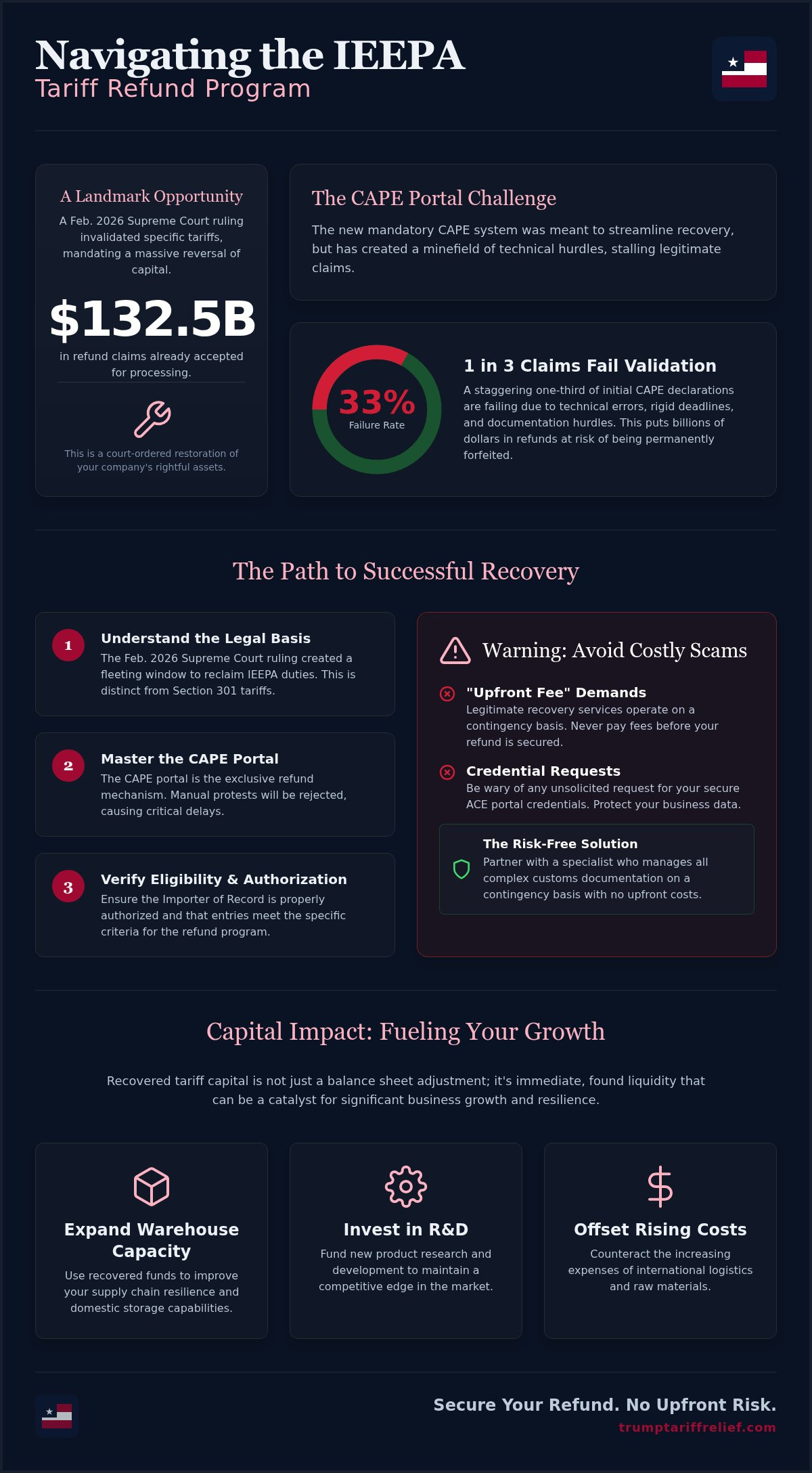
As of late August 2026, $132.5 billion in IEEPA tariff refunds has already been accepted for processing, yet a staggering 33% of initial CAPE declarations are failing validation due to technical errors. For many importers, the promise of the ieepa refund program feels trapped behind a wall of bureaucracy and the high-stakes complexity of the ACE Secure Data Portal. You likely believe that the government's shift to the CAPE system was supposed to streamline recovery; instead, it's created a minefield of documentation hurdles and rigid deadlines that threaten your capital return.
We recognize that your internal teams are already stretched thin and that the fear of missing the statute of limitations on unliquidated entries is a legitimate business risk. This guide provides the strategic roadmap you need to navigate the new CAPE portal, manage Phase 2 eligibility requirements, and reclaim your overpaid duties with zero upfront risk. By following this framework, you'll discover how to secure your IEEPA tariff refunds through a streamlined process that minimizes disruption to your daily operations while ensuring every dollar is successfully recovered through the mandatory ACH system.
Key Takeaways
- Understand how the February 2026 Supreme Court ruling invalidated specific duties, creating a fleeting window for significant financial restoration.
- Learn to navigate the mandatory CAPE portal within ACE to bypass the technical validation errors that currently stall one-third of all claims.
- Identify the specific entry criteria for the ieepa refund program and ensure the Importer of Record is properly authorized to secure capital.
- Protect your business by recognizing the red flags of "upfront fee" scams and unsolicited requests for secure ACE portal credentials.
- Discover a risk-free path to recovery through a contingency-based model that manages complex customs documentation with no upfront costs.
Understanding the IEEPA Refund Program and the 2026 Ruling
The International Emergency Economic Powers Act (IEEPA) serves as a broad legislative tool that grants the executive branch authority to regulate international commerce during declared national emergencies. While historically used for targeted sanctions, its application to broad, multi-sector import tariffs faced a decisive legal challenge that reached the highest level of the judiciary. On February 20, 2026, the Supreme Court issued a landmark ruling that invalidated specific tariffs imposed under this act, concluding that the government had exceeded its statutory authority. This decision didn't just stop future collections; it mandated a massive reversal of capital, forcing U.S. Customs and Border Protection (CBP) to establish the ieepa refund program to return billions in overpaid duties.
For U.S. businesses, this represents an unprecedented opportunity to reclaim capital that was essentially seized through an overreach of regulatory power. The scale of this recovery is massive. As of August 21, 2026, over $132.5 billion in refund claims had already been accepted for processing. This isn't a government handout. It's a court-ordered restoration of your company’s rightful assets, yet the window for claiming these funds is strictly tied to the liquidation status of your entries.
The Legal Precedent: Why Your Tariffs Are Refundable
The Supreme Court ruling was followed by a series of specific enforcement orders from the Court of International Trade (CIT). On July 17, 2026, the court mandated that CBP reliquidate entries for thousands of plaintiffs, setting the legal floor for a broader recovery mechanism for all impacted importers. It's vital to distinguish these claims from standard Section 301 duties, which remain subject to different regulatory frameworks. The IEEPA-specific claims are unique because the legal basis for their collection was found to be fundamentally flawed from the outset.
This creates a narrow recovery window that requires immediate attention. Unlike ongoing trade disputes that may drag on for years, the ieepa refund program addresses a specific set of invalidated duties with clear cut-off dates. If you don't act within the prescribed timelines for unliquidated entries, that capital could be permanently forfeited to the Treasury. You can learn more about IEEPA explained to see how these legal shifts specifically impact your past import filings and current eligibility status.
Capital Impact for Importers
Recovering these overpaid duties offers more than just a balance sheet adjustment; it provides immediate, found liquidity. In an era of tight margins and high operational costs, the return of tariff capital can be the catalyst for significant growth. Many of our clients use these recovered funds to:
- Expand domestic warehouse capacity to improve supply chain resilience.
- Invest in new product research and development to stay competitive.
- Offset the rising costs of international logistics and raw materials.
Navigating the CAPE Portal: The New Refund Mechanism
The establishment of the Consolidated Administration and Processing of Entries (CAPE) system represents a fundamental shift in how CBP manages large-scale duty recovery. Before the April 20, 2026, launch of the CAPE portal, importers typically relied on manual protests to challenge duty assessments. However, the sheer volume of claims under the ieepa refund program necessitated a more robust, electronic solution. CAPE isn't just an alternative; it's the exclusive mechanism for reclaiming these specific funds. If your business attempts to use standard protest protocols for IEEPA-related duties, your filing will likely be rejected, causing critical delays in capital restoration.
Accessing this system requires an active account within the ACE Secure Data Portal. This isn't merely a login issue. It involves ensuring your account permissions are correctly configured to handle the new CAPE Declaration module. CBP deployed the system in phases, starting with Phase 1 on April 20 and expanding to Phase 2 on June 29, 2026, to accommodate complex entries like those flagged for reconciliation. Timing is everything. If you haven't accessed your ACE account recently, reactivation protocols can take weeks, potentially pushing your filing past critical deadlines.
Steps to File a CAPE Declaration
Successful recovery through the portal follows a strict, four-step technical sequence. Precision at each stage is mandatory to avoid the "rejection loop" that many importers currently face.
- Step 1: Data Identification. You must pull all entry summaries for which IEEPA duties were paid, specifically targeting payments made starting January 30, 2026.
- Step 2: CSV Preparation. Prepare an electronic data set limited to 9,999 entries per declaration. The formatting must be exact; even a single misplaced comma in the entry number field can trigger a system-wide failure.
- Step 3: Authorization Audit. Confirm that the "Importer of Record" (IOR) or a legally authorized broker is the party initiating the filing. Unauthorized submissions are flagged immediately.
- Step 4: Queue Monitoring. After submission, you must track the status through the ACE dashboard to respond to any "File Validation" errors within the 60 to 90-day processing window.
Common Technical Hurdles in the Portal
The technical barrier to entry is higher than many businesses anticipate. CBP reports that approximately 33% of CAPE declarations initially fail file validation. These failures often stem from data mismatches between the uploaded CSV and the underlying ACE records. Additionally, as of February 6, 2026, all refunds are issued via Automated Clearing House (ACH) only. If your ACE account lacks verified ACH information, your refund will stay on hold indefinitely. Currently, over 22,000 refunds totaling $1.7 billion are stuck in this administrative limbo.
Navigating these digital requirements requires a steady hand and deep technical knowledge. If you're unsure if your documentation meets these rigid standards, you can review how the recovery process works to ensure your filing is optimized for first-time acceptance. Managing these hurdles internally often strains resources, making a specialized partner essential for timely capital return.
Eligibility and Deadlines: Does Your Business Qualify?
Determining your eligibility for the ieepa refund program begins with a clear audit of your "Importer of Record" (IOR) status. Only the entity that legally entered the goods and paid the duties to U.S. Customs and Border Protection has the standing to reclaim that capital. This distinction is critical for large-scale manufacturers and retailers who often manage complex supply chains. If your business absorbed these costs as part of your landed cost calculations, you're the primary beneficiary of the 2026 ruling. This isn't a consumer-facing rebate; it's a corporate restoration of liquidity for the businesses that fueled international trade during the emergency period.
The government's mandate to issue these refunds isn't an open-ended invitation. Trade law operates on a "use it or lose it" principle. If your entries have liquidated and you fail to file a timely CAPE declaration or protest, your right to that capital expires. This statute of limitations acts as a hard ceiling on your recovery potential. Waiting for the government to "fix" the error on its own is a gamble that rarely pays off in a complex regulatory environment.
Critical Deadlines for 2026 Filings
The timeline for recovery is governed by strict procedural rules within the ACE portal. While the Supreme Court ruling invalidated the tariffs, it didn't suspend the standard 180-day window for protests after liquidation. If you miss these windows, the legal precedent becomes irrelevant to your specific case. Many importers mistakenly believe that the $132.5 billion already accepted for processing covers all eligible parties automatically. It doesn't. You must proactively assert your claim through the digital filing system to secure your funds. For a deeper breakdown of these windows, read our analysis on the Tariff Refund Statute of Limitations: The Critical Deadlines.
Documentation Requirements for Success
A successful filing requires more than just an entry number. You must build a defensible data set that proves you paid IEEPA-specific duties on valid entries. CBP's validation systems are designed to flag inconsistencies, and a single documentation gap can lead to a summary rejection. To ensure your claim passes the initial 33% failure rate currently plaguing the portal, you must have the following ready:
- CBP Form 7501: The Entry Summary is the primary evidence of the duty rate applied and the specific legal authority used for the collection.
- Proof of Payment: Verifiable ACH transaction records that link the payment to the specific entry summaries in question.
- HTS Code Correlation: Documentation that confirms your goods fell under the specific categories invalidated by the February 2026 ruling.
If your internal records are fragmented, the recovery process becomes significantly more difficult. If you're unsure if your documentation meets current standards, consult our Frequently Asked Questions on Eligibility to see where your business stands.
Avoiding Scams and Errors in the IEEPA Process
The announcement of over $132.5 billion in accepted claims has unfortunately attracted bad actors looking to exploit the ieepa refund program. If you receive an unsolicited email claiming to be from "Customs Support" or a "Federal Refund Liaison" asking for your ACE Secure Data Portal credentials, treat it as a high-level security threat. Legitimate government agencies or authorized partners will never request sensitive portal passwords or ACH information via social media or insecure email channels. These phishing attempts often use the urgency of the 2026 deadlines to pressure importers into compromising their corporate data.
The most prevalent risk comes from "upfront fee" consultants. These entities often demand thousands of dollars for "eligibility assessments" or "documentation packages" before a single dollar is recovered. This contradicts the professional standard of trade recovery. A legitimate partner should operate on a contingency basis, meaning they only win when you do. If a provider cannot show a clear history of navigating the Court of International Trade or handling complex CBP reliquidations, they lack the insider expertise required for this high-stakes recovery. Verifying credentials through official trade associations or legal registries is a mandatory step before sharing your entry data.
The Risk of Filing Errors
Beyond external fraud, internal technical errors remain the primary obstacle to capital restoration. As previously noted, 33% of CAPE declarations fail initial validation. A single data entry error in a CSV file, such as a transposed digit in an entry number or an incorrect HTS correlation, can lead to the immediate disqualification of a million-dollar claim. Duplicate filings are another common pitfall. If multiple parties attempt to claim the same entry, the CAPE system triggers an administrative lock that can take months to resolve. Many importers who attempt self-filing find that they significantly under-recover because they lack the tools to identify every eligible unliquidated entry across their entire 2026 trade history.
Vetting Your Recovery Partner
To protect your capital, you need a vetting framework that prioritizes transparency and specialized trade knowledge. A generalist law firm or a standard customs broker may not have the dedicated documentation management systems required to process thousands of entries simultaneously. Look for these "green flags" when choosing a partner:
- Contingency-Only Fee Structure: No upfront costs or hidden consulting fees ensure the partner is motivated by your success.
- Direct ACE Integration: Proven experience submitting high-volume CAPE declarations with low rejection rates.
- Legal-First Strategy: The ability to handle complex reliquidation orders following the July 17, 2026, court mandate.
Trump Tariff Relief: Risk-Free IEEPA Recovery
Successfully navigating the ieepa refund program requires more than just knowing the rules; it demands a partner who can execute with surgical precision. At Trump Tariff Relief, we specialize in identifying and capturing these restoration opportunities for U.S. importers. We don't just point you toward the CAPE portal. We manage the entire lifecycle of your claim, from the initial Tariff Eligibility Assessment to the final submission of your CAPE declarations. Our specialized focus on IEEPA and Section 301 tariff restoration means we understand the nuances of the February 2026 ruling and the broader regulatory landscape. This end-to-end Customs Documentation Management ensures that your internal resources remain focused on your core operations while we handle the technical heavy lifting.
Why a Contingency Fee is the Strategic Choice
Most trade consultancies or legal firms operate on billable hours, which forces you to take a financial risk before you've even seen a dime of your overpaid duties. We've eliminated that barrier. Our contingency-based recovery model means you pay nothing upfront. If we don't successfully recover your capital, you don't owe us a fee. This alignment of interests ensures our specialized team of trade and legal experts is just as motivated as you are to win. By removing the uncertainty of hourly billing, we transform the recovery process from a risky expense into a strategic asset that rightfully returns liquidity to your balance sheet.
Start Your Free Assessment Today
The window for reclaiming these funds is closing, and the 33% validation failure rate reported by CBP shows that technical errors are a very real threat to your bottom line. We've built a streamlined process to minimize the burden on your team. Our initial assessment identifies every eligible unliquidated entry in your ACE account, providing a clear timeline for your capital return. You don't have to navigate the bureaucracy alone or fear the complex CAPE filing system. See how our recovery process works and let our seasoned insiders secure the refunds your business is legally owed with zero upfront risk.
Secure Your Rightful Capital Before the Recovery Window Closes
The February 2026 Supreme Court ruling isn't just a legal victory; it's a mandate for financial restoration that requires immediate action. Successfully navigating the ieepa refund program through the CAPE portal demands technical precision to avoid the validation errors currently stalling billions in capital. By auditing your unliquidated entries and verifying your ACH information now, you ensure your business doesn't permanently forfeit funds that are legally yours.
You don't have to face the complexities of CBP bureaucracy or the high stakes of documentation management alone. We provide a specialized, contingency-based recovery model that removes every financial barrier to entry. Our team handles the heavy lifting with zero upfront costs, aligning our success entirely with your capital return. It's time to right the wrong of invalidated duties and put that liquidity back into your operations where it belongs.
Claim Your IEEPA Refund Assessment today and take the first step toward reclaiming your trade capital. Your business earned this recovery, and we're here to help you win it back.
Frequently Asked Questions
Is the IEEPA refund program real or a scam?
The ieepa refund program is a legitimate, court-mandated recovery process resulting from the February 20, 2026, Supreme Court ruling. While the program itself is authorized by the U.S. government, you must remain vigilant against bad actors. Fraudsters often use phishing emails to solicit ACE credentials or demand upfront payments. Legitimate recovery partners operate on a contingency basis, ensuring you only pay a fee once your capital is successfully restored to your bank account.
How do I know if my business is eligible for an IEEPA refund?
Eligibility depends on your status as the Importer of Record (IOR) for goods that incurred specific IEEPA-authorized duties. If your business paid these tariffs on entries made starting January 30, 2026, you likely qualify for a refund. The program primarily covers unliquidated entries or those liquidated within the last 180 days. A formal Tariff Eligibility Assessment is the most reliable way to verify your standing and identify every recoverable dollar in your trade history.
What is the deadline for filing an IEEPA refund claim in 2026?
The deadline for filing is dictated by the liquidation status of your entries rather than a single calendar date. Generally, you have a 180-day window to protest after an entry liquidates. However, the 3-year statute of limitations on unliquidated entries makes 2026 a critical year for recovery. If you fail to submit a CAPE Declaration before these procedural windows close, your right to reclaim that capital is permanently forfeited to the U.S. Treasury.
What is the CAPE portal and do I need an ACE account?
The Consolidated Administration and Processing of Entries (CAPE) portal is the exclusive electronic system for processing these refunds. Launched on April 20, 2026, it's integrated directly into the ACE Secure Data Portal. You absolutely need an active ACE account to participate in the ieepa refund program. If your account has lapsed, you must initiate reactivation protocols immediately, as technical validation errors currently cause 33% of initial declarations to fail.
How long does it take to receive a tariff refund check?
Valid refunds are typically issued within 60 to 90 days after U.S. Customs and Border Protection (CBP) accepts your CAPE Declaration. It's important to understand that CBP no longer issues paper checks for these claims. As of February 6, 2026, all refunds are processed via Automated Clearing House (ACH) only. If your ACE account lacks verified ACH information, your payment will remain on hold indefinitely, even if your claim is approved.
Can I file for an IEEPA refund if I already filed a Section 301 protest?
Yes, you can and should file for an IEEPA refund regardless of any existing Section 301 protests. These represent two distinct legal categories of duties. The Supreme Court ruling specifically targeted the authority used under the International Emergency Economic Powers Act, which is separate from the trade enforcement actions of Section 301. Filing for one doesn't disqualify you from the other, but you must ensure your documentation clearly distinguishes between these different duty types.
What documents are required to start the recovery process?
To start the recovery process, you need a comprehensive data set for every eligible entry. The primary document is CBP Form 7501 (Entry Summary), which provides the legal record of the duty rates applied. You also need verifiable proof of payment, such as ACH transaction records, and specific HTS codes for the imported goods. Organizing these documents into a validated CSV format is mandatory for submission through the CAPE portal's digital filing queue.
How much does it cost to hire a consultant for IEEPA recovery?
Hiring a specialized consultant for recovery shouldn't involve any upfront costs or hourly legal fees. At Trump Tariff Relief, we operate on a contingency-fee basis, which means our revenue is a percentage of the total refund we successfully secure for your business. This model eliminates the financial risk for your company and ensures our interests are perfectly aligned. If we don't recover your capital, you don't pay us a single dime for our services.
Ready to find out what your business may be owed?
Check My Eligibility