
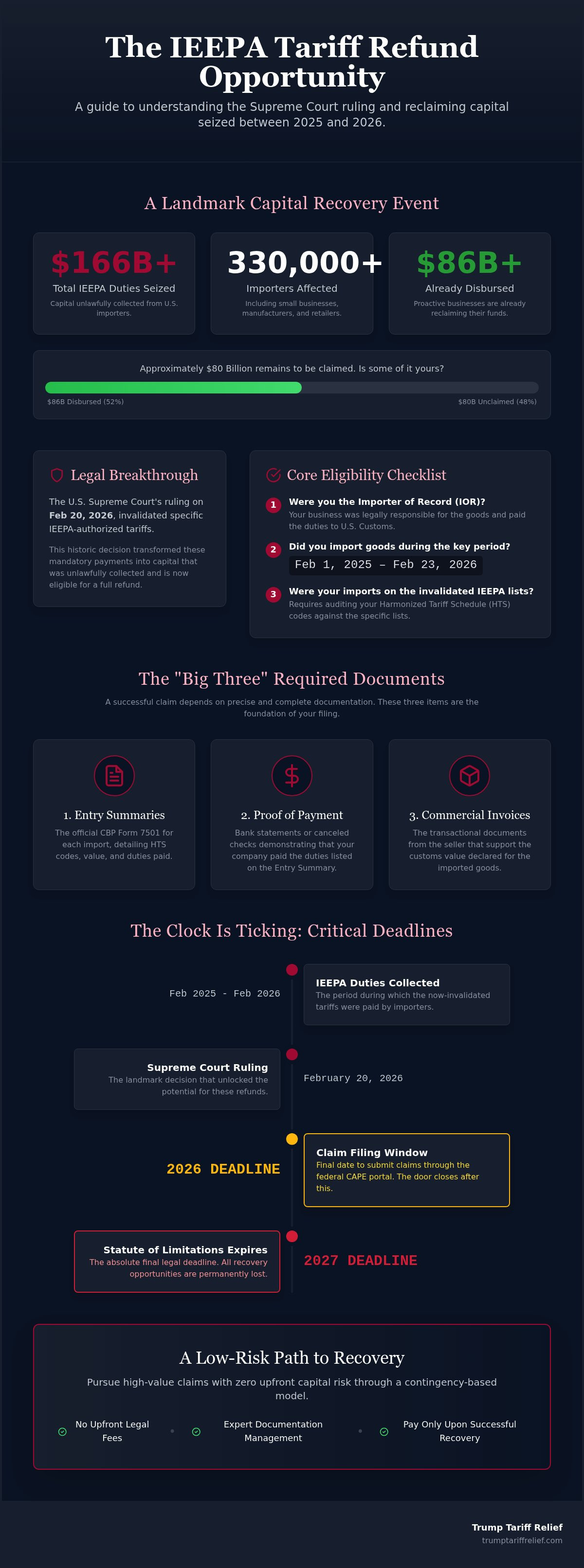
Over $166 billion in IEEPA duties were seized from more than 330,000 importers, yet a massive portion of that capital remains trapped in the federal CAPE system. You've likely realized that the Supreme Court's landmark ruling was only the first step; the real challenge lies in meeting the rigorous tariff refund claim requirements before the 2026 deadlines shut the door for good. It's exhausting to manage complex customs documentation while worrying about the financial risk of a failed filing or the burden of high legal fees.
We understand that your business shouldn't have to pay twice just to recover what's rightfully yours. This guide promises to strip away the complexity by providing a definitive checklist of the documentation and legal hurdles you'll face. You'll discover a low-risk path to recovery that bypasses the need for upfront capital, positioning you to reclaim your liquidity with confidence. We're going to detail the three phases of the CAPE system, the necessity of Court of International Trade orders for liquidated entries, and the exact steps to ensure your claim is processed before the 2027 statute of limitations expires.
Key Takeaways
- Understand the Supreme Court ruling that invalidated specific IEEPA-authorized duties, creating a rare opportunity to recover capital previously lost to federal tariffs.
- Learn the precise tariff refund claim requirements, focusing on the "Big Three" documents—Entry Summaries, Proof of Payment, and Commercial Invoices—required for a successful filing.
- Identify the strict 2026 and 2027 statute of limitations windows to ensure your claim is submitted before the federal portal closes or legal deadlines expire.
- Determine your eligibility by cross-referencing your manufacturing or retail operations with the specific IEEPA-authorized lists targeted for restoration.
- Discover how a contingency-based recovery model allows you to pursue high-value claims with zero upfront capital risk and expert documentation management.
The IEEPA Ruling: Why Your Tariff Refund Claim is Now Possible
On February 20, 2026, the U.S. Supreme Court delivered a decisive blow to executive overreach. The court ruled that the International Emergency Economic Powers Act (IEEPA) does not grant the president unilateral authority to impose broad import tariffs. For years, your business likely paid these duties under the assumption they were a mandatory cost of global trade. This ruling changes everything. It transforms those payments from a standard expense into capital that was unlawfully collected and is now eligible for recovery. It's a landmark victory for importers who have been waiting for a path to reclaim their liquidity.
The April 2026 launch of the federal CAPE system marked the beginning of a massive capital restoration effort. Since then, over $86 billion has already been disbursed to importers who acted quickly. However, the window isn't open indefinitely. Understanding the specific tariff refund claim requirements is the only way to ensure your business doesn't leave its liquidity in government hands. This isn't just a regulatory update; it's a critical opportunity to right a financial wrong that has strained supply chains since early 2025.
The Legal Foundation of IEEPA Claims
The legal path to recovery is distinct from previous trade litigation. While many importers are familiar with Section 301 duties, the IEEPA litigation focuses on the scope of emergency powers rather than trade practices. In July 2026, the Court of International Trade (CIT) issued specific orders to facilitate these refunds, even for entries that were finally liquidated more than 80 days ago. This distinction is vital. If your entries were previously considered closed by customs, they may now be eligible for reliquidation under these new court mandates. The IEEPA refund opportunity is a strictly time-sensitive window for capital restoration that requires immediate legal and administrative alignment.
The 2026 Federal Refund Portal
The Consolidated Administration and Processing of Entries (CAPE) system within the ACE portal has streamlined the process, but it hasn't removed the burden of proof. While the portal allows for electronic filing, it also enforces rigid data standards that can lead to immediate rejection if not handled precisely. To navigate this, you must secure verified tariff refund eligibility before you begin the submission process. Meeting the tariff refund claim requirements involves more than just logging into a portal; it requires a strategic audit of every entry filed between February 2025 and February 2026 to ensure no capital is left behind.
Core Eligibility: Who Can File a Tariff Refund Claim?
Eligibility for capital recovery is not restricted to a narrow niche of trade giants. If your business imported goods into the United States between February 1, 2025, and February 23, 2026, you likely paid duties that are now legally refundable. While the manufacturing and retail sectors were the most heavily impacted, the scope of the Supreme Court's ruling extends to any entity that served as the Importer of Record (IOR) during this high-stakes period. The IOR is the party legally responsible for ensuring goods comply with all customs regulations and, crucially, the party that paid the duties to U.S. Customs and Border Protection.
As detailed in the Congressional Research Service report on IEEPA, the expansive use of emergency powers affected a staggering array of consumer and industrial goods. Many small to mid-sized businesses mistakenly believe that these litigation-driven refunds are reserved for Fortune 500 corporations. This is a costly misconception. With over 330,000 importers identified as having paid these duties, the federal government is currently holding billions of dollars belonging to mid-market retailers, local distributors, and specialized manufacturers. If you paid the duty, you have a right to reclaim it.
HS Code and Tariff List Verification
Success in reclaiming your capital depends on precise technical identification. You must verify that your specific Harmonized Tariff Schedule (HTS) codes fall under the invalidated IEEPA lists. Auditing past entries is a fundamental part of the tariff refund claim requirements. You shouldn't assume your customs broker flagged every eligible entry; many imports were misclassified or overlooked during the chaotic initial rollout of these tariffs in early 2025. A thorough audit often reveals recovery opportunities that were previously hidden in complex entry summaries.
Non-Importer Eligibility and Supply Chain Rights
If you are a retailer who purchased goods under "Delivered Duty Paid" (DDP) terms, you were generally not the Importer of Record. In these cases, the legal right to the refund typically remains with the entity that actually disbursed the funds to CBP. However, the impact of supply chain contracts on these recovery rights can be complex. Reviewing these IEEPA explained nuances is vital for determining if your purchase agreements allow for a pass-through of recovered duties. If you're uncertain about your standing, you can request a preliminary eligibility assessment to clarify your path to recovery before the 2026 deadlines expire.
Essential Customs Documentation Management for 2026
Documentation is the single most common failure point for recovery attempts. While the legal victory is settled, the administrative burden is just beginning. U.S. Customs and Border Protection (CBP) requires an exact match between your submission and their internal database. If your data is "dirty"—containing typos, incorrect HTS codes, or mismatched values—your claim will be rejected without hesitation. Meeting the tariff refund claim requirements involves a meticulous reconciliation of your internal records against the federal Automated Commercial Environment (ACE) logs to ensure total alignment.
The "Big Three" documents form the backbone of every successful claim. Retrieving these files can be a logistical nightmare, especially for entries dating back to the February 2025 start of these duties. Many businesses have transitioned ERP systems or changed customs brokers in the intervening years, making the recovery of "clean" digital records a race against the 2026 portal deadlines. You must secure the following:
- CBP Form 7501 (Entry Summary): The verified record of your import and duty payment.
- Proof of Payment: ACH confirmations, wire transfers, or bank statements showing the disbursement to CBP.
- Commercial Invoices: Original documentation from the supplier that confirms the value and nature of the goods.
The Importer's Checklist: Required Forms
The CBP Form 7501 is the "birth certificate" of your claim. It contains the entry number, date of liquidation, and the specific IEEPA duty amount paid. For the 2026 portal, having these records in a structured digital format is essential for bulk filing. Manual entry for thousands of lines is not just inefficient; it's a recipe for clerical errors that trigger government audits. It's vital that required documents for IEEPA tariff refund must be audited for accuracy before submission to ensure every decimal point aligns with federal records.
Supply Chain and Contractual Proof
A significant gap in most recovery strategies is the failure to address contractual "rights of recovery." If you are a retailer or a claim purchaser, you must be prepared to prove "economic burden" if the government requests additional verification. This means demonstrating that your entity actually bore the financial weight of the tariff rather than passing it entirely to a downstream customer. You'll need a clear audit trail that links the original entry to your final payment ledger. Maintaining this level of detail for the duration of the multi-month claim process is a non-negotiable part of the tariff refund claim requirements. If you are unsure how your current contracts impact your standing, you can review how the recovery process works for complex supply chains.
Filing Requirements and the 2026 Statute of Limitations
Time is the most critical variable in your recovery strategy. While the 2026 federal portal has simplified the submission process, the underlying tariff refund claim requirements are governed by strict, unforgiving timelines. For entries made in early 2025, the two-year statute of limitations for filing litigation at the Court of International Trade (CIT) will begin to expire as early as February 2027. Waiting for a "universal" refund solution is a dangerous gamble. If your business hasn't initiated a claim before these individual deadlines pass, your right to recovery may be forfeited forever.
The submission process depends heavily on the status of your entries. If an entry is "unliquidated," it can often be processed directly through the CAPE system within the ACE portal. However, if your entries have already liquidated, you must navigate the "Protest" requirement. Importers generally have only 180 days from the date of liquidation to file a formal protest with CBP. For entries that are finally liquidated beyond that 180-day window, a court order from the CIT is now the only viable path to reliquidation and refund. This tiered system means your filing strategy must be tailored to the specific status of every entry summary in your history.
Navigating the 2026 Submission Window
The federal government rolled out the CAPE system in distinct phases to manage the volume of over 53 million affected entries. Phase 1 launched on April 20, 2026, targeting unliquidated entries. Phase 2 followed on June 29, 2026, expanding to include entries flagged for reconciliation. By late July 2026, Phase 3 became operational for finally liquidated entries, provided a CIT order is in place. Missing these specific operational milestones can delay your disbursement by months. You can visit our FAQ for detailed breakdowns of how these phases apply to different deadline scenarios.
Avoiding Common Filing Errors
The automated nature of the CAPE portal leaves zero room for clerical oversight. Incomplete filings or mathematical errors in duty calculations are the primary triggers for government audits and immediate claim rejections. CBP will not correct your mistakes; they will simply deny the request. This is why tariff refund statute of limitations knowledge combined with audit-ready data is the most important requirement for your CFO. To ensure your documentation meets the tariff refund claim requirements without the risk of audit, you should start the recovery process with a professional eligibility audit today.
Maximizing Recovery: The Case for Specialized Consultancy
The administrative burden of these filings is immense. Many businesses consider a "Do It Yourself" approach to save on fees, but this often results in leaving significant capital on the table. Internal teams, while capable, rarely possess the specialized legal and trade expertise required to navigate the federal CAPE system's nuances. A single clerical error or a failure to properly link an entry to a CIT order can lead to an immediate rejection. When you consider that over $166 billion was collected, the stakes are too high for a trial-and-error strategy. Professional intervention ensures that every eligible dollar is identified and reclaimed through a process that satisfies all tariff refund claim requirements.
Trump Tariff Relief operates as a high-performing partner, taking on the heavy lifting so your team can focus on core operations. Our "we-do-the-work" narrative isn't just a slogan; it's a commitment to managing the entire lifecycle of your claim, from the initial data scrape to the final ACH disbursement. By positioning ourselves as the active engine of your recovery, we remove the friction of bureaucratic navigation and ensure that your business isn't penalized for the government's previous overreach.
The Zero-Risk Contingency Model
Traditional legal and consulting firms often demand high hourly rates or upfront retainers, creating a financial barrier for businesses already strained by the original tariff payments. Our model is different. We operate on a contingency-fee basis, meaning there are no upfront costs and no billing for hours spent on unsuccessful filings. This success-based structure aligns our interests perfectly with yours. We're motivated to maximize your recovery because our compensation depends on your win. It's a low-risk, high-reward partnership that allows you to pursue your capital without any impact on your current cash flow. You can learn how it works to see how we manage the end-to-end process with zero financial risk to your business.
Securing Expert Audit and Filing
A professional audit goes beyond simply listing known entries. Our team identifies "hidden" recovery opportunities that internal audits often overlook, such as misclassified HTS codes or entries flagged for reconciliation that are now eligible under Phase 2 of the federal rollout. When the government issues pushback or requests additional evidence of economic burden, we handle the response with the authority of seasoned trade experts. Meeting the tariff refund claim requirements is only the baseline; our goal is to exceed it by ensuring your filing is bulletproof against federal scrutiny. Secure your financial restoration by starting your preliminary eligibility assessment today.
Secure Your Financial Restoration Before the 2026 Deadlines
The window to reclaim your unlawfully collected capital is narrowing. With the federal CAPE system now in its final phases, your ability to satisfy the rigid tariff refund claim requirements hinges on immediate, accurate action. You've seen how the Supreme Court ruling invalidated these duties; however, that victory only matters if you can produce an audit-ready trail of Entry Summaries and proof of payment before the statute of limitations expires in early 2027.
Don't let the complexity of customs bureaucracy prevent you from righting this financial wrong. Our team offers specialized expertise in managing the entire documentation lifecycle on a contingency-fee basis, meaning you only pay when we successfully recover your capital. We handle the heavy lifting of government audits and CIT orders so your business can remain focused on growth. Start Your Free Eligibility Assessment Now to identify every dollar you're owed. Your liquidity belongs in your accounts, not the government's. It's time to reclaim what is rightfully yours.
Frequently Asked Questions
What are the primary IEEPA tariff refund claim requirements for 2026?
The primary tariff refund claim requirements involve verifying your status as the Importer of Record for goods entered between February 2025 and February 2026. You must provide a CBP Form 7501, proof of payment, and commercial invoices that align with federal ACE portal records. These documents are essential for validation within the CAPE system. Failing to meet these data standards results in immediate rejection, making a professional eligibility audit the safest first step for recovery.
Is there a deadline for filing an IEEPA tariff refund claim?
Yes, the timelines are strict and unforgiving. For finally liquidated entries, you must file a lawsuit at the Court of International Trade within two years of the duty deposit date. Some of these deadlines expire as early as February 2027. If your entry was liquidated within the last 180 days, you may still file a protest with CBP. Missing these windows means forfeiting your right to reclaim capital that was unlawfully collected by the government.
Which documents do I need to prove my eligibility for a refund?
You need the "Big Three" documents: the CBP Form 7501 Entry Summary, proof of duty payment such as ACH confirmations, and the original commercial invoices. These records serve as the legal proof of your claim. Because the federal portal uses automated validation, every decimal point on your forms must match the government's internal data. Retrieving these files from previous years or defunct ERP systems is often the most time consuming part of the process.
Can small businesses file for a tariff refund, or is it only for large importers?
Any business that served as the Importer of Record and paid the duties is eligible, regardless of size. Over 330,000 importers are affected. Small to mid-sized retailers and manufacturers often have significant capital waiting in the CAPE system. You don't need a massive legal department to file; specialized consultancy allows smaller firms to leverage the same recovery mechanisms used by Fortune 500 corporations without the burden of upfront legal costs.
What happens if I don't have all my original customs entry summaries?
Missing records can be retrieved through the ACE Secure Data Portal, but the process is technically demanding. If you cannot produce a clean audit trail, your claim will likely fail government scrutiny. Securing these "birth certificates" for your entries is a core part of the tariff refund claim requirements. Our team manages this documentation retrieval process on your behalf, ensuring that your submission is complete and audit-ready before it reaches the federal portal for review.
How long does the government take to process a tariff refund claim in 2026?
While the government has already disbursed over $86 billion as of August 2026, individual processing times depend on the complexity of your entries. Phase 1 claims for unliquidated entries move the fastest, while Phase 3 claims requiring court orders take longer. All payments are issued electronically via ACH. Because the government will not issue paper checks, having verified bank information on file within the ACE portal is a non-negotiable requirement for a successful disbursement.
Do I have to pay upfront fees to start a tariff recovery claim?
You do not pay any upfront costs or hourly fees when working with Trump Tariff Relief. We operate strictly on a contingency-fee basis, which means our interests are perfectly aligned with yours. We take on the financial risk of the audit and filing process, and we're only compensated once your business successfully receives its refund. This model allows you to pursue your capital without any impact on your current operational budget or cash flow.
Can I claim a refund for tariffs paid on Section 301 China lists?
This recovery path is specifically for duties collected under the International Emergency Economic Powers Act (IEEPA), which the Supreme Court ruled unauthorized in February 2026. Section 301 China tariffs are governed by different legal precedents and are not currently eligible under the CAPE refund system. It's vital to distinguish between these duty types to ensure your filing is accurate. We provide a preliminary assessment to verify which of your specific imports fall under the valid IEEPA recovery lists.
Ready to find out what your business may be owed?
Check My Eligibility