
Did you know that an estimated $166 billion in unlawfully collected duties is currently sitting in government accounts, waiting for businesses to demand its return? For years, companies have watched their margins erode under the weight of trade penalties that legal experts argue exceeded executive authority. If your capital is currently tied up in these accounts, you aren't alone in feeling that the administrative maze of Customs and Border Protection makes recovery feel impossible. It's natural to fear that a filing might trigger an audit or simply consume more resources than it's worth.
The reality is that the benefits of claiming IEEPA tariff refund payouts in 2026 go far beyond a simple check in the mail. This guide explains how you can reclaim your share of that massive recovery pool and transform stagnant duties into immediate working capital. We'll show you how a contingency-based approach removes the financial risk, allowing you to correct historical financial records and secure a liquidity injection. You'll discover a streamlined path to navigate the Court of International Trade without the typical bureaucratic headaches, ensuring your business finally gets what it's owed.
Key Takeaways
- Identify the legal precedents that unlocked a $166 billion recovery pool, allowing businesses to reclaim duties seized under executive overreach.
- Analyze the strategic benefits of claiming IEEPA tariff refund payouts to immediately inject liquidity and restore historical profit margins.
- Avoid the common documentation pitfalls within the CBP Automated Processing Engine (CAPE) that lead to the automatic liquidation or denial of claims.
- Recognize the urgent 2026 deadlines and legislative threats like the RELIEF Act that could permanently divert your eligible funds.
- Leverage a risk-free, contingency-based partnership to manage the complex filing process without incurring upfront legal or consulting fees.
The $166 Billion Opportunity: Why IEEPA Refunds are a Reality in 2026
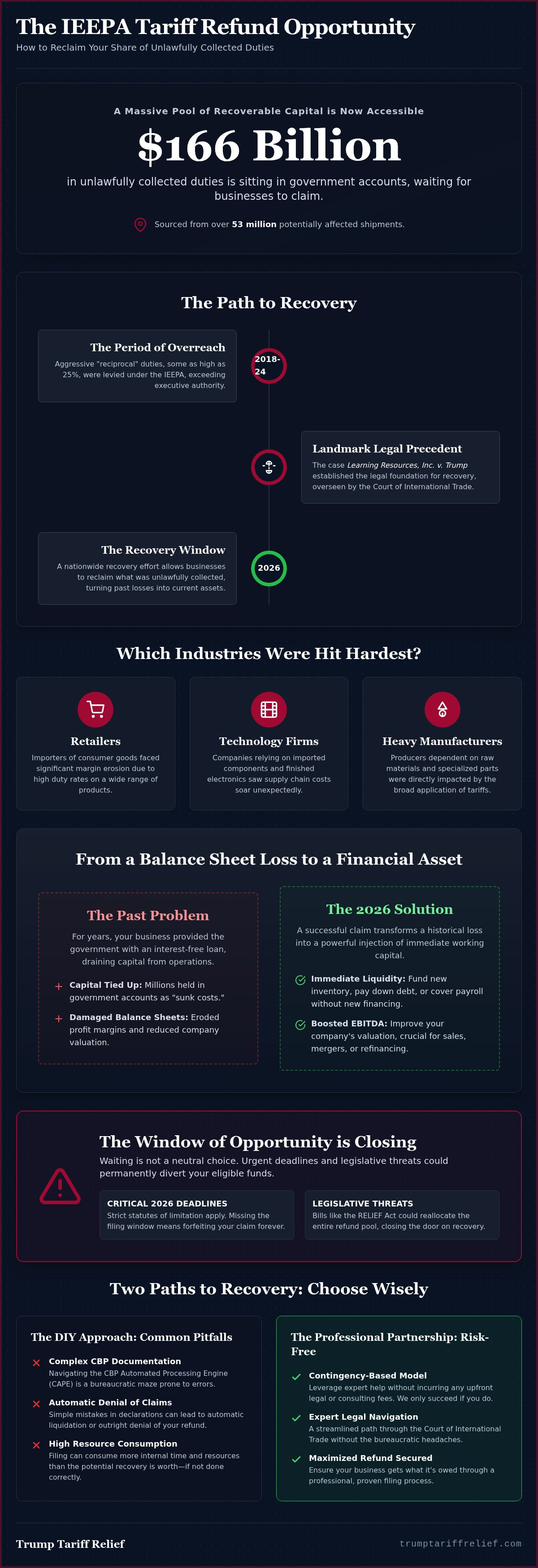
The trade landscape shifted permanently when the judiciary challenged the expansive use of the International Emergency Economic Powers Act (IEEPA). Originally designed as a tool for national security emergencies, this act became the cornerstone for aggressive trade duties between 2018 and 2024. Today, in 2026, the scale of this financial correction is staggering. With over 53 million shipments potentially affected, the pool of recoverable duties has reached an estimated $166 billion. This isn't just a legal theory; it's a massive redistribution of capital back to the importers who kept the economy moving. The Court of International Trade (CIT) now oversees a nationwide recovery effort that allows businesses to reclaim what was unlawfully seized during years of trade volatility.
The Legal Precedent for Recovery
The catalyst for this recovery was the landmark case Learning Resources, Inc. v. Trump. This litigation exposed a critical flaw in how duties were levied, proving that the executive branch exceeded its statutory authority. Judge Richard K. Eaton played a pivotal role in this correction, directing Customs and Border Protection (CBP) to halt these specific collections and process returns for those who filed on time. For a detailed breakdown of the legal mechanics, you can review our IEEPA Explained resource. This judicial intervention transformed these payments from mandatory costs into refundable assets. It's a rare moment of accountability where the legal system provides a direct path to financial restoration.
Who Qualifies for the Refund Pool?
Not every tariff is eligible, but the sectors hit hardest by "reciprocal" duties have the most to gain. Retailers, technology firms, and heavy manufacturers often find that their 2018-2024 imports fall directly under the IEEPA umbrella. One of the primary benefits of claiming IEEPA tariff refund payouts is the ability to repair balance sheets that were damaged by 25% duty rates. Eligibility depends on the specific statutory codes used at the time of entry. Because the requirements are technical, conducting a Tariff Refund Assessment is the only way to confirm your standing in the recovery pool. If your business imported goods during the period of executive overreach, you're likely sitting on a significant amount of tied-up capital that can be unlocked through a professional filing.
Direct Financial Benefits: Why Your Business Cannot Afford to Wait
For years, your company effectively provided the government with a massive, interest-free loan. Every duty payment made under the 2018-2024 trade mandates represented capital pulled directly from your operational engine. In 2026, the opportunity to call that debt due has arrived. Waiting to file isn't just a neutral choice; it's a decision to let your hard earned capital sit in a government account while your business faces the inflationary pressures of the current market.
Reclaiming Working Capital
One of the primary benefits of claiming IEEPA tariff refund payouts is the immediate injection of liquidity into your business. For mid-sized manufacturers, where cash flow is the lifeblood of production, reclaiming these "sunk costs" can be the difference between stagnation and scaling. Reciprocal tariffs are specific trade duties imposed in direct response to foreign trade actions, often exceeding the statutory limits of executive authority. When you successfully challenge these duties, you transform a historical loss into accessible working capital that can be used to pay down debt, cover payroll, or fund new inventory without high-interest financing.
The legislative history and legal challenges surrounding these tariffs prove that importers have a legitimate, superior claim to these funds. Beyond simple cash flow, a successful recovery directly impacts your EBITDA. By moving these funds from the loss column to the asset column, you're boosting your company's valuation and improving your debt-to-equity ratio. This shift is critical for any firm considering a sale, merger, or refinancing in the near future. To understand the mechanics of this recovery, you can explore how it works within the current regulatory framework.
Strategic Reinvestment Opportunities
Recovered duties provide a unique "second chance" for strategic reinvestment. Many businesses use these funds to diversify their supply chains, moving production to regions not affected by ongoing trade disputes. This proactive approach builds resilience against future geopolitical shifts. Additionally, correcting your historical financial statements to reflect the recovery provides a more accurate picture of your firm's profitability to stakeholders and lenders.
Taking action now also provides a distinct competitive advantage. While your rivals remain idle, overwhelmed by the perceived complexity of the filing process, your business gains the capital needed to invest in R&D or aggressive market expansion. This isn't just about getting your money back. It's about utilizing a risk-free recovery to outmaneuver your competition and secure your market position for the rest of the decade. The window for this financial restoration is closing, making immediate action the only logical business strategy.
Professional Recovery vs. DIY: Avoiding the CAPE Declaration Pitfalls
While the government portal might look accessible, the administrative burden of the CBP Automated Processing Engine (CAPE) is designed for precision, not ease. Attempting an internal filing often leads to missed opportunities because most corporate accounting systems aren't built to map historical trade data against the specific statutory authorities used during the 2018 to 2024 period. If your data mapping is off by even a few HTS codes, you risk leaving significant capital on the table. A professional assessment identifies every eligible shipment, even those hidden in complex supply chain records, to ensure your claim captures the full scope of your overpayments.
The Risks of Incomplete Documentation
A successful recovery hinges on the perfection of your records. The essential documentation for these filings includes highly specific entry summaries and commercial invoices that must match the government's digitized records exactly. Missing just one entry summary can invalidate a multi-million dollar claim, leading to immediate liquidation or denial by CBP. Beyond simple paperwork, you must also navigate a landscape filled with unverified emails and agency fraud warnings. Partnering with a vetted, high-performing consultancy ensures your claim is treated with the legitimacy it requires to pass federal scrutiny without the risk of administrative audits.
Why Expertise Matters in CIT Oversight
The Court of International Trade (CIT) maintains strict oversight of the refund process, which adds layers of complexity to every filing. Judge Eaton’s reporting requirements for CBP are nuanced, demanding that the agency provides regular updates on the status of pending refunds and specific justifications for delays. Navigating the "protest" and "liquidation" phases requires specialized insider knowledge that general legal teams or standard brokers rarely possess. One of the greatest benefits of claiming IEEPA tariff refund payouts through a specialist is the assurance that every technical hurdle is cleared before legal deadlines expire.
A professional partner takes on the heavy lifting of how it works, from initial eligibility assessment to the final government issuance. This allows your team to focus on core operations while we manage the bureaucratic risk. By choosing a contingency based model, you align our success with your own, ensuring a low risk path to financial restoration. We don't just file papers; we advocate for your right to reclaim capital that was unlawfully seized, providing a streamlined shortcut through a complex system.
The Closing Window: Legislative Threats to Your Refund
Time is no longer a neutral factor in your recovery strategy. As we move deeper into 2026, the opportunity to reclaim your capital is rapidly diminishing. The most significant threat to your balance sheet isn't the complexity of the filing, but the expiration of legal rights. Waiting to act means risking the permanent forfeiture of funds that belong to your business. Every day of delay is a day where the government’s obligation to pay potentially evaporates under the weight of statutory deadlines.
The Statute of Limitations Explained
Federal law imposes a strict 3 year window for challenging customs duties. This means that as we progress through 2026, older entries from the peak of the trade conflict are falling off the eligibility list forever. One of the key Tariff Refund Statute of Limitations rules involves the "liquidation" date of your entries. Once that window shuts, even the most compelling legal argument cannot force the government to issue a check. You can't afford to let these dates pass silently while your capital remains stagnant in a government account.
Legislative Risk Mitigation
Beyond the calendar, political shifts pose a direct threat to importer recoveries. The proposed RELIEF Act represents a coordinated push to divert the $166 billion refund pool away from businesses and toward general consumer rebates. State Attorneys General are actively lobbying for this change, arguing that the funds should be "returned to the people" rather than the importers who actually paid the duties. This legislative pressure aims to bypass the judicial rulings that favored businesses, creating a high-stakes race for your own money.
Filing your claim immediately serves as a critical defensive maneuver. By becoming an active litigant in the CIT pool, you "lock in" your legal standing. This status creates a protected interest that is much harder for new legislation to override retroactively. It ensures that your business is prioritized as an established claimant rather than a passive observer. To secure your place in the recovery queue, you should start your eligibility review before the legislative window closes.
The backlog at the Court of International Trade is another reason for urgency. With millions of shipments under review, the court typically operates on a first-come, first-served basis. Early filers avoid the administrative bottleneck that occurs when thousands of companies rush to file at the last possible second. One of the strategic benefits of claiming IEEPA tariff refund payouts right now is the certainty it provides. You aren't just seeking a refund; you're protecting your company's right to its own capital against a tide of political and administrative pressure.
Trump Tariff Relief: Risk-Free Recovery on a Contingency Basis
Securing a significant refund from the government shouldn't require your business to take on additional financial risk. While the administrative burden of the Court of International Trade can be daunting, the right partnership transforms this complexity into a streamlined capital recovery mission. We position ourselves as your high performing ally, taking on the heavy lifting of documentation and legal maneuvering so your team can remain focused on growth. By leveraging our specialized insider knowledge of Judge Eaton’s nationwide refund system, you gain a shortcut through the bureaucracy that most firms simply can't access on their own.
Our Contingency-Based Model
One of the most compelling benefits of claiming IEEPA tariff refund payouts through our firm is our total alignment with your success. We operate on a strict contingency basis, which means we absorb all upfront legal and administrative costs associated with your claim. If the government doesn't issue a refund check, you don't owe us a dime. This model removes the financial barriers that often prevent mid sized companies from challenging unlawful duties, ensuring that your pursuit of justice is entirely risk free. It's a no nonsense approach to business advocacy where our performance is the only metric that matters. For more details on how we structure our partnerships, you can visit our FAQ page.
We manage the entire lifecycle of your recovery, from the initial data mapping to the final issuance of funds. Our team understands the nuance of customs documentation management and the technical requirements of the CAPE system. We don't just file paperwork; we actively monitor the status of your entries to prevent the "liquidation" errors that frequently cause DIY claims to fail. This end to end oversight provides the professional confidence you need to correct your historical financial records without the fear of triggering an unnecessary administrative audit.
Start Your Eligibility Assessment Today
Submitting your entry data is the first step toward unlocking your tied up capital. Our streamlined assessment process is designed to identify eligible shipments with surgical precision, ensuring no recoverable duty is left behind. Given the legislative threats and the closing window of the statute of limitations in 2026, waiting even a few weeks could result in the permanent loss of your funds. It's critical to review the 2026 Guide to IEEPA Recovery to understand exactly how these deadlines apply to your specific industry and shipment history.
The path to financial restoration is direct and low friction when you have a seasoned mentor navigating the system for you. We take on the risk, the work, and the bureaucratic headaches so your business can enjoy the rewards of reclaimed liquidity. Don't let your hard earned capital remain in government accounts while the 2026 window shuts. You can get your free eligibility assessment now and begin the process of righting these historical financial wrongs.
Secure Your Capital Before the 2026 Window Closes
The opportunity to reclaim your share of the $166 billion recovery pool is a rare chance to correct historical financial records and inject immediate liquidity into your operations. By understanding the benefits of claiming IEEPA tariff refund payouts, you transition from a passive observer of trade volatility to an active architect of your company’s financial restoration. Legislative shifts and strict statutes of limitations threaten to permanently divert your funds; navigating the CAPE system requires a high-performing partner who manages the entire lifecycle of your claim with specialized insider knowledge.
Our contingency-based model ensures you pay nothing unless we secure your refund, providing a truly risk-free path to recovery. We handle the comprehensive documentation management and technical filing, allowing you to focus on your core business. Start your risk-free IEEPA refund assessment today and reclaim the capital your business is rightfully owed. Your financial restoration is within reach.
Frequently Asked Questions
What is the IEEPA tariff refund and why does it exist?
An IEEPA tariff refund is a recovery of duties paid under the International Emergency Economic Powers Act. It exists because the judiciary ruled that the executive branch overstepped its authority when imposing certain "reciprocal" tariffs between 2018 and 2024. One of the primary benefits of claiming IEEPA tariff refund payouts is the opportunity to reclaim these unlawfully seized duties and restore your company’s historical profit margins through a court-mandated recovery process.
How do I know if my company is eligible for an IEEPA refund?
Your company is likely eligible if you imported goods under specific HTS codes subject to trade penalties during the 2018 to 2024 window. Sectors like manufacturing, technology, and retail were hit hardest by these duties. Because eligibility depends on the precise statutory authority used at the time of entry, we recommend a professional Tariff Eligibility Assessment to map your historical data against the Court of International Trade requirements.
What is the deadline for filing an IEEPA tariff refund claim in 2026?
The deadline for filing is dictated by a strict three year statute of limitations from the date your entries were liquidated by Customs and Border Protection. In 2026, this means that entries from 2023 are rapidly reaching their expiration dates. Once this window closes, your legal right to reclaim those specific duties is permanently forfeited, making immediate action a critical requirement for any business seeking to secure its capital.
Is the IEEPA tariff refund different from Section 301 China tariffs?
Yes, these are distinct legal categories. While Section 301 tariffs focus on trade investigations related to China, IEEPA tariffs were imposed under different emergency economic authorities. Only duties specifically levied under the IEEPA framework are currently part of this $166 billion recovery pool. Understanding the technical distinction between these authorities is essential for ensuring your claim is filed correctly and isn't rejected by the Court of International Trade.
How long does it take to receive a refund once the claim is filed?
The processing time generally depends on the current backlog at the Court of International Trade and the speed of CBP’s administrative processing. While timelines can vary, most businesses can expect the process to take several months to over a year. Filing your claim as early as possible in 2026 ensures you're positioned higher in the nationwide queue, protecting you from the administrative bottlenecks that occur as deadlines approach.
Can I file for an IEEPA refund myself through the ACE portal?
While the ACE portal is accessible to importers, the complexity of the CAPE declaration process makes DIY filing highly risky. Minor errors in data mapping or documentation frequently lead to immediate claim liquidation or denial. Professional Customs Documentation Management ensures that every entry summary is perfect, providing a low-friction path to recovery that minimizes the risk of administrative audits or the permanent loss of eligible funds.
What happens if the government passes the RELIEF Act?
The RELIEF Act is proposed legislation designed to divert these duty refunds away from importers and toward general consumer rebates. If this act passes, it could significantly complicate or even block your ability to reclaim your capital. Filing your claim now establishes you as an active litigant in the CIT pool, which helps "lock in" your legal standing and protects your financial interest against future retroactive legislative shifts.
Why does Trump Tariff Relief use a contingency-fee model?
We use a contingency fee model to remove all financial risk for our clients and align our interests with your recovery. This means we take on all the upfront legal and administrative costs, and we only get paid when the government issues your refund check. It's a high performing partnership that allows you to pursue the benefits of claiming IEEPA tariff refund payouts without any out of pocket expenses or hourly billing.
Ready to find out what your business may be owed?
Check My Eligibility