The tariff refund for industrial chemical importers generally turns on which entity served as the Importer of Record. U.S. Customs and Border Protection has begun accepting claims for duties paid under the specified IEEPA tariffs while they were in effect in 2025 through early 2026, plus interest. If your company imported the chemicals directly, its entry records are central to assessing eligibility.
That can leave manufacturers and distributors with a difficult question: how should they discuss a potential refund when tariff costs were built into supplier prices, but they were not the Importer of Record? The key is to distinguish an indirect cost impact from the party that may pursue a refund.
This guide explains how to assess eligibility, how ACE and CAPE fit into the claims process, and what importers can tell customers without presenting a potential recovery as money already secured. It also covers the records and filing considerations that shape the next steps.
Key Takeaways
- Identify which entity acted as Importer of Record to understand who may pursue a refund.
- Learn how ACE and CAPE fit into the claims process and why accurate entry data matters.
- See which customs records help connect chemical imports to duties paid and potential claims.
- Communicate clearly with customers by distinguishing a possible refund from a recovery that has been approved.
IEEPA tariff refund eligibility
Eligibility depends on whether an entry includes covered IEEPA duties and which entity was the Importer of Record. For chemical importers, product origin and the tariff program recorded in customs documents help distinguish potentially refundable duties from other charges.
Eligibility for Chemical Import Duties
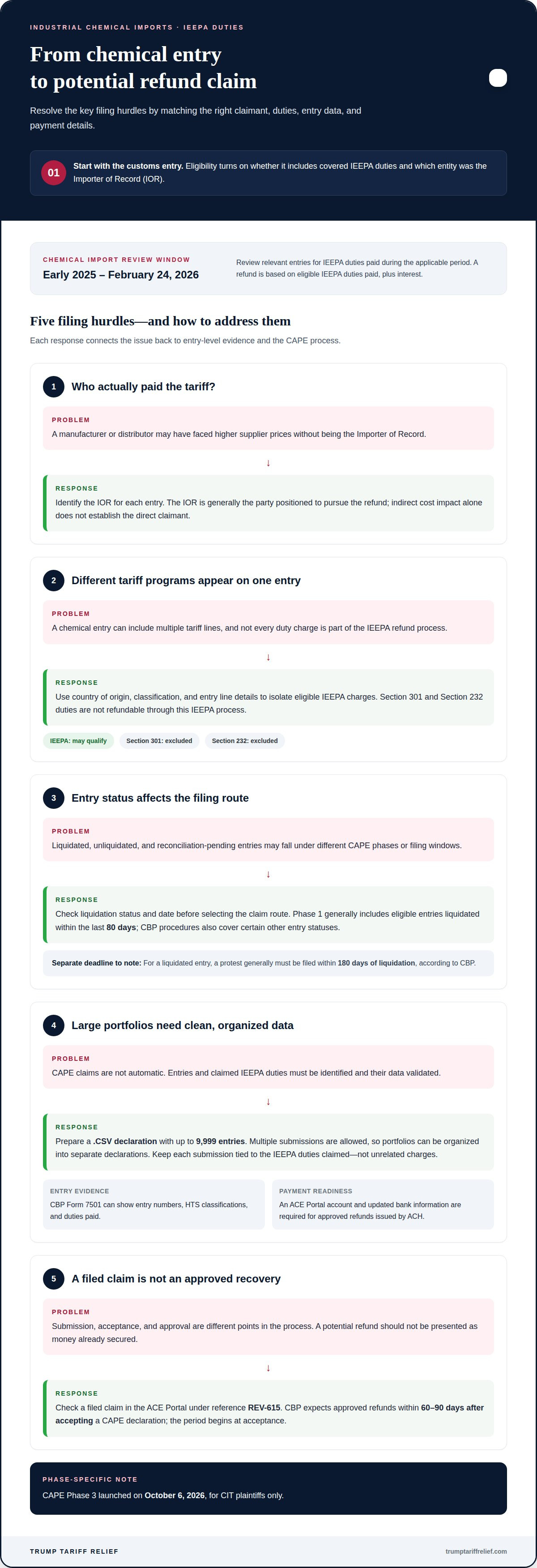
IEEPA eligibility concerns duties imposed under the International Emergency Economic Powers Act, not every duty assessed on a chemical shipment. The relevant window for chemical imports runs from early 2025 through February 24, 2026. The Importer of Record is generally the party positioned to claim a refund, so manufacturers paying higher supplier prices may not be the direct claimant.
Industrial chemicals, organic compounds, specialty chemicals, and related products classified under HTS chapters 28-38 may warrant entry-level review. A customs broker can help identify the Importer of Record, but the entry and duty details determine whether IEEPA charges were paid.
Separating IEEPA Duties from Other Tariffs
IEEPA duties must be separated from tariffs imposed under other authorities because a refund claim does not recover every charge on an entry. Section 301 and Section 232 duties are not refundable through the IEEPA process. Country of origin and classification help explain why one chemical entry can include multiple tariff lines.
Can importers recover Section 301, Section 232, or IEEPA tariffs? IEEPA duties may qualify; Section 301 and Section 232 duties do not qualify for this refund. The February 20, 2026 Supreme Court ruling struck down sweeping IEEPA tariffs, but does not turn separate tariff programs into refundable charges.
CBP’s CAPE system is the channel for eligible IEEPA refund claims. Refunds are not automatic: entries must be identified and their data validated. For a liquidated entry, a protest generally must be filed within 180 days of liquidation, according to U.S. Customs and Border Protection. A CAPE claim may also require accurate entry details and payment information.
How are refunds calculated? The recovery is based on eligible IEEPA duties paid, plus interest; other tariff charges are excluded. What risks and timelines matter? Costs depend on the procedural route and representation, while drawback claims must be filed within 5 years of import and can take 12 to 24 months to process. CBP’s rollout of CAPE has also affected the timing of immediate refund claims, so entry status and filing deadlines matter.
Filing refund claims through ACE and CAPE
CBP processes eligible IEEPA refund claims through CAPE, the Consolidated Administration and Processing of Entries system. Filing depends on matching each entry to the applicable phase and providing accurate entry data. Because the process is not automatic, potentially eligible chemical shipments must be identified and included correctly.
Phase 1 generally includes eligible entries liquidated within the last 80 days. CBP procedures also cover certain unliquidated entries, entries within applicable liquidation windows, and some entries awaiting reconciliation of final tariff calculations. A finally liquidated entry has been reviewed and finalized by CBP; an unliquidated entry remains open. How does liquidation status affect eligibility? Its status and liquidation date help determine which CAPE phase or filing window applies, and whether a separate deadline may matter.
A CAPE declaration must use a .CSV file and may include up to 9,999 entries. Filers may make multiple submissions, allowing large import portfolios to be organized into separate declarations. CBP has also expanded the portal to process entries awaiting reconciliation of final tariff calculations. Each submission should connect entry data to the IEEPA duties claimed, rather than mixing in unrelated charges.
After submission, businesses can check a filed claim’s status in the ACE Portal under reference REV-615. CBP’s CAPE system is designed to consolidate refunds and distribute approved amounts electronically to designated bank accounts. Approved refunds are expected within 60 to 90 days after CBP accepts a CAPE declaration. That period begins at acceptance, not simply when a company starts preparing its filing.
Phase timing matters for finally liquidated entries: CAPE Phase 3 launched October 6, 2026, for CIT plaintiffs only. If entry dates, liquidation status, or reconciliation details complicate a portfolio, a structured CAPE refund filing process can help connect the records to the correct claim route.
What should importers of record do to get a refund?
Build the claim around the customs entry, the Importer of Record, and the duties paid. Accurate records link the chemical shipment to the refund request and its payment details.
Reviewing Customs Entry Records
Reviewing customs entry records means matching each shipment’s entry details with its declared classification and duty payments. CBP Form 7501, the Entry Summary, can show entry numbers, HTS classifications, and duties paid. Those fields help distinguish IEEPA charges from other duties and connect the claim to the correct import. If several chemicals appear on an entry, use its line-level details to track the charges tied to each product.
Supporting Documentation and Recordkeeping
Supporting documentation is the set of customs and business records that substantiates the entry and refund request. Keep the Entry Summary alongside available import records, duty payment details, and documents that explain product classification or origin. Consistent references across those records make discrepancies easier to identify. CBP Form 4811 can designate another party to receive a refund, so the refund instructions should match the intended recipient.
CBP requires an ACE Portal account and updated bank information for approved refunds issued by ACH. These electronic payment details are part of claim readiness, not proof of eligibility. The Importer of Record or an authorized customs broker generally manages the refund process. A manufacturer that bought chemicals from a supplier may not be the direct claimant.
Preparing and Reconciling Refund Records
Before filing, compare each claim entry with the underlying customs records. Match entry numbers, HTS classifications, and duties paid, then separate IEEPA amounts from other tariff lines. Resolve inconsistent identifiers or duty totals before submission, since mismatches can make it harder to connect the requested refund to the entry.
For a portfolio of chemical shipments, organize records by entry and maintain a clear trail from the Entry Summary to the claimed amount. Customs Documentation Management can help organize and reconcile documents for a refund filing. Accurate recipient and bank details also help align the claim with CBP’s electronic refund process.
Customer communications about refunds
Refund communications should distinguish tariff costs your company absorbed from refunds the Importer of Record may claim. A manufacturer that paid higher supplier prices does not automatically receive money from U.S. Customs and Border Protection. Explain this distinction before discussing customer credits, price adjustments, or reimbursement expectations, so a potential recovery is not mistaken for funds already received.
Describe the claim’s actual stage in plain language. For example, “we’re assessing entries for IEEPA duties” means eligibility review is underway, not that a claim has been filed. “A claim has been submitted” means filing has taken place, while “CBP approved a refund” means approval has occurred. Keep these statements distinct in customer updates, sales discussions, and internal manufacturing forecasts.
Explain the legal change without overstating its effect. The Supreme Court ruling addressed tariffs imposed under the International Emergency Economic Powers Act; it didn’t convert every customs duty into a refundable charge. If an entry also includes Section 301 or Section 232 duties, clarify that those are separate tariff programs. Customers need to know which charges relate to the IEEPA claim and which do not.
For each update, identify the relevant entry or shipment, the party pursuing the claim, and the current action. If liquidation or reconciliation affects timing, describe that procedural status rather than promising a payment date. Keep supporting records consistent with customer-facing explanations, including the duties claimed and any refund amount approved by CBP. Separate estimates from confirmed figures in invoices and account statements.
Set a clear policy for any customer credit: explain whether it depends on funds actually received, how the amount will be calculated, and when you will provide the next update. Do not present a supplier’s potential recovery as a guaranteed customer benefit. A documented, consistent explanation can protect commercial relationships while claims move through CBP’s process. For help aligning entry records with a recovery claim, request a tariff refund assessment.
Trump Tariff Relief: IEEPA Tariff Refund Recovery
Trump Tariff Relief helps businesses assess and pursue IEEPA tariff refunds, including cases where chemical entries, duty records, or Importer of Record details need careful review. Its Tariff Eligibility Assessment identifies potentially eligible duties, and Customs Documentation Management organizes records to support claims.
Consider IEEPA Tariff Refund Recovery if your business was the Importer of Record and needs help managing a refund claim. The service is contingency-based: there is no upfront cost, and payment is only a percentage of what is recovered. A business that absorbed tariff costs indirectly should distinguish that supplier impact from the importer’s claim.
Contact Trump Tariff Relief to discuss your entries and refund situation.
Turn a potential recovery into a sound business decision
Next, bring your trade, finance, and customer-facing teams onto the same page. A tariff refund for industrial chemical importers is not only a customs matter; it can affect forecasts, supplier discussions, and decisions about customer credits. A consistent internal view helps your business respond as the claim progresses without making commitments based on assumptions.
Use the claim’s documented status to guide financial planning and customer updates. The potential recovery and outcome depend on eligible entries, supporting records, and CBP processing. Tie decisions to the evidence, and revise forecasts when the underlying facts change.
For support assessing your next step, contact Trump Tariff Relief. A clear, evidence-led approach can help your team move forward with confidence.
Frequently Asked Questions
What are the timelines for requesting a tariff refund?
A tariff refund for industrial chemical importers depends on entry status, liquidation date, and the applicable filing route. Phase 1 generally covers eligible entries liquidated within the last 80 days, while approved CAPE refunds are expected within 60 to 90 days after CBP accepts a declaration. A separate protest deadline may apply to liquidated entries, so track each entry’s dates rather than relying on one timeline for an entire shipment portfolio.
What if the tariff was passed through by a supplier?
If a supplier included tariff costs in its price, your business may have borne the cost without being the Importer of Record. Refund claims generally belong to the Importer of Record, not automatically to the manufacturer or distributor that paid a higher invoice. Review the import arrangement and purchase documents to identify who imported the goods and who should discuss any recovered funds with affected customers.
Will tariffs be refunded under the latest U.S. trade policies?
Only eligible duties imposed under the specified IEEPA tariffs are covered by this refund process. The February 20, 2026 Supreme Court ruling struck down sweeping tariffs imposed under IEEPA, but it didn’t make other tariff programs refundable through the same process. CBP’s CAPE procedures determine how eligible entries are handled, and the entry’s duty lines remain central to the claim.
Which U.S. tariffs on industrial chemicals are eligible for refunds?
For a tariff refund for industrial chemical importers, potentially refundable charges are specified IEEPA duties paid on eligible chemical imports, including relevant entries from early 2025 through February 24, 2026. Section 301 and Section 232 duties are separate programs and aren’t refundable through the IEEPA claim process. An entry can contain multiple duty types, so its customs lines must be distinguished before estimating the IEEPA amount.
What is the process for filing a U.S. customs duty refund claim for chemical imports?
The Importer of Record or authorized filer identifies eligible entries, reconciles entry and duty data, and submits a CAPE declaration through CBP’s process. The declaration uses a .CSV file and can include up to 9,999 entries. An ACE Portal account and current bank details support electronic refund delivery. Organize the claim by entry, rather than treating all chemical imports as one undifferentiated amount.
What are the deadlines for protesting an import duty assessment or requesting a refund?
U.S. Customs and Border Protection states that importers generally have 180 days after liquidation to file a protest disputing a duty assessment. A Post-Summary Correction may be filed within 300 days of entry and at least 15 days before scheduled liquidation. These are different routes with different timing triggers; identify each entry’s status and dates before choosing the applicable filing path.
Ready to find out what your business may be owed?
Check My Eligibility