
A tariff refund is not the final step. Reconcile the payment with the entries it covers, preserve supporting records, and confirm that your ACE account and U.S. bank details are set up for electronic refunds. If you’re deciding what to do after receiving a tariff refund, check the amount and any applicable interest, then keep a clear audit trail. CBP sends refunds by ACH to enrolled recipients, so accurate banking information matters.
It’s reasonable to treat the deposit as the finish line after a lengthy recovery process. But a careful closeout helps your finance and customs records align, and makes it easier to address questions about the payment.
This article explains how to prepare for CBP review, understand ACE and ACH requirements, confirm the refund recipient, and review interest on refunded duties. It also covers which records to retain and how to reconcile the refund for your business records.
Key Takeaways
- Match the refund to the relevant entries and keep supporting customs and financial records organized for CBP review.
- U.S. Customs and Border Protection says importers should file protests within 180 days after initial liquidation to potentially delay final liquidation and preserve a refund claim.
- ACE enrollment and accurate ACH details matter: CBP doesn’t automatically fix incomplete banking or account setup.
- Confirm that the refund is directed to the eligible recipient and a U.S. bank account on file with CBP.
- Review how interest applies to refunded duties and how it should be reflected in your financial records.
Q: What other immediate action items are also required or best practice for tariff refunds?
After submitting through CAPE, keep the entry details, declaration, payment records, and CBP correspondence together. CAPE means Consolidated Administration and Processing of Entries. It is the channel for IEEPA tariff refund requests; Post Summary Corrections are not used for these refunds. An accepted declaration confirms receipt for processing, not CBP approval. Match each entry on the declaration with your customs and accounting records so any later review has a clear audit trail.
Who is eligible to receive a U.S. tariff refund? The Importer of Record that paid the IEEPA duties is generally the claimant; qualifying consignees who took ownership after customs clearance may also be eligible. CBP may issue payment to the Importer of Record or to a recipient designated on CBP Form 4811. An authorized broker that originally filed the entry can submit a CAPE claim, but that role does not automatically make the broker the refund recipient.
How long does CAPE refund processing take? CBP anticipated releasing CAPE refunds within 60-90 days after CAPE acceptance, unless compliance concerns require further review. Treat that estimate as a processing expectation, not proof of approval or a payment date. Track the filing status and retain notices so you can distinguish a submission under review from a completed refund.
Can I appeal or dispute a tariff refund decision, and what are the deadlines? U.S. Customs and Border Protection says importers should file protests within 180 days after initial liquidation to potentially delay final liquidation and preserve a refund claim. A lawsuit challenging a denied protest must be filed within 180 days after the denial, or within two years after the cause of action first accrues.
How can I verify that a tariff refund payment is legitimate? Compare the amount and recipient against your CAPE filing, CBP account records, and bank statement. Confirm that the deposit went to the Importer of Record or the party designated on Form 4811; don’t treat an accepted declaration alone as proof that CBP approved payment.
Can a tariff refund affect customs duties, fees, or other refunds? An IEEPA refund covers IEEPA duties, not Section 232, Section 301, Section 201, antidumping and countervailing duties, or most-favored-nation tariffs. Keep those entries separate in your reconciliation rather than combining unrelated duty adjustments.
What should I do if my tariff refund amount is incorrect or missing? Reconcile the CAPE declaration with entry-level duty records and identify the specific mismatch or omitted entry. Keep supporting documents and CBP notices, then use the relevant CAPE or protest process to address the discrepancy before a liquidation deadline passes.
Preparing for CBP review and electronic disbursement
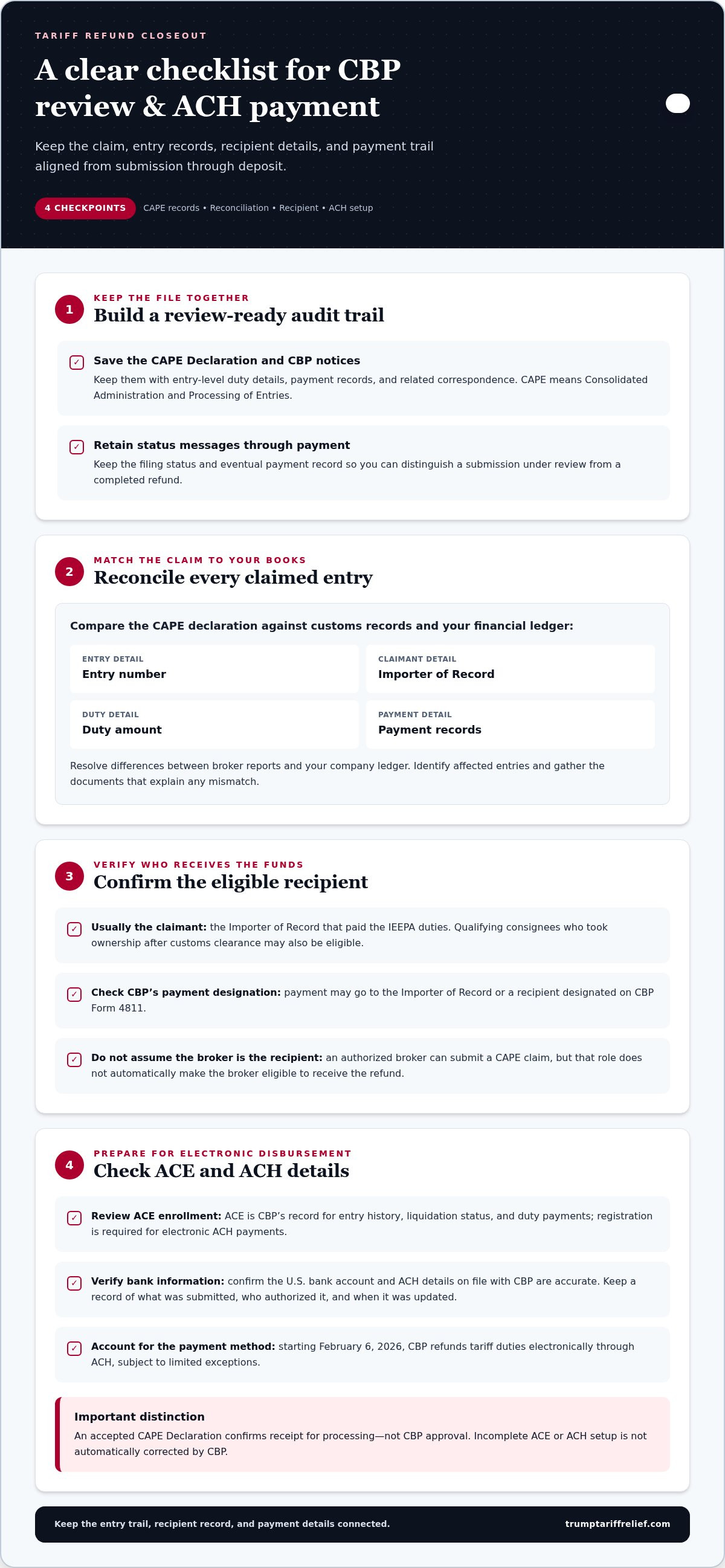
CBP uses CAPE to process IEEPA tariff refund claims, including duties imposed under the International Emergency Economic Powers Act. An accepted CAPE Declaration means the system received the submission, not that CBP approved the refund. Keep the declaration, entry-level duty details, and related correspondence together. These records help your business show how each claimed entry relates to the requested amount.
Before and after submission, reconcile CAPE entries with your customs records and financial ledger. Compare details such as the entry number, Importer of Record, duty amount, and payment records. If a broker report and your company ledger differ, resolve the discrepancy before relying on either as a complete audit trail. Clear documentation can help answer review questions and flag missing or inconsistent entry details.
Electronic delivery is part of the process, not an automatic correction service. Starting February 6, 2026, CBP refunds tariff duties electronically through ACH, subject to limited exceptions. CBP has transitioned to ACH disbursement for enrolled recipients. If your ACE or ACH setup is incomplete, CBP does not automatically fix banking issues. A claim can therefore face a payment obstacle even when the refund information is otherwise in order.
Prepare the recipient and payment details as carefully as the entry records. Confirm that the person or business receiving the funds matches the eligible recipient information in CBP’s records. Keep a record of the bank details submitted through ACE, who authorized them, and when they were updated. If a broker helped prepare the claim, document who handles the refund and who maintains the underlying entry evidence.
- Keep the CAPE Declaration and CBP notices with the supporting entry records.
- Reconcile claimed duties against customs records and the company ledger.
- Review the ACE enrollment and ACH details for accuracy before relying on electronic disbursement.
After submission, retain status messages and compare them with the eventual payment record. If CBP requests clarification, identify the affected entries first, then gather the documents that explain the discrepancy. Don’t treat acceptance as approval or assume an incomplete bank setup will resolve itself. These distinctions help businesses separate claim review from payment delivery.
For businesses organizing IEEPA claim records, the tariff refund recovery process shows how documentation supports the filing workflow.
Accessing ACE and enrolling for ACH refunds
The Automated Commercial Environment (ACE) is U.S. Customs and Border Protection’s official record for entry history, liquidation status, and duty payments. For an IEEPA tariff refund, ACE serves two purposes: importers can review customs records, and registration is required for electronic ACH payments. Importers who aren’t registered in ACE can’t receive CAPE refunds.
Start by confirming who in your business can access the ACE account and review its records. Compare entries connected to the refund claim with the importer’s customs and payment documentation. For example, if a broker’s entry report and the company ledger show different duty amounts, resolve the discrepancy before treating either record as complete. ACE records can help identify entries that need closer review.
ACE access and ACH enrollment are related, but serve different purposes. Access lets an importer review entry and duty information. ACH enrollment provides the electronic payment arrangement for refunds. Having one does not mean the other is complete. Confirm that your business can access its ACE account and that the refund recipient’s electronic payment details are enrolled.
- Confirm that the business can access its ACE account.
- Review ACE entry, liquidation, and duty-payment information against company records.
- Complete ACE registration and ACH enrollment before relying on an electronic refund.
- Keep a record of who manages account access and banking updates.
Plan ahead if the business needs a new account. Some importers have reported that setting up a new ACE account takes 3-4 weeks. That reported timeframe makes early preparation important, particularly when a CAPE filing is underway or refund processing is approaching. A customs broker may help with entry records, but the importer remains responsible for ensuring it can receive its own refund through ACE enrollment.
Use ACE as a working record, not just a payment portal. Review the entry history supporting the IEEPA claim, identify records that need reconciliation, and keep relevant documentation together. If company personnel change, maintain access continuity so the person handling the refund can still review the account and payment setup. Clear responsibility for ACE access helps prevent an avoidable break between claim review and ACH disbursement.
These checks connect account access with entry processing and the eventual refund payment. An importer enrolled for electronic refunds can receive disbursement through ACH, while an importer not registered in ACE cannot receive the CAPE refund. Treat ACE setup as part of claim preparation, rather than a last-minute administrative task, to keep customs records and the payment path aligned.
Electronic refund payments and U.S. bank accounts
CBP issues tariff refunds electronically through Automated Clearing House (ACH), subject to limited exceptions, starting February 6, 2026. Its electronic payment program launched in the first quarter. For businesses, that makes the bank record part of refund administration and processing, not a task to postpone until after approval. A U.S. bank account must be on file with CBP before a tariff refund can be issued.
Connect the payment details to the eligible refund recipient. CBP may pay the Importer of Record or a party designated on CBP Form 4811. Compare the recipient recorded for the claim with the account information maintained in CBP’s system. If a broker or another representative helped prepare the filing, distinguish that filing role from the party entitled to receive the refund.
Use your ACE account to manage electronic refund enrollment and keep a record of the banking information submitted. Store the account details with the CAPE filing records, including who provided or authorized them. The CAPE portal handles IEEPA refund submissions, while ACE supports electronic payment enrollment. These functions are connected, but submitting an IEEPA claim does not itself put a U.S. bank account on file.
- Confirm the eligible payment recipient for the refund.
- Make sure a U.S. bank account is on file with CBP.
- Retain the enrollment record and related payment notices.
- Reconcile the eventual ACH deposit with the refund information.
These distinctions matter for claims tied to tariffs imposed under the International Emergency Economic Powers Act. After the Supreme Court ruled on February 20, 2026, that IEEPA does not authorize the president to impose tariffs, CBP established CAPE for related refund claims. The ruling concerns IEEPA tariffs; it does not make other customs duties part of the same refund. Keep the IEEPA claim and its payment records identifiable in your company’s books.
When the ACH deposit arrives, compare its amount and recipient with CBP notices and supporting entry records. Record the deposit separately from unrelated duty payments or refunds so your accounting team can trace it to the correct claim. If the payment doesn’t match available records, preserve the notice and identify the difference before adjusting the ledger. CBP does not charge a fee to process tariff refunds, so don’t treat a separate processing charge as a CBP refund fee.
Electronic payment depends on an accurately identified recipient and bank information on file. Keeping these records aligned helps businesses distinguish claim processing from successful disbursement and gives finance teams a clear basis for reconciling the refund.
Interest on refunded duties
A tariff refund may include interest on excess duty deposits, not just the underlying duties. Federal law, 19 U.S.C. § 1505(c), requires interest to accrue from the estimated-duty deposit until liquidation or reliquidation. For an IEEPA refund, that period connects the original payment to the entry’s customs resolution. The interest calculation therefore depends on the deposit and liquidation records tied to each entry.
The current interest rate on excess duty deposits is 6%. Apply that rate only to the relevant excess deposit and accrual period, rather than treating it as an annual return on the entire refund. For example, an importer reviewing several entries should separate each deposit and liquidation date. A combined CAPE payment can cover multiple entries, but the supporting records remain essential to understanding the interest component.
The U.S. Court of International Trade reported that interest on tariff overpayments was accruing at approximately $650 million per month. That figure describes interest across tariff overpayments, not the amount owed to an individual importer. Your company’s calculation turns on its own eligible deposits, entry records, and liquidation or reliquidation dates. Use the court-reported total as context, not as a per-claim estimate.
CBP’s CAPE refund process launched in phases to handle IEEPA claims. Keep your interest review connected to the entries submitted through that process. A useful reconciliation separates duty principal from interest, then compares both amounts with CBP’s payment records and your accounting ledger. If an entry’s status or dates differ across records, identify the mismatch before posting the payment as final.
- Match each claimed entry to its estimated-duty deposit record.
- Identify the liquidation or reliquidation date used for accrual.
- Separate refunded duties from interest in the reconciliation.
- Compare the recorded payment with CBP notices and company books.
For administration and finance teams, this review also supports accurate reporting of international trade costs. Keep the CAPE declaration, entry-level duty evidence, payment notice, and accounting entry together. This file helps explain how the refund process produced the recorded amount, especially when one payment covers multiple International Emergency Economic Powers Act entries. Assemble the records before closing the reconciliation so duty and interest remain traceable.
Interest is part of the recovery review, not an unrelated bonus. Comparing entries individually helps an importer assess whether the payment reflects the relevant deposits and timing. It also gives finance staff a clear record for explaining the refund in later customs, tax, or audit reviews.
Trump Tariff Relief: IEEPA Tariff Refund Recovery
Trump Tariff Relief supports businesses pursuing IEEPA tariff refunds through IEEPA Tariff Refund Recovery. Turn to this support when you need to assess whether your entries may qualify, organize supporting customs records, or manage the refund filing process. A Tariff Eligibility Assessment helps clarify which entries may fall within the IEEPA recovery process.
Customs Documentation Management helps organize entry records and duty-payment information into a usable claim file. This is useful when broker reports, internal accounting records, and customs documentation need to be reconciled before submission. The service focuses on IEEPA tariff recovery, not unrelated customs duties or ongoing brokerage.
Trump Tariff Relief works on a contingency-fee basis: there is no upfront cost, and payment is only a percentage of funds successfully recovered. Visit trumptariffrelief.com to discuss your tariff refund situation.
Turn Your Refund Into a Stronger Recovery Process
Knowing what to do after receiving a tariff refund means looking beyond the deposit. Build a clear record of how the recovery was assessed, documented, and accounted for. This can help your business make informed decisions about remaining IEEPA entries and keep customs documentation aligned with financial records.
Trump Tariff Relief offers IEEPA Tariff Refund Recovery for businesses pursuing eligible refunds, along with a Tariff Eligibility Assessment to evaluate potential claims. Its Customs Documentation Management helps organize the records that support recovery efforts. The next step depends on the status of your entries and whether your documentation supports the claim you want to pursue.
Move forward with a clear view of your recovery options. Discuss your IEEPA tariff refund needs with Trump Tariff Relief, and take the next step with confidence.
Frequently Asked Questions
How do I account for tariff refunds for federal income tax purposes?
Start by reviewing how your business treated the original duties for federal tax purposes. If they were included in inventory costs, compare the refund with the affected cost basis or cost of goods sold; if they were deducted as an expense, review that deduction. Keep refund principal separate from interest in your reconciliation. Give your tax preparer the original entry records, prior tax treatment, and refund statement so they can determine the appropriate reporting period and adjustment.
How exactly will the refund system work?
Importers submit IEEPA refund claims through CBP’s CAPE process, identifying eligible entries in a CAPE Declaration. The declaration is a claim submission, not evidence of final approval. After filing, follow the claim’s status and retain CBP notices or requests. If the payment later differs from the declaration, compare the affected entries and duty calculations individually rather than treating the total deposit as a complete explanation.
What steps should I take after receiving a tariff refund?
When deciding what to do after receiving a tariff refund, first match the deposit with its CBP payment notice and the entries covered by your claim. Record principal and interest separately, then reconcile the deposit with your accounting records. Keep the notice, claim details, and supporting entry documents together. If a business unit or supplier shared the original duty cost, review the relevant contract and internal records before deciding how to allocate the recovered amount.
Do I need to report a tariff refund as income or adjust my tax return?
Don’t assume the refund is automatically taxable income or automatically tax-free. Its accounting and tax treatment depends on whether the original duties reduced taxable income, remained in inventory costs, or affected cost of goods sold. Compare the refund with the original deduction and tax year, keeping interest separate from refunded duties. Give your tax preparer this reconciliation to determine whether a current-year entry or return adjustment is appropriate.
How should businesses record tariff refunds in their accounting and import records?
Create a traceable record linking the bank deposit with the CBP notice, CAPE claim, and individual import entries. In your accounting records, identify refunded duty principal separately from interest and note which inventory or expense accounts the original duties affected. Keep the declaration and entry-level supporting documents with the payment records. This lets finance staff explain the accounting entry later without relying on the bank deposit description alone.
How long do tariff refunds take, and how can I track them?
CBP anticipated releasing CAPE refunds within 60-90 days after acceptance, unless compliance concerns require further review. Acceptance does not establish that CBP approved the claim or issued payment. Track the filing through available CBP status information, retain notices, and compare each update with your CAPE submission. If the expected payment has not appeared, check whether the claim remains under review and whether the recipient’s payment records match the filing.
Are tariff refunds taxable under federal or state law?
Assess federal and state reporting separately, since treatment depends on how the original duties affected taxable income and the rules applicable to your business. Trace each refund to its original accounting treatment, and distinguish principal from interest. Keep the entry records, payment documentation, and related tax schedules together. If your business files in multiple states, evaluate the relevant state treatment rather than assuming one state’s approach applies everywhere.
Ready to find out what your business may be owed?
Check My Eligibility