
The professional you trust to clear your cargo through customs every day might actually be the biggest obstacle to reclaiming your share of the $166 billion in invalidated IEEPA tariffs. While your current partner is essential for logistics, the debate between a tariff refund consultant vs customs broker is about more than just filing paperwork; it's about specialized financial recovery versus routine compliance. With the U.S. Supreme Court's February 2026 ruling, the clock is ticking on a massive restoration opportunity that requires a specific set of legal and technical tools that standard brokers often lack.
You've likely felt the sting of these unlawful tariffs as a sunk cost for years, and the confusion surrounding the new CAPE system requirements only adds to the administrative burden. We recognize that you can't afford to miss the 180 day protest deadline or risk non-compliance with the latest CBP electronic filing rules. This article will show you how to distinguish between standard brokerage and specialized recovery to ensure you capture every dollar plus interest. You'll discover the critical differences in expertise and contingency models that will define your success in this high-stakes recovery window.
Key Takeaways
- Distinguish between daily import compliance and specialized forensic recovery to ensure your legal rights to IEEPA refunds are fully exercised.
- Analyze the tariff refund consultant vs customs broker dynamic to see why bandwidth constraints often prevent traditional brokers from handling complex retroactive claims.
- Determine how the contingency fee model eliminates upfront financial risk compared to the standard per-entry or hourly rates charged by logistics partners.
- Uncover the "liquidation hurdle" and why most brokers stop tracking entries exactly when they become eligible for recovery under the new 2026 rules.
- Learn how to streamline the entire documentation management process to secure your capital before the fleeting window of opportunity closes.
The Role of Compliance vs. The Power of Recovery
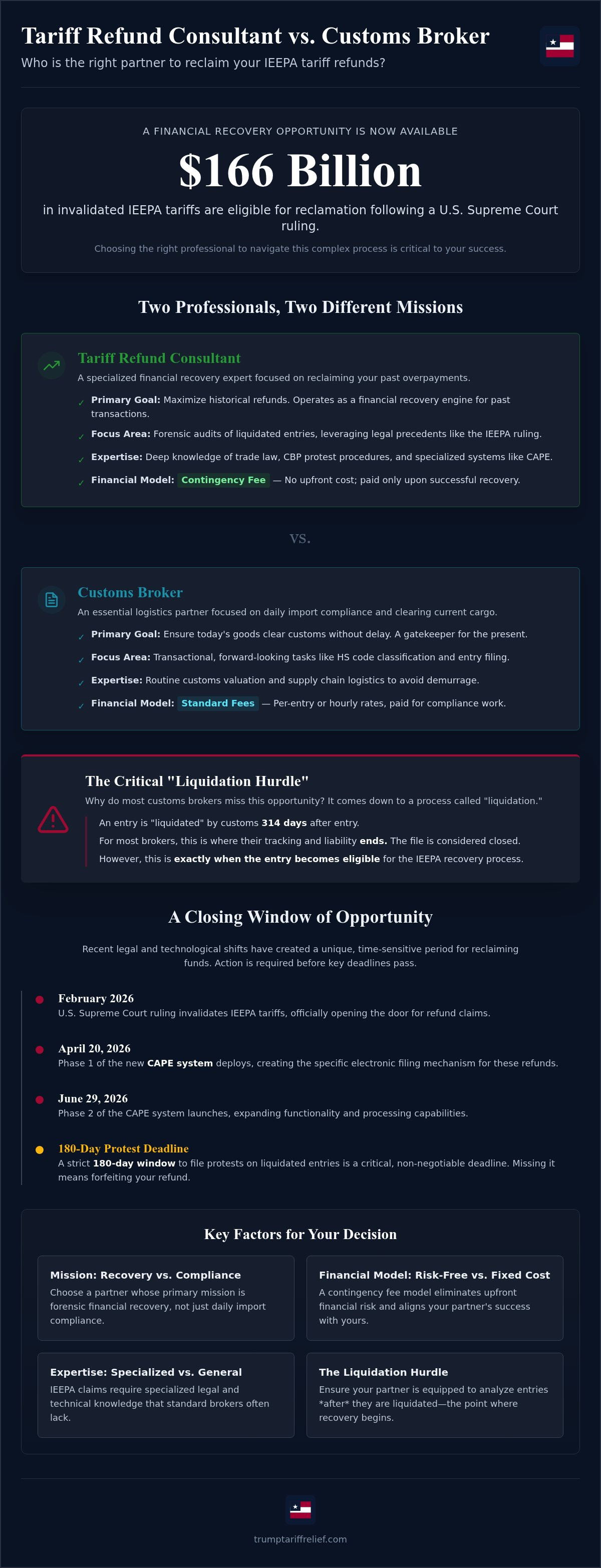
Importers often mistake a long-standing relationship with a logistics partner for a guarantee of financial recovery. This misconception can be costly. When evaluating a tariff refund consultant vs customs broker, you must understand that these professionals operate in entirely different spheres of trade. One is a gatekeeper for the present; the other is a recovery engine for the past. With approximately $166 billion in overpaid tariffs currently eligible for reclamation following the February 2026 Supreme Court ruling, the distinction has never been more critical for your bottom line.
A customs broker is an essential ally for your daily operations. Their primary mandate is to ensure your goods clear the port without delay, adhering to standard customs valuation procedures to keep the supply chain moving. In contrast, a tariff refund consultant focuses exclusively on forensic audits and the legal precedents that allow you to claw back capital you've already written off as a loss. The IEEPA ruling has created a unique, high-stakes recovery event that falls outside the scope of routine brokerage, requiring an aggressive, specialized approach to secure what is rightfully yours.
Customs Brokerage: Managing the Daily Flow
Your broker's world is transactional and forward-looking. They prioritize HS code classification accuracy and the immediate filing of entries to avoid expensive demurrage and supply chain bottlenecks. Because their business model relies on high-volume, repetitive tasks, they are rarely equipped to pause and perform a multi-year forensic deep dive into liquidated entries. For most brokers, once an entry clears and the fee is collected, the file is effectively closed. They are built for speed and compliance, not for the exhaustive litigation and documentation management required to challenge historical collections.
Tariff Recovery: Reclaiming Historical Capital
A tariff refund consultant operates as a specialized advocate, identifying eligibility that standard automated systems or busy brokerage departments often overlook. This process involves a meticulous review of past entries to identify those impacted by the IEEPA ruling. While your broker manages the "now," a consultant identifies the "then," uncovering opportunities to restore liquidity from years of unlawful tariff payments. This is not about clearing today's cargo; it's about righting a financial wrong through expert navigation of complex trade law.
The timeline for action is shrinking rapidly. The April 20, 2026, deployment of Phase 1 of the CAPE system within the ACE portal fundamentally changed the landscape for importers. This technological shift by CBP was the catalyst that moved IEEPA refunds from a legal theory into a functional reality. Because the CAPE system operates on strict phases, including the Phase 2 launch on June 29, 2026, and the upcoming Phase 3 in late July, you cannot afford to rely on a generalist. You need a partner who understands these specific electronic filing rules to ensure 100% compliance and maximum recovery.
Why Your Customs Broker Might Not Handle IEEPA Claims
While your current logistics partner is likely licensed by U.S. Customs and Border Protection, their operational infrastructure is rarely designed for the retroactive forensic audits required for IEEPA recovery. Most brokerage firms are built for high-volume, forward-facing transactions. They focus on clearing today's cargo to avoid supply chain delays. When you examine the tariff refund consultant vs customs broker dynamic, you'll find that the "Liquidation" hurdle is often where the relationship stalls. Once an entry is liquidated, typically 314 days after entry, most brokers stop tracking it entirely. Reopening those files requires a level of forensic dedication that standard brokerage software simply isn't configured to handle.
There's also a significant liability concern that keeps many brokers on the sidelines. Filing protests on old entries, especially those they didn't originally manage, creates a risk profile many firms aren't willing to accept. Because IEEPA refunds involve reclaiming capital from a pool of approximately $166 billion in overpaid tariffs, the documentation must be flawless. Standard systems are often incompatible with the new CAPE system within the ACE portal, which was specifically deployed in April 2026 to process these unique claims. Without specialized technology to map thousands of line-item entries to the new electronic filing rules, the administrative burden on a typical brokerage staff becomes insurmountable.
The Bandwidth Gap in Standard Brokerage
Your broker's priority is clearing your next shipment to avoid port storage fees. They don't have the idle hours required to manually review entries spanning several years for 330,000 potential importers. Recovering IEEPA funds is a high-intensity project, not a routine task. Each CAPE declaration can include up to 9,999 entries, and managing that volume requires a dedicated team that doesn't have to worry about clearing a ship at 3:00 AM. If your current partner hasn't proactively approached you about the 180 day protest deadline for liquidated entries, it's a clear sign they lack the bandwidth to protect your capital.
Legal and Technical Specialization
The nuances of the February 2026 Supreme Court ruling are distinct from standard Section 301 exclusions. Identifying eligibility requires more than just looking at a country of origin; it requires a deep dive into the specific legal precedents that invalidated these collections. Specialized consultants invest heavily in custom software designed to interface directly with the CAPE Phase 2 and Phase 3 modules. You can Learn how IEEPA works to see why a generalist might miss the subtle data points that qualify an entry for a 100% refund plus interest. To ensure you aren't leaving money on the table, consider a professional Tariff Eligibility Assessment to identify every recoverable dollar.
Consultant vs. Broker: A Side-by-Side Comparison
Choosing between a tariff refund consultant vs customs broker isn't about replacing your current logistics partner; it's about selecting the right tool for a high-stakes financial recovery. While your broker ensures your supply chain remains operational, a consultant ensures your overpaid capital is restored. The differences in their operational DNA become clear when you compare how they handle the IEEPA recovery process. The table below illustrates why a specialized approach is necessary for reclaiming funds from the $166 billion pool of invalidated tariffs.
| Feature | Customs Broker | Tariff Refund Consultant |
|---|---|---|
| Primary Focus | Daily cargo clearance and compliance. | Retroactive forensic recovery and litigation. |
| Fee Structure | Transactional (Per-entry or hourly). | Contingency (Success-based fee). |
| Audit Depth | Surface level for immediate filing. | Line-by-line forensic verification. |
| Risk Profile | Upfront costs regardless of outcome. | Zero financial risk to the importer. |
| Scope of Work | Current and future shipments. | Multi-year historical entry analysis. |
The most significant divergence is the fee model. Most brokers charge a flat fee per protest or an hourly rate for research. This means you pay even if the claim is denied. A consultant operates on a contingency basis, meaning they only receive a percentage of the actual refund check. This aligns their incentives perfectly with yours. They don't just file the form; they maximize the check amount by identifying every eligible line item across thousands of entries.
Operational Flow vs. Forensic Recovery
Brokers handle the "now," focusing on moving goods through the port. Their systems are optimized for speed, which often leads to surface-level data entry. Conversely, a consultant handles the "then." They conduct a deep dive into liquidated entries that your broker has likely archived. This forensic approach is essential because standard automated systems often overlook subtle eligibility markers in the IEEPA unlawful collection precedent. A consultant’s goal isn't just to complete a task; it's to secure a result. You can see our process in action to understand how this forensic depth translates into higher recovery totals.
The Advocacy Advantage
When a claim faces scrutiny or denial, the role of your partner shifts from administrator to advocate. According to the U.S. Customs and Border Protection, brokers are licensed to act as intermediaries, but their primary responsibility is often to the regulations themselves. A tariff refund consultant acts as a bold advocate for your business. They leverage industry-wide precedents and legal expertise to challenge CBP denials. If a claim is rejected, a broker may simply move on to the next shipment. A consultant fights because their success is tied directly to your recovery. They use their specialized knowledge of the February 2026 ruling to navigate the bureaucracy and ensure your business isn't left behind as the CAPE system phases close.
The Financial Case: Contingency Fees vs. Hourly Rates
When you weigh the merits of a tariff refund consultant vs customs broker, the most immediate impact on your balance sheet is the fee structure. Traditional brokers typically operate on a transactional basis, charging per entry, per protest, or by the hour. This creates an inherent financial risk for the importer. If U.S. Customs and Border Protection (CBP) denies a claim after months of administrative back-and-forth, you are still responsible for the broker's fees. In contrast, a specialized consultant operates on a contingency basis. This model ensures you only pay when the refund check actually arrives in your hands, transforming a potential legal expense into a risk-free pursuit of capital.
The contingency model aligns the consultant's incentives perfectly with your own. Because their compensation is a percentage of the recovered amount, they are motivated to identify every eligible line item and challenge every questionable denial. A broker charging a flat fee has little incentive to spend dozens of hours forensic auditing a single complex entry. They are paid for the filing, not the result. For a recovery event as massive as the $166 billion IEEPA invalidation, you need a partner whose success is inextricably linked to the total dollar amount restored to your accounts.
Eliminating the Financial Barrier to Entry
Many manufacturers and retailers hesitate to pursue historical refunds because they fear the upfront costs of legal research and documentation management. They worry that the administrative burden will cannibalize their current operational budgets. The contingency model removes this barrier entirely. It treats the recovery process as a performance-based partnership where the consultant takes on all the initial labor and risk. This allows your business to pursue "found money" without impacting your quarterly cash flow or requiring a dedicated line item for trade litigation.
Calculating the Value of Specialization
It is a common mistake to choose the lowest flat fee without considering the "leakage" of missed opportunities. An inexperienced filer might charge a small fee to process a claim but only capture 40% of the eligible entries due to a lack of specialized forensic software. In this scenario, a 20% contingency fee on a 100% recovery is far more valuable than a flat fee on a partial recovery. The hidden costs of denied claims or missed deadlines like the 180 day protest window are far greater than any success fee. To ensure you aren't leaving millions on the table, you should review our Tariff Refund Assessment: A Guide to IEEPA Eligibility to see the depth required for a full recovery.
The window to reclaim these funds is closing as the CAPE system moves through its final phases. Don't let administrative costs prevent you from reclaiming what is rightfully yours. You can start your IEEPA recovery assessment today with zero upfront cost and zero financial risk to your organization.
Secure Your Capital with Trump Tariff Relief
The distinction between a tariff refund consultant vs customs broker is no longer just a matter of professional preference; it's a matter of realized capital versus lost opportunity. With the April 2026 ACE deployment of the CAPE system now fully operational, the window for claiming your share of the $166 billion in invalidated IEEPA tariffs is rapidly narrowing. Trump Tariff Relief stands as the premier choice for manufacturers and retailers who require more than just a filing service. We are a specialized engine for financial restoration, built specifically to navigate the technicalities of the February 2026 Supreme Court ruling that traditional logistics partners often overlook.
Our firm takes on the heavy lifting so your internal staff can remain focused on your core business operations. We manage the exhaustive administrative burden of IEEPA Tariff Refund Recovery, from the initial forensic audit to the final electronic filing. Our 3-step onboarding process is designed for maximum efficiency and zero disruption to your daily workflow:
- Data Submission: You provide us with basic entry data for the impacted period.
- Forensic Assessment: Our team performs a line-by-line audit to identify every eligible dollar.
- Automated Recovery: We manage all Customs Documentation Management and file through the CAPE portal to secure your check.
The Trump Tariff Relief Advantage
We offer a national reach combined with deep, insider knowledge of the IEEPA ruling. Our team consists of legal experts and trade consultants who focus exclusively on recovery, not daily brokerage. This specialization allows us to identify eligibility markers that generalists miss, ensuring you don't fall victim to the strict 180 day protest deadlines. You can read more about these timelines in our guide on the Statute of Limitations: Critical Deadlines for IEEPA to understand the urgency of your situation.
Start Your Recovery Assessment Today
Preparing for your initial audit is simple. We only require access to your historical entry data to begin our preliminary eligibility check. This assessment is performed on a contingency basis, meaning there is no financial barrier to discovering exactly how much capital your business is owed. Because we only succeed when you recover your funds, our incentives are perfectly aligned with maximizing your total refund amount. Don't let your unlawful tariff payments remain a sunk cost. Get your IEEPA eligibility assessment now and reclaim the capital your business deserves before the 2026 deadlines pass.
Reclaim Your Capital Before the Window Closes
The distinction between a tariff refund consultant vs customs broker is the difference between maintaining status quo compliance and actively restoring your company's liquidity. While your broker is indispensable for today's shipments, only a specialist has the forensic tools and legal focus required to navigate the complex CAPE system phases. With billions in invalidated IEEPA tariffs waiting to be reclaimed, you cannot afford to let administrative inertia stand in the way of financial restoration.
Trump Tariff Relief provides a national service for all U.S. importers, acting as a bold advocate in a complex bureaucracy. Our specialized IEEPA recovery experts handle the entire documentation process on a contingency-based model. We only get paid if you do. This performance-based partnership ensures your recovery is handled with the urgency and precision it deserves. Don't leave your capital in the hands of the government when the path to recovery is clear and risk-free.
Claim your no-risk IEEPA refund assessment today
It's time to right this financial wrong and secure the funds your business is legally owed. We're ready to start the heavy lifting for you.
Frequently Asked Questions
Can I use both a customs broker and a tariff refund consultant?
Absolutely. Your customs broker remains your essential partner for daily logistics and clearing new cargo through the port. A tariff refund consultant works alongside them as a specialized recovery engine to audit past entries and reclaim capital from historical overpayments. This dual approach ensures you maintain your operational flow while maximizing your financial restoration from the $166 billion in overpaid tariffs.
Why hasn't my customs broker told me about the IEEPA refund?
Most brokers prioritize the immediate clearance of current shipments to avoid expensive port delays. They often lack the forensic software and dedicated legal teams required to monitor liquidated entries or the new CAPE portal requirements launched in April 2026. The debate of tariff refund consultant vs customs broker often comes down to bandwidth; brokers are built for volume, while consultants are built for recovery.
Is there an upfront cost to hire a tariff refund consultant?
No. Professional consultants operate on a contingency-fee basis. This means you don't pay any out-of-pocket costs for the initial audit or the complex filing process. You only pay a success fee after your refund check is secured. This model eliminates all financial risk for your organization and ensures the consultant is motivated to maximize your total recovery.
What is the deadline for filing an IEEPA tariff refund claim in 2026?
Deadlines vary depending on the status of each individual entry. For entries that have already liquidated, you must file a formal protest within 180 days of the liquidation date. Unliquidated entries are currently being processed through the CAPE system phases that began on April 20, 2026. Each day you wait increases the risk of an entry falling outside the statute of limitations.
Will filing for a refund trigger a CBP audit of my other entries?
Filing a CAPE Declaration is a standard administrative procedure established by CBP to comply with the February 2026 Supreme Court ruling. It's a targeted claim for specific overpaid tariffs, not a general invitation for a full-scale audit. Reclaiming your legally owed capital is a routine part of trade finance and is not considered a red flag by customs authorities.
How long does it take to receive the refund after the consultant files the claim?
Valid IEEPA refunds are typically issued within 60 to 90 days after the CAPE Declaration is accepted by CBP. This streamlined timeline is a direct result of the new ACE portal automation. While the forensic audit takes time to ensure 100% compliance, the actual repayment process is relatively fast once the documentation is successfully submitted.
Do I need to provide all my past entry records to the consultant?
Yes, providing access to your historical entry data is essential for a comprehensive forensic audit. However, the consultant handles the heavy lifting of organizing and mapping thousands of line items. They use specialized software to identify every eligible entry that your standard brokerage systems might have archived or overlooked once liquidation occurred.
What happens if my current customs broker made a mistake on the original entries?
Identifying and correcting historical filing errors is a core part of the recovery process. A specialized consultant's forensic audit often uncovers discrepancies in HS codes or valuation that were missed during the daily rush of port clearances. Correcting these mistakes is the first step toward maximizing your total refund amount and ensuring your historical data is fully compliant with the new 2026 rules.
Ready to find out what your business may be owed?
Check My Eligibility