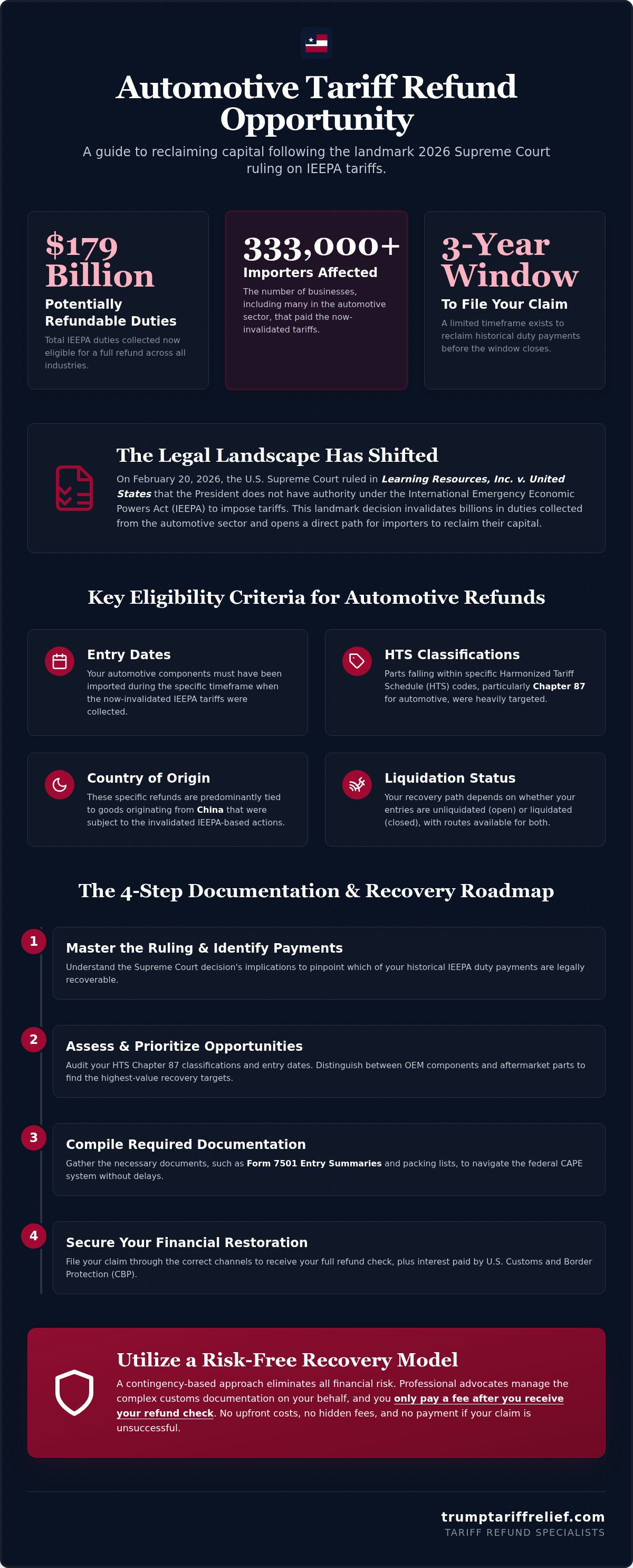
Did you know that an estimated $166 billion to $179 billion in IEEPA duties collected from over 333,000 importers is now potentially eligible for a full refund? Following the Supreme Court's February 2026 ruling that invalidated these tariffs, the window to reclaim your capital is officially open. You've likely spent years watching your profit margins shrink due to aggressive trade policies. Determining your specific tariff refund eligibility for automotive parts often feels like a losing battle against bureaucratic red tape and complex HTS codes.
We understand that the fear of missing strict filing deadlines or being buried in high legal fees keeps many automotive executives from taking action. This guide changes that. You'll discover exactly how to navigate the CAPE system phases to reclaim your historical duty payments using a risk-free, contingency-based model where you only pay when you receive your check. We'll preview the current CBP implementation phases and the precise steps required to secure the financial restoration your business deserves. It's time to stop letting the government hold your capital hostage and start the recovery process before the three-year window closes.
Key Takeaways
- Master the implications of the 2026 Supreme Court ruling to identify which of your historical IEEPA duty payments are now legally recoverable.
- Assess your tariff refund eligibility for automotive parts by auditing HTS Chapter 87 classifications and aligning your entry dates with current CBP refund phases.
- Distinguish between OEM components and aftermarket accessories to prioritize the highest-value recovery opportunities within your historical import data.
- Compile the necessary 7501 Entry Summaries and packing lists required to navigate the federal CAPE system without administrative delays.
- Utilize a contingency-based recovery model to eliminate financial risk while professional advocates manage the complex customs documentation on your behalf.
The IEEPA Ruling and Automotive Parts: A 2026 Overview
For years, the International Emergency Economic Powers Act (IEEPA) served as a primary mechanism for the executive branch to impose aggressive trade barriers. While intended for national emergencies, this authority was frequently used to bypass traditional legislative hurdles, resulting in billions of dollars in duties collected from the automotive sector. On February 20, 2026, the legal landscape shifted permanently. The U.S. Supreme Court ruled in Learning Resources, Inc. v. United States that the IEEPA does not grant the President the authority to impose tariffs. This landmark decision effectively invalidated billions in historical duty payments, creating an immediate path for importers to reclaim their capital.
The automotive industry bore the brunt of these now-defunct policies. Extensive duties on components ranging from steering systems to electrical harnesses were collected under the assumption of executive power that the Court has now found non-existent. As of July 2026, U.S. Customs and Border Protection (CBP) has launched the Consolidated Administration and Processing of Entries (CAPE) system to manage this massive refund effort. We're currently seeing a dual-track recovery process; while the Court of International Trade began issuing direct refund orders on July 15, 2026, for active litigants, other importers must navigate the specific CAPE phases to secure their checks.
Navigating the tariff refund eligibility for automotive parts requires a precise understanding of which entries fall under the invalidated IEEPA authority versus those still subject to Section 301 or Section 232. The historical context of these trade policies, often discussed in the context of Trump Tariff Relief, shows how these duties were leveraged to reshuffle global supply chains. Now, the focus has shifted from compliance to recovery.
Why Automotive Importers Are Primary Candidates
Automotive businesses are uniquely positioned for significant recoveries due to their high volume of imports from regions like China. Supply chains in this sector are notoriously complex, often involving thousands of individual HTS codes. This complexity frequently led to over-taxation during the IEEPA era. Specifically, parts falling within Chapter 87 of the Harmonized Tariff Schedule were heavily targeted. If your business imported OEM components or aftermarket parts that were flagged under IEEPA-based actions, you're likely sitting on a significant, uncollected asset.
The Financial Impact: Reclaiming Your Working Capital
Recovering these duties isn't just about administrative correction; it's about injecting liquidity back into your operations. With an estimated $166 billion to $179 billion in total duties eligible for refund across all industries, the capital available for automotive R&D and inventory expansion is staggering. It's also important to remember that CBP is required to pay interest on these successful claims, which can substantially increase the final check amount. You can learn more about IEEPA explained to see how these specific legal nuances affect your bottom line and why the time to file is right now.
Key Eligibility Criteria for Automotive Tariff Refunds
Determining your tariff refund eligibility for automotive parts requires a meticulous review of three primary variables: entry dates, HTS classifications, and liquidation status. The invalidated IEEPA tariffs targeted a specific timeframe where duties were collected under executive orders later found unconstitutional. If your automotive components were imported during this window, you're likely entitled to a full recovery of those specific duty payments. Country of Origin rules remain a strict gatekeeper; these particular refunds are largely tied to goods originating from China that were subjected to the invalidated IEEPA-based actions. Precise documentation is the only way to prove origin and secure your check.
The status of your entries, whether unliquidated or liquidated, determines your path through the CAPE system. Unliquidated entries are still "open" in the eyes of CBP, making them eligible for Phase 1 processing which began on April 20, 2026. Liquidated entries are more complex because they represent "closed" transactions. However, the July 15, 2026, Court of International Trade orders have started to clear the way for these older entries to be re-opened for refunding. Real-world legal challenges, such as The IEEPA Ruling and Automotive Parts litigation, highlight how even major manufacturers are fighting to claw back these funds through the judicial system.
The Importance of Proper HTS Classification
HTS Code Verification is the cornerstone of any successful claim. While Chapter 87 covers most vehicles and parts, many importers inadvertently classified components under general machinery (Chapter 84) or electrical equipment (Chapter 85) headings. These misclassifications can lead to missed opportunities or lower refund amounts. A comprehensive tariff audit is often necessary to re-verify these codes and maximize your recovery potential. Your specific HTS code is the single determining factor that dictates the exact percentage of your duty refund.
Reconciliation and Flagged Entries
If your automotive entries were "flagged for reconciliation," they fall into Phase 2 of the CBP rollout, which launched on June 29, 2026. These entries are prioritized because the importer and CBP already agreed that the final duty amount was subject to later adjustment. If your entries weren't flagged, you still have rights, but the documentation burden is higher. To ensure you aren't leaving capital on the table, you can request a preliminary assessment to verify your standing before the next filing deadline passes. Preserving your rights for non-flagged entries requires immediate action to prevent the statute of limitations from expiring.
Automotive Parts Categories: Assessing Your Recovery Potential
Recovery potential isn't uniform across the automotive sector. Your tariff refund eligibility for automotive parts depends heavily on whether your goods fell under List 3 or List 4a of the original trade actions. List 3 imports, which faced a 25% duty rate, represent the most significant recovery opportunities for importers of steering components, suspension systems, and braking assemblies. In contrast, List 4a items, which carried lower rates of 15% or 7.5%, require a higher volume of entries to justify the administrative effort. Understanding these distinctions is vital for prioritizing your claims within the CAPE system before the 2026 windows expire.
High-tech components and semiconductor-heavy assemblies, such as electronic control units (ECUs) and sensor arrays, often present the most complex recovery scenarios. These parts were frequently subjected to overlapping trade authorities, including Section 301 and the now-invalidated IEEPA duties. The IEEPA Tariff Ruling for the Automotive Industry clarifies that while some Section 301 duties remain, any portion of the tax collected under the specific IEEPA authority is now ripe for clawback. This creates a specific "righting a wrong" scenario for innovators who were penalized for importing advanced mobility technology. Reclaiming these funds allows businesses to reinvest in the very R&D that was previously stifled by over-taxation.
Collision and Body Parts: The ABPA Opportunity
Body panels, bumpers, and lighting assemblies are high-priority categories for recovery. These parts are typically imported in high volumes with relatively straightforward HTS classifications within Chapter 87. Importers of collision repair parts often face thin margins, making the recovery of historical duties a critical boost to working capital. You'll need to provide clear evidence of the import date and the specific IEEPA-linked duty paid. Review our guide on how to get money back from China tariffs for broader context on the recovery landscape.
OEM and Internal Components
Original Equipment Manufacturer (OEM) components like engine blocks and transmissions involve managing massive SKU counts. The challenge here lies in proving the country of origin for complex sub-assemblies containing parts from multiple regions. If a sub-assembly was classified under an IEEPA-targeted HTS code, the entire value may qualify for a refund. We've compiled a list of Frequently Asked Questions about eligibility to help you determine if your complex component imports qualify for this 2026 recovery window.
The Documentation Roadmap for Automotive Claims
Organizing a successful claim for automotive duties requires absolute precision. It's not enough to simply believe you qualify; you must prove it with a paper trail that satisfies the rigorous standards of U.S. Customs and Border Protection. The process begins with compiling every 7501 Entry Summary related to your imports. These summaries are the DNA of your transactions, containing the HTS codes and duty rates that establish your tariff refund eligibility for automotive parts. Once you've secured these, you must cross-reference them with commercial invoices and packing lists to verify the country of origin and confirm the parts imported were indeed those targeted by the invalidated IEEPA actions.
The next critical step involves securing concrete proof of duty payment. This typically requires pulling ACH records or monthly statements that show the funds were successfully transferred to the government. Without this, CBP will reject the claim regardless of its legal merit. After your data is organized, you'll need to prepare the formal refund application through the CAPE system or file a protest for entries that have already liquidated. Finally, you must monitor the claim as it moves through the processing phases. If you're struggling to manage this high-stakes administrative burden, you can partner with a specialized recovery expert to handle the heavy lifting on a contingency basis.
Avoiding Common Filing Mistakes
Incomplete documentation is the leading cause of claim rejection. If a single entry number is mistyped or an invoice is missing from the digital bundle, CBP will likely flag the entire submission for denial. Even more dangerous is missing the Tariff Refund Statute of Limitations for your older entries. Once these deadlines pass, your right to reclaim that capital is forfeited forever. The government won't grant extensions for administrative oversight, making immediate action a necessity for your bottom line.
The Role of ACE Reports in Eligibility Verification
The Automated Commercial Environment (ACE) is your most powerful asset for verification. Pulling comprehensive ACE reports allows you to identify liquidation dates across thousands of automotive entries in seconds. This data is essential for determining which entries belong in Phase 1 versus Phase 2 of the federal refund rollout. For a complete list of the data points you need to extract from your portal, refer to our Required Documents for IEEPA Tariff Refund guide. Using this technology correctly ensures no eligible entry is left behind.
Maximizing Your Recovery with Trump Tariff Relief
The complexity of securing a refund shouldn't be a barrier to reclaiming your capital. While previous sections of this guide outlined the technical hurdles of HTS codes and ACE reports, the reality for most automotive executives is a lack of bandwidth to manage such a massive undertaking. Trump Tariff Relief functions as your specialized advocate, navigating the bureaucracy of the CAPE system so your internal accounting team can remain focused on core operations. We don't just provide advice; we execute the entire recovery process, from the initial tariff refund eligibility for automotive parts assessment to the final management of customs documentation.
Our firm brings a seasoned, insider perspective to IEEPA litigation and automotive trade regulations. We understand that the "righting a wrong" narrative is more than just rhetoric; it's a financial necessity for businesses that were over-taxed during a period of executive overreach. By taking on the heavy lifting, we ensure that no eligible entry is overlooked due to administrative fatigue. The urgency of 2026 cannot be overstated. With the federal government now actively processing refunds through the CAPE system, the window to identify and file for your historical duty payments is rapidly narrowing. Waiting to act only increases the risk that your capital remains in the government's accounts instead of your own.
The Contingency Advantage for Importers
Traditional legal services often require high upfront retainers and hourly billing that can drain your budget before a single dollar is recovered. We've eliminated this financial barrier by utilizing a strictly contingency-based model. This means you pay nothing unless we successfully secure your refund check from the government. This approach aligns our success directly with the magnitude of your recovery, ensuring we fight for every possible cent. You can see how our process works to understand how we remove the risk and the cost of entry for automotive importers of all sizes.
Start Your Preliminary Eligibility Assessment Today
Beginning your recovery journey is a straightforward, no-nonsense process. You simply provide access to your basic import data, and our team performs a comprehensive audit to determine your tariff refund eligibility for automotive parts. During your initial consultation, we'll provide a transparent overview of your recovery potential and a clear timeline for the filing process. We handle the data extraction, the HTS verification, and the formal submission to CBP. The three-year statute of limitations for filing your claim is absolute and non-negotiable. Don't let administrative hesitation cost your business millions in legitimate refunds.
Secure Your Automotive Refund Before the 2026 Window Closes
The Supreme Court's decision to invalidate IEEPA tariffs has created a definitive window for your business to reclaim its lost capital. Success in this landscape depends on moving quickly to audit historical entries and verifying your tariff refund eligibility for automotive parts against the current CBP processing phases. You've already navigated the burden of over-taxation; you don't have to navigate the bureaucracy of recovery alone. By leveraging specialized HTS expertise and a direct approach to customs documentation, you can ensure no eligible dollar is left behind.
Our team manages the entire administrative burden, allowing you to focus on your core operations while we fight for your financial restoration. With our contingency-based model, there's no financial risk to your firm. We only win when you win. It's time to right this trade imbalance and inject liquidity back into your supply chain. Claim Your Risk-Free Automotive Eligibility Assessment today and let our experts secure the check your company is legally owed. This is your moment to reclaim what belongs to your business.
Frequently Asked Questions
Are automotive parts imported from China eligible for IEEPA refunds?
Yes, most automotive components originating from China that were subjected to duties under the International Emergency Economic Powers Act are eligible for recovery following the 2026 Supreme Court ruling. This includes a wide array of items from steering systems to body panels. You must distinguish between these invalidated IEEPA duties and Section 301 or Section 232 tariffs, which may still apply to the same goods depending on their specific classification.
What is the deadline to file for an automotive tariff refund in 2026?
The deadline to file depends on your entry's liquidation status, but the general window for IEEPA-related claims is tied to a three-year statute of limitations. Because the Supreme Court issued its landmark decision on February 20, 2026, importers should aim to complete their filings well before the expiration of this period. Missing this strict window results in a permanent forfeiture of your right to reclaim overpaid duties, as the government won't grant extensions for administrative delays.
Can I claim a refund if my automotive parts were already liquidated?
Yes, liquidated entries are eligible for recovery, though the process requires more rigorous documentation than unliquidated entries. Following the July 15, 2026, Court of International Trade orders, CBP has established pathways to re-open these closed transactions for refunding through the CAPE system. You'll need to provide specific evidence, such as 7501 Entry Summaries, to prove the original duty payment and establish tariff refund eligibility for automotive parts for these historical imports.
How much does it cost to hire a consultant for automotive tariff recovery?
Professional recovery services typically operate on a contingency-fee basis, which means there are no upfront costs or hourly legal fees for the importer. You only pay a percentage of the actual refund amount once you receive the check from the U.S. government. This model eliminates the financial risk for your business while ensuring that your advocates are highly motivated to maximize the total recovery of your historical duty payments.
What HTS codes are most commonly eligible for automotive refunds?
Automotive parts classified under Chapter 87 of the Harmonized Tariff Schedule (HTS) represent the highest volume of eligible entries. This includes bumpers, steering wheels, suspension systems, and braking components that were caught in the List 3 and List 4a IEEPA duty expansions. Additionally, some electronic components in Chapter 85 and mechanical assemblies in Chapter 84 may qualify if they were specifically targeted by the invalidated executive orders. Verifying your tariff refund eligibility for automotive parts requires a code-by-code audit of your import history.
How long does it take for the U.S. government to process an IEEPA refund?
Processing times vary based on the CAPE system phase, but Phase 1 entries began seeing action following the April 20, 2026, launch. While some court-ordered refunds for active litigants began moving in July 2026, general administrative claims may take several months to finalize. The speed of your refund often depends on the accuracy of your initial documentation and how quickly CBP can verify your data against their internal entry records.
Do I need my customs broker's permission to file a refund claim?
No, you don't need permission from your customs broker to pursue an IEEPA refund. As the importer of record, the legal right to reclaim these funds belongs entirely to your business. While brokers can provide the historical data you need, many importers choose to work with specialized recovery experts who focus exclusively on IEEPA litigation to ensure a more aggressive and thorough filing process than a standard brokerage might offer.
Is the IEEPA tariff refund program legitimate for small automotive businesses?
The program is entirely legitimate and applies to any importer of record regardless of company size. Over 333,000 importers are estimated to be eligible for a portion of the $166 billion to $179 billion in total available refunds. Small businesses often have the most to gain from reclaiming this working capital, as it provides an immediate cash injection to offset the high costs of inventory management and research and development.
Ready to find out what your business may be owed?
Check My Eligibility