
A tariff refund for solar panel importers hinges first on who can file and receive it. Only the Importer of Record or the licensed customs broker that filed the entries can submit a CAPE declaration. For IEEPA duties, CBP can issue a refund only to the Importer of Record or a Notify Party designated on CBP Form 4811, provided the recipient has U.S. bank account information in an ACE Portal account.
Importer status and entry records matter just as much as the tariff paid. A supplier, buyer, or other party that bore the economic cost may not be entitled to file or receive a refund, so contractual rights matter too. This guide explains how to assess those rights, how claim procedures relate to liquidation status, and how the details of tariff collection affect a filing. Understanding these factors can help you identify the right path for your entries without assuming every solar shipment qualifies on the same basis.
Key Takeaways
- Separate IEEPA refund claims from Section 201 safeguard tariffs; the tariff program determines which recovery route applies.
- Use each entry’s liquidation status and duty type to understand whether a CAPE declaration, Post Summary Correction, or protest is relevant.
- Account for interest and liquidation or reliquidation when assessing how a refund amount is calculated.
- Review contracts alongside customs records to understand how any recovered funds may be allocated between the importer and other parties.
Importer of record and contractual refund rights
Country of origin and circumvention findings can change which duties apply to solar products. In 2023, the U.S. Department of Commerce found some companies in Vietnam, Malaysia, Thailand, and Cambodia were circumventing duties on Chinese crystalline-silicon solar modules and cells. Covered products from those countries use Chinese wafers and more than two other Chinese-made components. CBP began collecting circumvention duties on covered solar products in June 2024.
A tariff refund for solar panel importers depends partly on who filed the entry. Only the Importer of Record or the licensed customs broker who filed the entry can submit a CAPE declaration. CBP can refund IEEPA duties only to the Importer of Record or a Notify Party designated on CBP Form 4811, provided the recipient has U.S. bank account information in an ACE Portal account.
That distinction matters when a shipment has several commercial parties. A manufacturer, distributor, or project owner may have reimbursed the importer for duties, but that payment alone doesn’t make the buyer the authorized CAPE filer. The entry identifies the Importer of Record; CBP Form 4811 identifies an eligible alternate refund recipient. For companies navigating complex international supply chains, working with trade compliance specialists like Global4PL can help ensure Importer of Record designations and customs documentation are structured correctly from the outset.
Contracts determine how parties allocate recovered funds. For a tariff refund for solar panel importers, review purchase terms, duty-reimbursement clauses, and any agreement assigning refund proceeds. For example, if a buyer reimbursed the importer, the contract may specify whether a later refund stays with the importer or goes back to the buyer. Compare the contract language with invoices and entry records.
Organize the review around three records:
- Entry documents: identify the Importer of Record, tariff treatment, and duties paid.
- CBP Form 4811 and ACE details: show an eligible Notify Party and U.S. bank information for payment.
- Commercial contracts: clarify how parties allocate duty costs and any recovery.
Keep customs eligibility separate from private allocation. First assess whether the entry and duty fit the claim process. Then determine who can file and who holds contractual rights to the proceeds.
Refund claims, protests, and liquidation status
The appropriate filing route depends on the duty type, entry date, and liquidation status. Identify the tariff program for each solar entry before pursuing recovery.
Recoverability of Solar Import Duties
Recoverability means identifying whether the specific duty paid has an available refund procedure. Section 201 safeguard tariffs and antidumping and countervailing duties are separate from IEEPA duties, so a CAPE declaration for IEEPA should not be treated as a universal solar tariff claim. The U.S. President placed Section 201 tariffs on imported crystalline-silicon solar cells and modules in 2018. Classify each duty before selecting a filing path.
Supporting Documents for Refund Claims
Supporting documents link the refund request to the shipment, duty payment, and amount claimed. Gather the entry summary, proof of duties paid, commercial invoice, and records showing the goods’ origin and components. For CAPE, the Importer of Record number and entry details help identify eligible entries. Contracts and payment records can also clarify who bore the tariff cost. Together, these records allow a reviewer to compare the claim with the underlying transaction.
Refund Calculations and Liquidation Adjustments
A refund calculation begins with the duties paid and the entry’s liquidation history. Interest is included in IEEPA duty refunds and generally runs from the deposit or estimated duty payment date to liquidation or reliquidation. During Phase 1, CBP accepts CAPE declarations for entries liquidated within the preceding 80 days. CBP generally expects valid IEEPA refunds within 60 - 90 days after accepting a declaration, unless further review is required.
Risks of Incorrect Refund Claims
An inaccurate claim can conflict with the entry record, invite added scrutiny, or delay resolution. Do not include duties from a different tariff program in an IEEPA declaration. Before filing, compare the entry summary, payment evidence, origin records, and calculation. Correct inconsistencies rather than relying on an unsupported amount. Since no specific penalty amount is established here, focus on accurate classification and complete supporting records.
To understand how the IEEPA route works, review the IEEPA refund process alongside the entry records.
Can importers recover Section 201 solar safeguard tariffs?
Recovery depends on the Section 201 duty shown on each entry and the basis for seeking repayment. A solar importer should distinguish safeguard duties from IEEPA duties, antidumping duties, and countervailing duties before evaluating a refund. Each category follows its own authority and claim considerations.
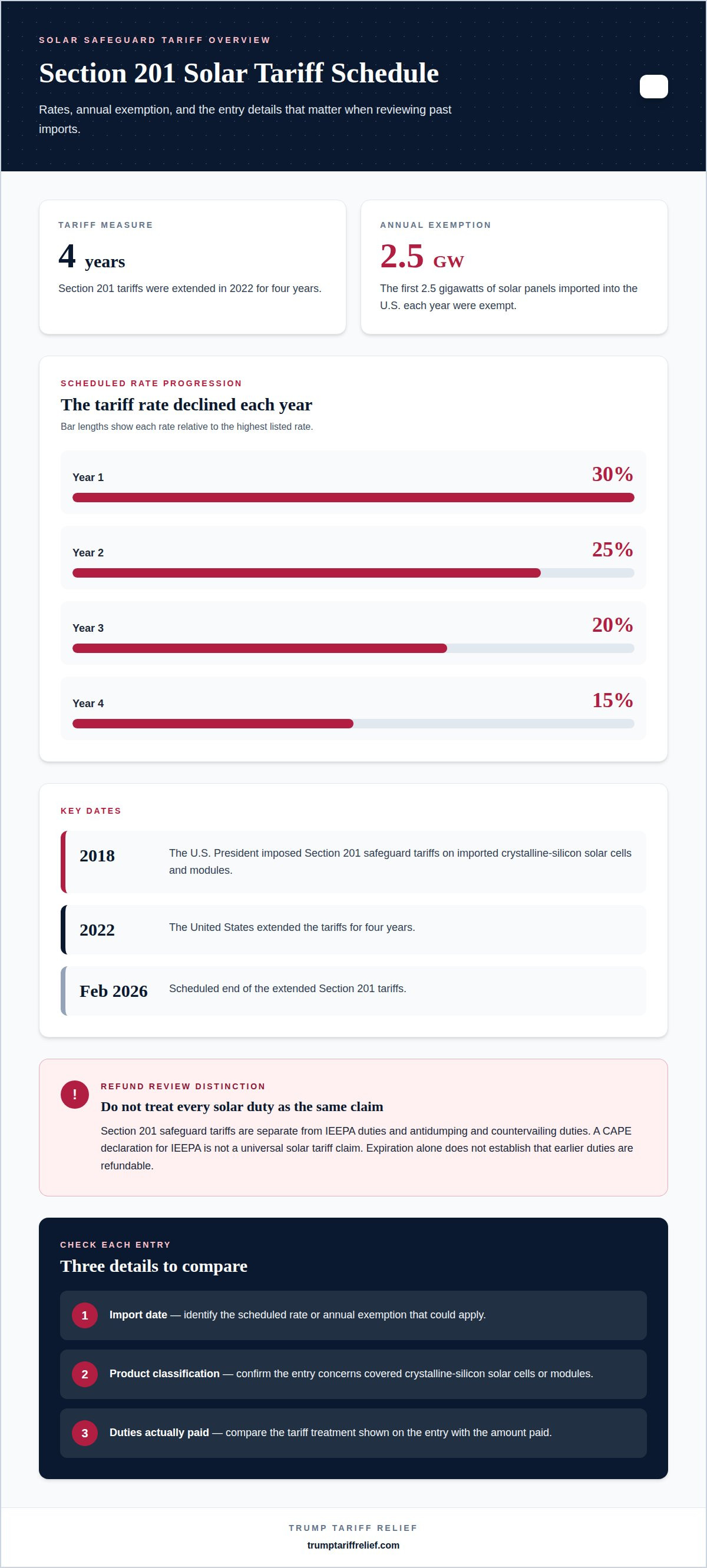
The U.S. President imposed Section 201 safeguard tariffs on imported crystalline-silicon solar cells and modules in 2018. The first-year tariff was 30 percent. The measure lasted four years, with rates of 25 percent in year two, 20 percent in year three, and 15 percent in year four. The first 2.5 gigawatts of solar panels imported into the United States each year were exempt.
In 2022, the United States extended Section 201 tariffs on imported crystalline-silicon solar cells and modules for four years. Those tariffs were scheduled to end in February 2026. The timeline matters because an entry’s import date determines which scheduled rate or annual exemption could apply. Compare the entry date, product classification, and duties actually paid against the applicable tariff treatment.
Expiration alone does not establish that duties paid on an earlier entry are refundable. A claim review must identify a specific reason for recovery, such as a potential mismatch between the entry’s treatment and the applicable rate or exemption. For example, an importer reviewing panels within the annual 2.5-gigawatt exemption must connect the entry to the relevant exemption treatment, rather than assume that all imports qualify.
- Identify the duty: separate Section 201 from IEEPA and trade-remedy duties.
- Match the entry: compare its import date, product, and tariff paid with the applicable schedule.
- Review exemptions: determine whether the annual 2.5-gigawatt allowance applied to the entry.
These records help establish whether a Section 201 refund question exists, but they do not make CAPE an all-purpose remedy. CAPE concerns IEEPA refunds; solar safeguard duties require a separate analysis of the underlying entry and applicable tariff treatment.
How are solar tariff refunds calculated, including interest and liquidation adjustments?
Start with the duties recorded for each solar entry, then separate the tariff type. An IEEPA refund calculation concerns IEEPA duties, not automatically Section 201 safeguards or antidumping and countervailing duties. Entry-level records show the amount deposited and the liquidation status used to assess the claim. Combining different tariff programs can distort the amount sought.
For IEEPA duty refunds, interest is included. It generally runs from the date of deposit or estimated duty payment to the entry’s liquidation or reliquidation date. The relevant dates therefore belong to each entry, not simply to the shipment’s arrival or the preparation of a refund request. Review the payment record alongside the liquidation history.
Liquidation establishes a point in the entry’s customs record that affects the interest period. If an entry is reliquidated, that later status may change the endpoint used in the calculation. Compare each solar entry’s current status with the status reflected in the refund work. A calculation based on an outdated record may miss an adjustment.
- Match the entry: align the claimed duty with the corresponding entry record.
- Identify the payment date: use the deposit or estimated duty payment date for IEEPA interest.
- Confirm the liquidation status: distinguish liquidation from any later reliquidation.
- Keep tariff types separate: don’t apply IEEPA interest treatment indiscriminately to other solar duties.
For example, two entries for the same solar product may have different payment and liquidation dates. Their principal duties may be alike, but their interest periods can differ. Review each entry separately, then reconcile the figures with the supporting records. This makes the claimed amount traceable from the duty payment through the relevant customs status.
For a clear explanation of the applicable IEEPA refund framework, review the IEEPA refund process alongside your entry calculations.
Trump Tariff Relief: IEEPA Tariff Refund Recovery
Trump Tariff Relief helps importers assess and pursue eligible IEEPA tariff refunds, including claims involving solar shipments. If your records show IEEPA duties, a Tariff Eligibility Assessment can help determine whether the entries fit the available refund process. Customs Documentation Management helps organize the records needed to support a filing.
For qualifying claims, IEEPA Tariff Refund Recovery manages the recovery process, from eligibility review and documentation through government filings. This can be useful when entry records, payment details, liquidation status, or contractual arrangements make the path difficult to evaluate internally. The service focuses on IEEPA duties, not a general refund route for every solar tariff. A review can distinguish potentially eligible entries from Section 201 or other duties that require separate analysis.
To discuss your entries, contact Trump Tariff Relief or visit trumptariffrelief.com.
Make refund review part of your import controls
A refund review can do more than address a past payment. It can help your finance and trade teams create a clearer process for matching customs entries with duty records and commercial agreements. That discipline can also support better decisions on future solar purchases. For a tariff refund for solar panel importers, assign responsibility for entry records and refund correspondence before documents become scattered across teams.
Keep the review focused on the entries and tariff programs at issue. If your records show potentially recoverable IEEPA duties, Trump Tariff Relief can assess eligibility and manage the documentation and recovery process. The right approach depends on the facts of each entry, so an eligibility assessment can clarify where to focus your efforts.
Contact Trump Tariff Relief to discuss your solar import records. A clear review can help your team move forward with greater confidence.
Frequently Asked Questions
What should importers consider when evaluating tariff refund filings?
Start by separating entries by tariff program, then compare the duty charged with each entry’s records. For every shipment, gather the entry summary, payment evidence, origin details, and liquidation history. Next, identify who has filing authority and whether commercial contracts address recovery proceeds. This approach helps isolate potentially relevant entries rather than combining different duties, dates, and contractual arrangements into one unsupported claim.
Who qualifies for a tariff refund on imported solar panels?
Qualification depends on the duty involved and the entry’s facts, not simply on importing solar panels. For IEEPA duties, certain finally liquidated entries may have a refund path when a valid Importer of Record number was submitted to CBP by July 30, 2026, as part of CAPE Phase 3. Keep the tariff type, entry status, and filing party distinct when assessing potential eligibility.
How do I request a solar panel tariff refund from U.S. Customs and Border Protection?
For an IEEPA refund, an authorized filer submits a CAPE declaration for eligible entries. The filer must be the Importer of Record or the licensed customs broker that filed those entries. Prepare the entry and duty records, and make sure the refund recipient’s U.S. bank information is in an ACE Portal account. CBP pays CAPE refunds electronically through ACH and does not charge a processing fee.
What are the deadlines for protesting or claiming refunds of solar import duties?
Deadlines depend on the duty and claim route. CBP’s Phase 1 CAPE process accepts entries liquidated within the preceding 80 days. For certain Chinese-origin goods entered July 1 through September 22, 2026, importers may seek Section 301 duty recovery through a Post Summary Correction or, in some cases, a protest. A 180-day deadline typically applies to formal protests of liquidated entries, so identify the entry’s status promptly.
Are solar tariff refunds available to distributors or end buyers, or only importers of record?
A distributor or end buyer doesn’t qualify to file a CAPE declaration solely because it paid the duty’s economic cost. For IEEPA duties, CBP may pay the Importer of Record or a Notify Party designated on CBP Form 4811, if the recipient has U.S. bank details in ACE. Contracts can separately govern how parties allocate recovered funds, so distinguish payment eligibility from private reimbursement rights.
Ready to find out what your business may be owed?
Check My Eligibility