
For importers asking how to get tariff money back, the route for eligible IEEPA duties is a CAPE Declaration filed through the ACE Portal by the Importer of Record or the licensed customs broker who filed the entries. CBP launched Phase 1 on April 20, 2026, and says valid refunds are generally issued within 60 to 90 days after accepting a declaration, unless further review is required.
Getting tariff money back depends on more than showing that duties were paid. Entry status affects which entries may qualify, and accurate entry and payment records help support a claim. This guide explains who may be eligible, what documents can show duties paid, how liquidated and unliquidated entries are treated, and what to expect from the refund process.
Key Takeaways
- Eligibility depends on who was named as the Importer of Record and who is permitted to receive the refund.
- Entry summaries and shipment, invoice, and transaction records can help support a claim for duties paid.
- Liquidation status affects how eligible entries are handled, so it matters when assessing the right refund route.
- A professional assessment and organized customs documentation can help identify eligible entries and prepare the recovery process.
How can a professional help me get a tariff refund?
A tariff refund specialist can organize entry evidence, assess the appropriate filing route, and manage the claim process. The right approach depends on the duty involved, the entry’s status, and the supporting records.
Preparing Records for Refund Claims
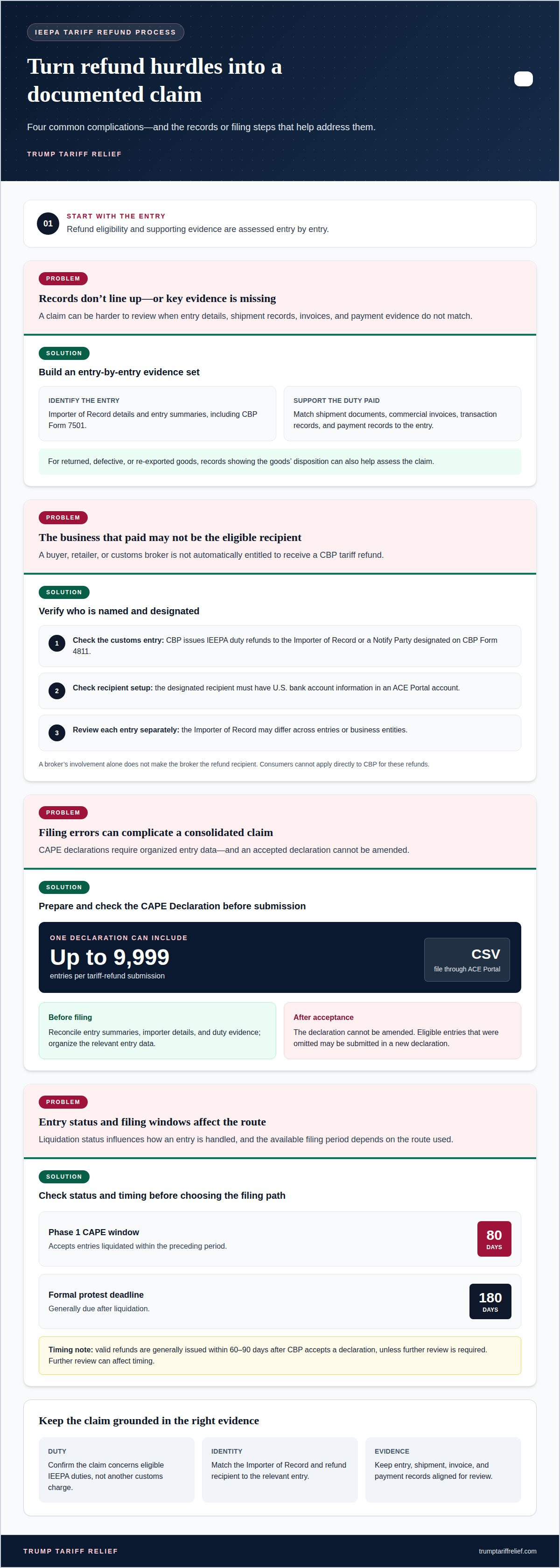
Start by organizing customs and transaction records so each claimed entry can be identified and supported. Missing or mismatched documents can complicate the review. A specialist can assemble Importer of Record details, entry summaries, shipment documents, invoices, and payment records. For returned, defective, or re-exported goods, records of the goods’ disposition can also help assess whether the claim involves eligible IEEPA duties.
Submitting Claims Through ACE with Professional Support
For an eligible CAPE claim, a professional prepares the entry data and submits a CSV declaration through the ACE Portal. The filer should be prepared to provide the information required for an electronic refund. Only the Importer of Record or the licensed customs broker who filed the entries can submit the declaration. After acceptance, valid IEEPA duty refunds generally arrive within 60 - 90 days, according to U.S. Customs and Border Protection, unless further review is required. Further review can affect timing.
Claim Deadlines and Customs Protests
Deadlines depend on the entry’s status and the route used. During Phase 1, CAPE accepts entries liquidated within the preceding 80 days; a formal protest is generally due within 180 days after liquidation. To challenge an incorrect tariff charge, a professional identifies the affected entry, organizes the supporting records, explains the disputed charge, and files the protest with U.S. Customs and Border Protection. Prompt review helps preserve the available filing window.
Policy Changes and Court Rulings
Court rulings and policy changes can alter which duties qualify and how CBP processes refunds. On February 20, 2026, the Supreme Court of the United States ruled that the Administration’s IEEPA tariffs were unconstitutional and must be refunded. The ruling concerns IEEPA tariffs, not every customs charge. CBP does not charge a fee to process tariff refunds, while claim preparation and professional services are separate considerations. A professional tracks the applicable process and matches each entry to its supporting evidence.
Who is eligible to receive tariff refunds
For businesses assessing how to get tariff money back, eligibility for IEEPA tariff refunds centers on the importer named in the customs entry. U.S. Customs and Border Protection can issue refunds only to the Importer of Record, the entity that directly paid the tariff. A business that bought imported goods from a U.S. seller isn’t automatically eligible. The key distinction is who appears as importer on the relevant entry, not who ultimately used or resold the goods.
Payment also has to reach an eligible recipient through the refund process. CBP pays IEEPA duty refunds to the Importer of Record or a Notify Party designated on CBP Form 4811. The designated recipient must have U.S. bank account information in an ACE Portal account. Businesses should distinguish between the party that submitted an entry and the party legally identified as importer. A customs broker’s involvement alone doesn’t make the broker the refund recipient.
Consumers can’t apply directly to CBP for these tariff refunds. If a business receives a refund, it isn’t legally required to pass the money on to customers. Any repayment to customers depends on the company’s decision, not a direct CBP consumer-refund process. For example, a retailer that paid a supplier may not be the Importer of Record on the underlying entry. A customer doesn’t become eligible simply by buying the imported product.
For businesses with multiple entries, eligibility can vary entry by entry. The importer named on one customs entry may differ from the importer on another, particularly across separate entities or purchasing arrangements. A Tariff Eligibility Assessment can sort entries by importer identity, designated refund recipient, and IEEPA duty exposure. Understanding how to get tariff money back starts with identifying which claims belong to the business and which entry records need closer review.
Entry summaries and proof of duties paid
A supported refund claim connects each entry to the importer, shipment, and duty payment. Entry summaries, including CBP Form 7501, can help establish those details. Supporting records may also include importer-of-record information, invoices, shipment documents, and transaction records. Together, they help distinguish duties assessed on an entry from other charges in the business’s accounts.
For duties under the International Emergency Economic Powers Act (IEEPA), records should identify the relevant entry and the amount paid. Documentation is most useful when entry details, commercial invoices, and payment records match. For example, a specialist can reconcile an entry summary with its shipment invoice and accounting record, then flag missing or inconsistent details before preparing the claim. This keeps the claim tied to supporting evidence.
Since Phase 1 began on April 20, 2026, eligible entry summaries can be grouped in one CAPE Declaration, even when entries have different liquidation statuses or upcoming liquidation dates. A declaration is submitted as a CSV file through the ACE Portal. Each tariff-refund submission may include up to 9,999 entries. After acceptance, the declaration receives a CAPE claim number, which helps identify the filed submission during processing.
Consolidated filing can reduce the work of handling eligible entries individually, but accuracy remains important. A CAPE Declaration cannot be amended after filing and acceptance. If eligible entries were omitted, the importer may submit a new declaration for them. A specialist can organize records by entry, reconcile duty evidence, and prepare the relevant CSV data for submission. This can help when entries span several shipments or accounting records do not align cleanly.
Liquidated and unliquidated entries
Liquidation is CBP’s process for determining final duties on an entry. An unliquidated entry has not reached that final determination; a liquidated entry has. That status affects how a tariff refund proceeds, so entries from the same importer may follow different timelines. A customs broker can help organize them by status and identify the correct handling for each group.
During Phase 1, a CAPE Declaration may include entries with suspended, extended, or under-review liquidation status. Refunds for validated entries in those categories are issued at liquidation. The first phase also covers certain entries liquidated within the preceding 80 days. Eligibility therefore depends on the entry’s status and timing, not simply on whether the importer paid an IEEPA duty.
CBP determines final duties within one year of entry during liquidation, typically after 314 days. As of March 4, 2026, approximately 20.1 million entries remained unliquidated. These entries may be eligible for the refund process, but their status affects when a validated refund is issued. A professional can classify entries as liquidated, unliquidated, suspended, extended, or under review, then prepare the appropriate CAPE submission.
For example, one shipment may include an entry that has already liquidated and another that is still under review. A specialist can assess each entry separately, then consolidate eligible entries in a declaration where appropriate. If an entry’s status changes, its refund timing may change too. Accurate entry records connect duty payments to the relevant liquidation status and support administration with U.S. Customs and Border Protection.
The Supreme Court ruling concerns IEEPA tariffs, but it doesn’t make every customs charge refundable. For importers with entries in different stages, organized status review can clarify which records and filing route apply. Assess your entry status to move toward a properly organized refund claim.
Trump Tariff Relief
Trump Tariff Relief helps businesses assess potential IEEPA refund eligibility and manage the recovery process. Its Tariff Eligibility Assessment identifies entries that may qualify, while Customs Documentation Management organizes records for review and filing. IEEPA Tariff Refund Recovery supports the claim process from eligibility assessment through government filings.
This support can help when entry status varies, records span multiple shipments, or CAPE preparation requires coordination. Trump Tariff Relief works on a contingency basis: there is no upfront cost, and payment is only a percentage of funds successfully recovered. There is no guarantee of a refund, as eligibility depends on the specific import history and documentation. To start an eligibility check, contact Trump Tariff Relief.
Move Your Refund Review Forward
If you’re deciding how to get tariff money back, start by turning the question into a recovery plan. Identify which entries warrant attention, organize the supporting records, and determine how each claim should proceed. A structured review also shows what information is ready and what needs to be assembled before filing.
Trump Tariff Relief supports this process through IEEPA Tariff Refund Recovery, Tariff Eligibility Assessment, and Customs Documentation Management. The right starting point depends on your entries and available records. An eligibility review can clarify the path from assessment to filing, with documentation and claim administration coordinated throughout.
Take the next step when you’re ready to put your tariff refund question into motion. Contact Trump Tariff Relief to discuss your situation and move toward a clearer recovery plan.
Frequently Asked Questions
How can a professional help prepare for a potential refund of IEEPA duties?
A tariff specialist can review import history, sort entries by duty type, and identify records that support a potential claim. Eligibility filtering separates IEEPA duties from anti-dumping duties and reconciled entries, which are excluded from the recovery review. The specialist can then organize claim documents and identify the filing instrument appropriate to each entry and its status.
What documentation should businesses provide for a tariff refund claim?
Gather the records available for your import activity, including entry summaries, commercial invoices, transportation documents, and duty statements. These help connect the goods, entry, and payment. If records are incomplete, note what you have rather than treating different documents as interchangeable. Trump Tariff Relief can identify gaps and organize materials supporting the relevant entries.
When Should Businesses Expect a Refund?
After CBP accepts a CAPE Declaration, valid IEEPA duty refunds generally take 60 - 90 days, according to U.S. Customs and Border Protection, unless further review is required. That is the agency’s refund-processing period, not the time needed to assess eligibility or prepare a claim. Entry status and additional review can affect when payment is issued.
Who can get a refund of U.S. tariffs or import duties?
For IEEPA duty refunds, the eligible recipient is generally the Importer of Record or a Notify Party designated on CBP Form 4811. A consumer who bought imported goods cannot claim directly from CBP. For example, a retailer’s customer does not become the refund recipient simply because the tariff cost may have affected the product’s price.
How can a professional request a refund of tariffs paid on imported goods?
For eligible IEEPA entries, the authorized filer submits a CAPE Declaration through the ACE Portal. The Importer of Record or the licensed customs broker who filed the entries can submit it. Once accepted, the declaration receives a claim number. A professional can coordinate the entry data and filing so the claim is associated with the correct importer and supporting records.
What documents and information are needed to claim a tariff refund?
For an initial eligibility check, prepare basic company information, estimated tariff fees paid, import regions, and details about available documentation. Entry summaries, invoices, transportation records, and duty statements can support the full review. Business information provided to Trump Tariff Relief is kept strictly confidential and isn’t shared without explicit consent.
Ready to find out what your business may be owed?
Check My Eligibility