
The $166 billion in IEEPA duties collected from American businesses wasn't just a regulatory hurdle. It was a massive financial injustice that the Supreme Court finally corrected on February 20, 2026. If your capital is still sitting in government accounts, you're likely facing the anxiety of missing rolling deadlines or getting lost in the ACE portal's labyrinth. You deserve a clear path to restoration, especially as the April 2026 launch of the CAPE portal has fundamentally changed the recovery landscape. Professional tariff refund filing assistance is now the critical factor between a successful claim and a permanent loss of liquidity.
We recognize that the shift from paper protests to digital declarations feels like another layer of complex bureaucracy. This guide promises to demystify the CAPE process, helping you navigate Phase 1 eligibility and the strict 180-day protest windows for liquidated entries. We'll preview the essential steps to secure your ACH payments, including how to maximize the 5% to 6% statutory interest currently available. By the end of this article, you'll have a high-stakes roadmap to reclaiming what’s rightfully yours before these fleeting 2026 windows close for good.
Key Takeaways
- Eliminate the search for a traditional paper form and master the digital CAPE portal, the government’s primary gateway for IEEPA recovery.
- Distinguish between Phase 1 eligibility for unliquidated entries and the strict 180-day protest window for liquidated duties to protect your right to a refund.
- Expedite your capital recovery by integrating ACH banking data into the ACE portal, bypassing the primary cause of automated processing failures.
- Leverage specialized tariff refund filing assistance to handle the high-stakes documentation management required for bulk claims, ensuring your internal team remains focused on core operations.
- Identify the three essential documents required for every entry and learn how to audit your filings for the data mismatches that lead to immediate rejection.
Understanding the IEEPA Tariff Refund Claim Form and Process
Many U.S. importers are currently wasting valuable time searching for a downloadable PDF or a standard "Form 123" to begin their recovery. The reality of 2026 is that the government hasn't released a paper form; it has launched a complex digital workflow. This shift occurred after the Supreme Court ruled on February 20, 2026, that the International Emergency Economic Powers Act (IEEPA) does not authorize the specific tariffs imposed between 2025 and 2026. This landmark decision didn't just correct a legal error; it unlocked $166 billion in overpaid duties. However, 2026 is a critical window because deadlines are rolling based on your specific entry liquidation dates. Engaging professional tariff refund filing assistance ensures you aren't left behind while the government processes billions in ACH payments for more proactive businesses.
What is a CAPE Declaration?
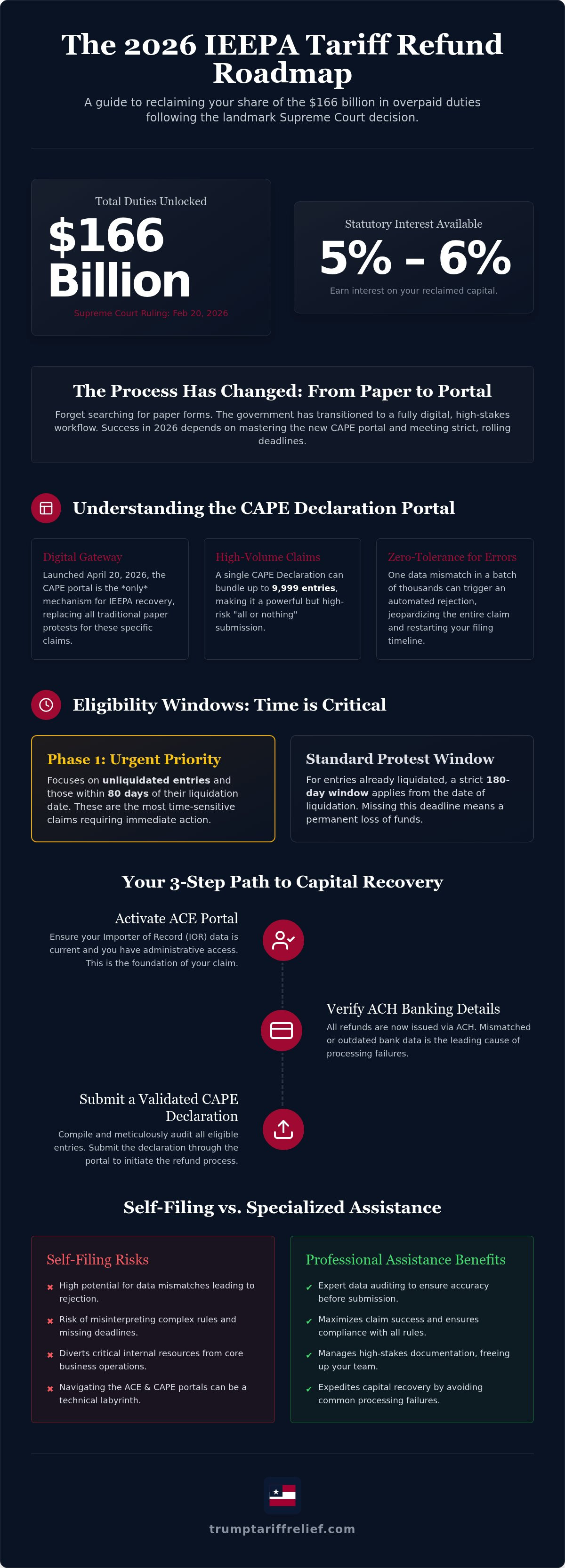
The Consolidated Administration and Processing of Entries (CAPE) tool is the primary digital mechanism for IEEPA recovery in 2026. Launched on April 20, 2026, this portal replaced the traditional, paper-heavy protest process for these specific claims. Unlike standard protests that require individual filings for every shipment, a single CAPE Declaration can include up to 9,999 entries. It's a high-stakes, "all or nothing" digital gateway. If one data point in a batch of thousands mismatches customs records, the entire claim can be flagged for manual review or rejection. This level of technicality is why most businesses now rely on specialized experts to audit their data before submission.
The Role of the ACE Portal in Your Claim
Securing your capital requires more than just knowing the rules; it requires access to the Automated Commercial Environment (ACE) Secure Data Portal. To receive a refund, your Importer of Record (IOR) account must be active and correctly configured with electronic banking details. As of early 2026, all refunds are issued via ACH, meaning paper checks are a thing of the past. Many importers discover too late that their legacy ACE data is outdated, leading to immediate processing failures. For a deeper understanding of why these tariffs were overturned, you can read our guide where IEEPA is explained in detail. Utilizing expert tariff refund filing assistance allows you to bypass these technical hurdles, ensuring your documentation is managed with the precision required to win back your capital.
Navigating the CAPE Declaration: How to File for Your Refund
Reclaiming your capital isn't as simple as clicking a button; it's a technical race against rolling deadlines. Since the government transitioned to a digital-first model in April 2026, the margin for error has narrowed significantly. Importers must now ensure their internal financial records align perfectly with the Customs and Border Protection (CBP) database. Any discrepancy, no matter how small, can trigger an automated rejection that resets your filing timeline. Securing professional tariff refund filing assistance is the most efficient way to audit these variables before your specific entry windows expire.
Step-by-Step Filing Requirements
The foundation of a successful claim is an active and verified ACE Portal Trade Account. As of February 6, 2026, the CBP has mandated that all refunds be issued exclusively via Automated Clearing House (ACH). This means paper checks are no longer part of the equation. To initiate your recovery, you must complete the following steps:
- Reactivate your ACE Portal: Ensure your Importer of Record (IOR) data is current and that you have administrative access to the Secure Data Portal.
- Verify ACH Banking: Your bank account information must match CBP records exactly. Mismatched data is the leading cause of "stuck" refunds in the CAPE system.
- Submit the CAPE Declaration: This digital submission aggregates your eligible entries. The IEEPA tariff refund process allows for up to 9,999 entries per declaration, but each must be meticulously validated.
Eligibility Check: Does Your Business Qualify?
Eligibility in 2026 is divided into specific phases. Phase 1 is currently the priority, focusing on unliquidated entries and those within 80 days of their liquidation date. If your entries fall into this category, the CAPE portal is your primary recovery tool. However, if your entries have already liquidated beyond that 80-day mark, you haven't necessarily lost your capital. You'll likely need to file a formal CBP protest, which must be completed within 180 days of the liquidation date.
Precision is mandatory when identifying which Harmonized Tariff Schedule (HTS) codes apply. The landmark ruling only covers specific duties imposed under the International Emergency Economic Powers Act. It doesn't apply to Section 301 China tariffs or anti-dumping duties. Once a declaration is successfully validated and accepted, the restoration of capital typically occurs within 60 to 90 days. Because these deadlines are entry-specific rather than a single calendar date, waiting even a week to assess your records could result in a permanent forfeiture of your overpaid duties.
Self-Filing vs. Specialized Consultancy: Securing Your Capital
Importers often underestimate the sheer volume of administrative labor required to reclaim capital. While the ACE portal is technically open to any Importer of Record, the "do-it-yourself" approach frequently collapses under the weight of thousands of entry summaries and individual proof of payment records. Diverting your internal finance team to manage this data isn't just a distraction; it's a high-cost gamble. When your team spends months on manual entry instead of high-value operations, the hidden costs of self-filing can quickly exceed the potential refund. Professional tariff refund filing assistance eliminates this internal strain by deploying trade experts who specialize in bulk customs documentation management.
The Burden of Documentation
Every CAPE Declaration requires a level of precision that standard business audits don't typically demand. A single mismatched invoice or an incorrect entry number in a batch of 9,999 records can trigger a systemic rejection from the CBP. These errors aren't just minor inconveniences. They can lead to missed rolling deadlines that permanently forfeit your right to recovery. Experts identify these pitfalls before submission, ensuring your documentation is airtight and aligned with the government's specific 2026 requirements. By auditing your records for the required documents for IEEPA tariff refund, specialists find hidden recovery opportunities that standard customs brokers often overlook. You can see how we manage this complex process by reviewing how it works for our partners.
Why Contingency Models Outperform Hourly Billing
Traditional legal and accounting firms often charge by the hour, creating a financial barrier that discourages recovery for many importers. This model places all the risk on your business, requiring upfront capital for a process that offers no guaranteed outcome. A contingency-based recovery model flips this script. It aligns the consultant's incentives directly with your success. We only win when you recover your capital. This "no-risk" framework allows businesses to pursue massive claims without impacting their current cash flow or increasing their overhead.
By removing the financial gatekeepers, specialized recovery services ensure that justice and financial restoration are accessible to every U.S. importer, regardless of their internal resource constraints. Professional tariff refund filing assistance should be a partnership that protects your bottom line, not another line item on your expense report. It's about righting a financial wrong with zero upfront exposure, ensuring that every dollar of overpaid duty is identified, verified, and returned to your bank account.
Essential Documentation and Avoiding Common Filing Errors
The success of your recovery depends entirely on the integrity of your evidence. The "Big Three" documents, which include Entry Summaries (CBP Form 7501), Commercial Invoices, and Proof of Duty Payment, form the backbone of every submission. Without these, even a valid claim will fail. However, even with perfect documentation, many importers face significant delays because of mismatched bank data. Under the current digital framework, your ACH information in the ACE portal must align perfectly with your filing. If there's even a character difference in your banking details, your capital remains stuck in government accounts. Professional tariff refund filing assistance ensures these technical details are handled with the precision required for immediate approval.
You must also remain vigilant against the growing threat of tariff scammers. Legitimate recovery partners operate on a contingency basis and possess deep trade law expertise. They don't solicit sensitive information via social media or demand upfront fees. Using professional tariff refund filing assistance provides a layer of security against these fraudulent actors who target vulnerable businesses. Timing is equally critical. If you ignore the tariff refund statute of limitations, your right to these overpaid duties vanishes forever.
Claim Verification Checklist
Before you submit any data through the CAPE portal, you must conduct a rigorous internal audit. This isn't a mere formality; it's a defensive measure against immediate rejection by the CBP's automated systems.
- HTS Code Eligibility: Verify that your specific Harmonized Tariff Schedule codes fall within the scope of the Supreme Court's IEEPA ruling.
- Entry Date Windows: Audit your entry dates to confirm they fall between the effective dates of February 1, 2025, and February 23, 2026.
- IOR Consistency: Double-check that your Importer of Record numbers are consistent across all consolidated filings to prevent automated system flags.
Common Pitfalls in CAPE Declarations
A frequent error in 2026 involves importers attempting to file for liquidated entries within the Phase 1 window. Phase 1 is strictly for unliquidated entries or those within 80 days of liquidation. Filing liquidated entries here results in an immediate rejection and can complicate future protest efforts. Incomplete documentation is another primary catalyst for lengthy and costly CBP audits that drain your internal resources. Accurate data entry in ACE is non-negotiable for approval. If you have concerns about your specific entry status, you can review our frequently asked recovery questions to gain more clarity.
Reclaiming Your Capital with Trump Tariff Relief
Retailers and manufacturers bore the brunt of the $166 billion in IEEPA duties, often seeing their margins erased by a policy that has now been declared unauthorized. This capital doesn't return automatically; it requires a deliberate and aggressive recovery strategy. Trump Tariff Relief functions as your specialized navigator through the bureaucracy of the 2026 refund cycle. By providing expert tariff refund filing assistance, we ensure that your business isn't just another number in a government queue. We take on the heavy lifting of ACE portal management and documentation auditing so your leadership can focus on scaling operations instead of chasing paperwork.
The first refund payments began arriving in importer bank accounts on May 12, 2026, proving that the system works for those who file correctly. However, the window for action is closing. Rolling deadlines based on liquidation dates mean that every day of hesitation is a day closer to permanent forfeiture. Our team uses a comprehensive tariff refund assessment to identify every eligible entry across your entire import history. We find the capital that standard audits miss, ensuring you recover the maximum amount possible, including the 5% to 6% statutory interest currently mandated for 2026 corporate overpayments.
Our Contingency-Based Approach
We believe in a results-oriented partnership that removes all financial barriers to justice. Our model is built on a simple premise: we only succeed when you recover your capital. There are no upfront costs, no hidden consulting fees, and no hourly billing. We invest our trade expertise and legal resources into your claim because we're confident in our ability to navigate the CAPE declaration process. Our success-based fees are a straightforward percentage of the actual capital restored to your accounts. This transparency ensures that our interests are perfectly aligned with yours throughout the entire recovery journey, from the initial document audit to the final ACH payout.
Next Steps: Your Preliminary Assessment
Starting your recovery is a low-friction process designed for busy executives. It begins with a simple data request that allows our team to analyze your IOR history and identify potential refund opportunities. You'll receive a detailed eligibility report and a recovery estimate that outlines exactly what's at stake for your business. Don't let your capital sit in a government treasury account while your competitors are already reinvesting their refunds into growth. If you have immediate concerns about specific entry types or deadlines, visit our FAQ for direct answers. Professional tariff refund filing assistance is your shortcut through the bureaucracy, providing the expertise you need to win back what’s rightfully yours.
Secure Your Capital Recovery Before the 2026 Windows Close
The path to financial restoration is no longer a matter of legal debate; it's a matter of technical execution. Success in the 2026 recovery cycle requires a transition from searching for outdated paper forms to mastering the digital complexities of the CAPE declaration. Because deadlines are tied to individual entry liquidation dates, every day your capital remains in government accounts is a day closer to permanent forfeiture. Engaging professional tariff refund filing assistance is the most effective way to ensure your documentation is airtight and your banking data is correctly synchronized within the ACE portal.
We've built our reputation on a commitment to righting these financial wrongs through a high-performing partnership. Our contingency-fee model ensures you face zero upfront risk; we only receive a fee when your capital is successfully restored. By providing expert-led documentation management and authorized navigation of the CAPE portal, we take the heavy lifting off your internal teams. It's time to stop navigating the bureaucracy alone and start reclaiming what your business earned. Start Your Risk-Free IEEPA Eligibility Assessment Now and secure your place in the 2026 refund queue. Your capital belongs in your accounts, not the government's treasury.
Frequently Asked Questions
Is there a physical tariff refund claim form I can download?
No physical form exists for this specific recovery process. The government has transitioned to a digital workflow via the Consolidated Administration and Processing of Entries (CAPE) portal. Importers must submit a digital declaration through the ACE Secure Data Portal rather than mailing a PDF. This digital-first approach streamlines bulk claims but requires precise data entry to avoid automated rejections. Relying on specialized tariff refund filing assistance ensures your digital submission aligns with CBP's exact technical requirements.
How long does it take for CBP to process an IEEPA refund claim?
Once your CAPE Declaration is validated and accepted by the system, you can expect a refund within 60 to 90 days. The first payments from the Supreme Court ruling began arriving in importer accounts on May 12, 2026. However, delays often occur if your ACH banking information is not perfectly synchronized with your ACE account. Ensuring your documentation is managed correctly from the start is the most effective way to maintain this timeline and secure your capital.
What is the deadline for filing an IEEPA tariff refund claim in 2026?
There is no single expiration date for all claims. Instead, the government uses rolling deadlines based on the liquidation date of each specific import entry. For liquidated entries, you must file a formal protest within 180 days of that date. Phase 1 of the CAPE rollout focuses on unliquidated entries and those within 80 days of liquidation. Because these windows are entry-specific, waiting for a general deadline could result in the permanent forfeiture of your overpaid duties.
Can I file for a refund if my entries have already liquidated?
Yes, you can still recover capital for liquidated entries, but the process is more restrictive. If the entry liquidated within the last 80 days, it may be eligible for Phase 1 of the CAPE portal. If it liquidated more than 80 days ago, you must file a CBP protest within the 180-day statutory window. Entries that passed the 180-day mark without a protest are generally ineligible for recovery, making an immediate assessment of your import history essential for financial restoration.
What is the success fee for professional tariff recovery services?
Trump Tariff Relief operates on a contingency-fee model, which means the success fee is a percentage of the actual capital recovered for your business. You don't pay any upfront costs or hourly consulting fees during the assessment or filing phases. This results-oriented structure ensures that our team is fully invested in the success of your claim. We only receive a fee once the government successfully restores the overpaid duties to your bank account.
Do I need an ACE Portal account to claim my refund?
An active ACE Secure Data Portal account is mandatory for any importer seeking an IEEPA refund. As of February 2026, all CBP refunds are issued electronically via ACH. Your account must be properly configured with your current banking details to receive these payments. Many businesses find that their legacy ACE data is outdated, which is the primary cause of processing failures. Professional tariff refund filing assistance includes a thorough audit of your ACE configuration to prevent these avoidable delays.
What happens if my IEEPA refund claim is denied?
If a claim is denied, it's typically due to a data mismatch or an eligibility error within the CAPE Declaration. Depending on the reason for denial and the remaining time in your filing window, you may be able to correct the discrepancies and resubmit. However, automated rejections can complicate your recovery timeline and push you past rolling deadlines. This risk underscores the importance of having trade experts manage your documentation and verify all entry summaries before submission.
Is the IEEPA tariff refund program legitimate or a scam?
The recovery program is entirely legitimate and stems from the February 20, 2026, Supreme Court ruling that found these specific tariffs unauthorized. Over $166 billion in duties are subject to recovery for U.S. importers. While the program is real, you should avoid any solicitor who asks for upfront fees or sensitive data via social media. Legitimate partners like Trump Tariff Relief use secure portals and a contingency-based model to protect your business while reclaiming your overpaid capital.
Ready to find out what your business may be owed?
Check My Eligibility