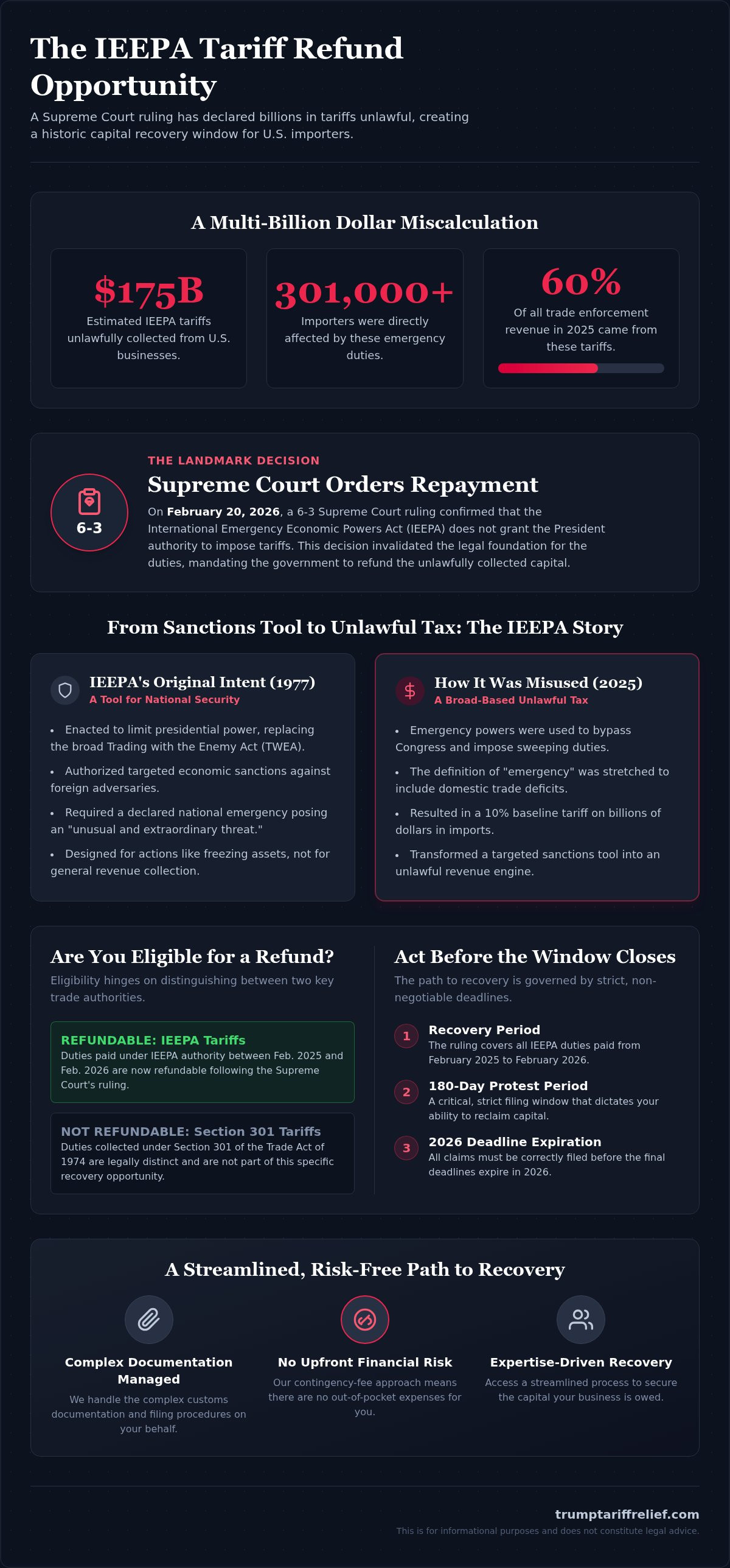
An estimated $175 billion in IEEPA tariffs were collected from U.S. businesses before the legal foundation for these duties collapsed. For over 301,000 importers, these payments represented more than 60% of all trade enforcement revenue in 2025, creating a massive drain on corporate capital. You've likely felt the frustration of managing these unpredictable costs while trying to distinguish between Section 301 actions and executive overreach. The history of IEEPA tariff rulings reveals a clear pattern of authority being pushed beyond its limits, a trend that hit a definitive wall with the Supreme Court's 6-3 ruling on February 20, 2026.
We'll help you understand how this sanctions tool became an unlawful tax and why the judiciary has now ordered the government to pay it back. You'll gain a complete timeline of the litigation that led to this moment and a clear look at the April 2026 refund process. This guide traces the evolution of trade law to verify your eligibility for a risk-free recovery of the capital your business is owed.
Key Takeaways
- Learn how the 1977 International Emergency Economic Powers Act transitioned from a sanctions tool to the engine behind recent executive trade actions.
- Understand the history of IEEPA tariff rulings to verify how the February 2026 Supreme Court decision creates a direct path to your refund.
- Distinguish between Section 301 and IEEPA authorities to accurately categorize your eligibility for the largest tariff recovery opportunity in U.S. history.
- Identify the strict filing windows, including the 180-day protest period, that dictate your ability to reclaim capital before the 2026 deadlines expire.
- Access a streamlined, contingency-fee approach to managing complex customs documentation and securing your recovery without any upfront financial risk.
Understanding IEEPA: The Statute Behind the Tariff Recovery
The International Emergency Economic Powers Act (IEEPA) was never intended to be a tool for domestic tax collection. Enacted in 1977, this statute provides the President with authority to regulate economic transactions during a declared national emergency. For decades, it functioned primarily as a mechanism for targeted sanctions against foreign adversaries. However, the history of IEEPA tariff rulings changed dramatically when the executive branch began using these emergency powers to bypass Congress and impose sweeping duties on billions of dollars in imports. This shift effectively turned a specialized sanctions tool into a broad revenue engine, leading to the current legal reckoning.
The 1977 Shift: From TWEA to IEEPA
Before 1977, the President operated under the Trading with the Enemy Act (TWEA) of 1917. This wartime statute granted nearly unlimited economic control during times of conflict. Post-Vietnam, a wary Congress sought to reclaim its constitutional authority over trade and revenue. They created IEEPA to limit presidential power to specific, declared emergencies that posed an unusual and extraordinary threat to the national security or economy. Under the National Emergencies Act (NEA), these declarations require specific procedural steps and reporting mandates. IEEPA is the legal framework that authorizes, and now limits, executive trade sanctions.
Why IEEPA Matters to Importers in 2026
The transition of IEEPA from a sanctions tool to a broad tariff mechanism reached a boiling point in 2025. What began as targeted measures quickly evolved into a 10% baseline tariff on imports from all countries. This transformation placed a staggering financial burden on U.S. firms, with IEEPA revenue accounting for more than 60% of total trade enforcement receipts by late 2025. These emergency duties became a permanent weight on corporate balance sheets, draining capital that should've been used for growth.
For a deep dive into the specific provisions of the statute, you can read our IEEPA Explained resource. The history of IEEPA tariff rulings reached its definitive turning point on February 20, 2026. On that day, the Supreme Court ruled 6-3 that IEEPA doesn't grant the President the authority to impose tariffs. This landmark decision didn't just stop future collections; it confirmed that billions of dollars were taken unlawfully. If your business paid these duties between February 2025 and February 2026, you're now standing at the threshold of a major capital recovery opportunity.
The Mechanics of Power: How IEEPA Governs Global Trade
To understand the current refund opportunity, you must first understand how executive power was weaponized through procedural shortcuts. The history of IEEPA tariff rulings demonstrates a clear shift from the law's original intent. Under the statute, the President can only exercise economic authority after declaring a national emergency regarding an "unusual and extraordinary threat" originating outside the United States. While this was designed for freezing assets of hostile regimes, the 2025 executive orders stretched this definition to include domestic trade deficits. This maneuver allowed the executive branch to bypass the Congressional approval typically required for tax and duty changes.
The law mandates strict consultation and reporting requirements. The President is supposed to consult with Congress before exercising these powers and provide periodic reports on the emergency's status. In practice, these mandates were often treated as formalities rather than actual constraints. U.S. Customs and Border Protection (CBP) acted as the enforcement arm, collecting approximately $500 million per day in IEEPA receipts at the height of the 2025 trade actions. Because CBP follows executive directives, the burden of proof fell on importers to challenge the legality of these collections in court.
Declarations of National Emergency vs. Trade Realities
The National Emergencies Act (NEA) provides the framework for these declarations, but it also includes provisions for termination. In February 2025, the administration used IEEPA to impose tariffs on imports from Canada, Mexico, and China, citing an economic emergency. The reality is that these "emergencies" were often used as leverage for trade negotiations rather than addressing immediate security threats. The history of IEEPA tariff rulings shows that when the executive branch uses emergency powers for permanent revenue generation, it creates a massive legal vulnerability for the government and a recovery window for your business.
Executive Authority vs. Importer Rights
The primary legal weapon for businesses has been the Administrative Procedure Act (APA). This act prevents federal agencies from taking actions that are "arbitrary, capricious, or in excess of statutory jurisdiction." The Supreme Court ruling on IEEPA tariffs confirmed that using a sanctions law to build a domestic tariff wall exceeded the President's authority. This decision effectively invalidated billions in collections, but the government won't issue these refunds automatically.
Importers must now navigate a complex administrative landscape to secure their capital. Understanding the step-by-step IEEPA refund claim process is the first move toward restoration. If your firm was caught in the net of these 2025 emergency duties, you should assess your eligibility immediately to ensure your claims are filed before the high-court-mandated deadlines expire.
IEEPA vs. Section 301: Navigating the Litigation Landscape
Distinguishing between Section 301 and IEEPA is the difference between a lost cost and a massive refund opportunity. While Section 301 of the Trade Act of 1974 focuses on rectifying unfair trade practices like intellectual property theft, IEEPA was designed for national security emergencies. The history of IEEPA tariff rulings reached a boiling point when the government attempted to use these statutes interchangeably. By late 2025, the executive branch began lumping IEEPA authorities into existing Section 301 actions to expand List 3 and List 4a tariffs, effectively bypassing the strict procedural timelines mandated by the Trade Act. This legal "stacking" created a massive vulnerability that trade experts and litigators eventually exploited in the Court of International Trade (CIT).
The CIT played a pivotal role in vacating these unauthorized duties, especially following the V.O.S. Selections, Inc. v. Trump appellate decision. That case signaled that the President couldn't simply cite a "national emergency" to extend or increase tariffs without new, specific findings. For importers, this meant that billions of dollars collected under the guise of emergency powers were suddenly legally suspect. Nearly 2,000 importers filed lawsuits at the CIT, arguing that the government had overstepped its bounds by using IEEPA as a permanent revenue tool rather than a temporary sanctions mechanism.
The Landmark 2026 Supreme Court Ruling
The legal battle culminated on February 20, 2026, with the Supreme Court's 6-3 decision in Learning Resources, Inc. v. Trump. The Court ruled decisively that IEEPA doesn't grant the President "indefinite" tariff power. This ruling affirmed that while the President can freeze assets or block transactions, the power to impose duties belongs solely to Congress. The impact was immediate and staggering. The decision effectively unlocked a $175 billion refund pool for U.S. importers who had been forced to pay these unlawful "emergency" duties over the preceding year.
Identifying Eligible IEEPA Tariff Lists
Identifying which of your shipments are eligible for recovery requires a surgical look at your HTS codes. Many customs brokers mistakenly lump all duties into a single "China tariff" category, missing the distinction between valid Section 301 duties and the now-vacated IEEPA levies. If your entries fall under the IEEPA-related litigation window, you're entitled to a full recovery of those specific duties. Understanding how to get money back from China tariffs involves separating these legal authorities to maximize your claim. Don't assume your current documentation is accurate; the complexity of the 2025-2026 rulings means that thousands of eligible entries are likely sitting in your files, waiting to be reclaimed.
Statutes of Limitations: Why the IEEPA Window is Closing
The February 20, 2026, Supreme Court ruling sparked a massive recovery effort, but the law doesn't wait for the unprepared. You must act within strictly defined legal windows or forfeit your right to a refund forever. The history of IEEPA tariff rulings shows that while the courts eventually side with importers, the administrative process is designed to favor the Treasury. If you don't file your claim within the specified timeframe, the government keeps your capital, regardless of whether the collection was unlawful. This isn't a suggestion; it's a hard legal ceiling that is already beginning to drop for the earliest 2025 entries.
Most importers face two primary deadlines that dictate their recovery strategy. First, there's the 180-day window following the "liquidation" of an entry. This is the standard period for filing a protest with U.S. Customs and Border Protection (CBP). Second, for those seeking relief through the Court of International Trade (CIT), Section 1581(i) provides a broader window, typically two years from the date the cause of action accrued. However, some specific claims regarding procedural violations can extend to three years. Waiting until the end of 2026 to start your audit is a high-risk strategy that could cost your business millions in recoverable duties.
Calculating Your Filing Deadline
Identifying your specific deadline starts with your entry summaries. You must find the "date of liquidation," which is the point where CBP finalizes the duty calculation for a specific shipment. If you miss this date, your options for a standard protest vanish instantly. Understanding the history of IEEPA tariff rulings helps clarify why these dates are so contentious; the government often uses the complexity of these timelines to block valid claims. For a more detailed breakdown of these dates, see our guide on the Tariff Refund Statute of Limitations.
The Consequences of Missing the Window
If you miss these deadlines, your right to recover those funds is permanently extinguished. This isn't just a paperwork error. It's a direct forfeiture of your firm's capital to the U.S. Treasury. In a competitive global market, leaving seven or eight figures on the table while your competitors reclaim theirs is a strategic failure. The government won't volunteer to return this money. You must seize it through active litigation or administrative protests.
Is it too late to file? For most entries liquidated in 2025 and early 2026, the window is still open, but it's narrowing daily. You shouldn't wait for another court ruling or a change in trade policy. Request your preliminary eligibility assessment today to secure your place in the refund queue before the 2026 deadlines expire.
Reclaiming Your Capital: The Trump Tariff Relief Solution
The history of IEEPA tariff rulings has finally arrived at a definitive point of restitution. While the legal path is now clear, the administrative path remains cluttered with bureaucratic hurdles and strict documentation requirements. We provide the active engine for your recovery. By operating on a contingency-fee model, we remove every ounce of financial risk from your balance sheet. We don't get paid until you receive your refund. This partnership aligns our success with yours, ensuring that our specialized team of trade experts works with maximum efficiency to reclaim every dollar your business is owed. It's time to right the financial wrong caused by years of unpredictable executive trade actions.
Recovering capital from the government isn't a passive process. It requires a sophisticated navigator who understands the nuance of trade law. Our team performs a deep-dive audit of your HTS codes and entry dates to isolate IEEPA-specific duties from standard Section 301 levies. This distinction is critical because the 2026 Supreme Court ruling applies specifically to the overreach of emergency powers. We handle the "heavy lifting" of customs documentation management, from identifying eligible entries to final government filings. Whether you're a high-volume retailer or a specialized manufacturer, our process is designed for simplicity. We take on the burden of bureaucracy so you can focus on running your business. You can see the full breakdown of our methodology by visiting How It Works.
Our Contingency-Based Recovery Process
Our trade experts begin by analyzing your past import data to identify every eligible transaction. We look for specific markers in the history of IEEPA tariff rulings that align with your unique HTS codes. Once we verify your eligibility, we manage the entire submission process through the CAPE system. This specialized focus on the 2026 IEEPA and Section 301 litigation ensures that your claims are robust and compliant with the latest judicial mandates. You won't have to worry about missing deadlines or filing incorrect paperwork; our team manages every detail from the initial audit to the moment the refund is issued.
Start Your Eligibility Assessment Today
Time is the only thing standing between your business and its lost capital. During your initial consultation, we'll review your import history and provide a clear timeline for your recovery. We focus on the specific litigation window surrounding the February 20, 2026 ruling, ensuring no deadlines are missed. This year is the absolute threshold for capital restoration. Once these windows close, the U.S. Treasury keeps your funds permanently. We serve businesses nationwide, providing an elite level of advocacy that was previously reserved for only the largest multinational corporations. If you have questions about specific entry types or legal standing, our Frequently Asked Questions page offers immediate clarity. Don't let your capital remain in government hands; start your risk-free eligibility assessment today.
Secure Your Capital Before the 2026 Deadlines Expire
The shift from a sanctions tool to a broad revenue engine has finally been reversed. The history of IEEPA tariff rulings proves that while executive power can be expansive, it's not absolute. With the Supreme Court's definitive ruling on February 20, 2026, the path to reclaiming your capital is legally clear but administratively complex. You've seen how the distinction between Section 301 and IEEPA authorities creates specific eligibility windows that your business can't afford to ignore. These deadlines are active, and the window for recovery is narrowing every day.
As these filing windows begin to close, waiting is the only strategy that guarantees a loss. Our specialized IEEPA litigation experts manage the entire recovery process on a national scale, allowing you to focus on your operations while we handle the heavy lifting. Because we operate on a contingency-fee basis, there's no financial risk to your firm. Secure your IEEPA tariff refund assessment today; no upfront costs. It's time to restore the capital your business worked hard to earn and ensure your firm remains competitive in a shifting trade landscape.
Frequently Asked Questions
What is the primary purpose of the IEEPA in trade?
The International Emergency Economic Powers Act (IEEPA) was designed to give the President authority to regulate economic transactions during a declared national emergency. Its original intent was to freeze assets or block transactions with hostile foreign actors. However, the history of IEEPA tariff rulings shows the statute was later stretched to impose broad import duties. The courts have now clarified that this power is limited to specific sanctions rather than permanent tax generation.
How did the 2026 Supreme Court ruling change IEEPA tariffs?
On February 20, 2026, the Supreme Court ruled 6-3 that IEEPA doesn't grant the executive branch authority to impose tariffs. This decision immediately halted the collection of emergency duties and triggered an executive order to end these practices. Most importantly, it ordered U.S. Customs and Border Protection to begin refunding duties that were collected unlawfully. This ruling is the legal catalyst for reclaiming the capital your business lost between 2025 and 2026.
Does IEEPA litigation apply to Section 301 China tariffs?
Yes, but only for specific entries. While some Section 301 China tariffs remain valid under separate statutory authority, the government frequently combined IEEPA and Section 301 to expand List 3 and List 4a duties. The history of IEEPA tariff rulings distinguishes between these two. If your duties were increased or extended using emergency powers, they're likely eligible for recovery. A detailed audit of your HTS codes is necessary to separate valid duties from refundable ones.
What is the deadline to file an IEEPA tariff refund claim in 2026?
Your deadline is tied to the "date of liquidation" for each entry. For standard administrative protests, you generally have 180 days from that date to file with CBP. For broader litigation in the Court of International Trade, a two-year window usually applies from the date the duty was paid or the cause of action accrued. Because the first phase of refund requests through the CAPE system began on April 20, 2026, you should act immediately.
Can my business claim a refund if we already paid the duties?
Yes, the entire purpose of the current recovery window is to return duties that have already been paid. The government collected approximately $175 billion in IEEPA tariffs before the Supreme Court intervened. These funds are currently held by the Treasury, and the judiciary has mandated their return to the importers who paid them. You don't need to wait for future changes; the right to your refund was established the moment the duties were declared unlawful.
Do I need a specialized consultant to file for an IEEPA refund?
While you can attempt to file on your own, the process involves complex HTS code audits and managing entries within the CAPE system. Most customs brokers aren't equipped to handle the legal nuances of IEEPA litigation. Working with a specialized partner ensures that every eligible entry is identified and documented correctly. Since we operate on a contingency-fee basis, you gain access to trade experts and documentation management without any upfront financial risk to your firm.
How much money is available for IEEPA tariff refunds nationwide?
An estimated $175 billion in IEEPA tariffs were collected from U.S. importers before the February 2026 ruling. Prior to the Supreme Court's intervention, the government was receiving approximately $500 million per day in IEEPA receipts. This represents one of the largest tariff refund opportunities in American history. Because these funds are finite and subject to strict statutes of limitations, businesses that file their eligibility assessments early are best positioned to secure their full recovery.
What happens if my IEEPA refund claim is denied?
If an initial refund claim is denied by U.S. Customs and Border Protection, you have the right to appeal the decision to the Court of International Trade. Denials often occur due to documentation errors or a failure to distinguish between different tariff authorities. Our team manages the entire filing and documentation process to minimize this risk. If a denial does happen, we leverage our specialized knowledge of trade law to navigate the secondary appeals process for you.
Ready to find out what your business may be owed?
Check My Eligibility